





‘Mindsnap’ Courtesy of Colorado River
It was a little after 4 a.m. on the last day of our Grand Canyon rafting trip and Tommy, a first generation Irish immigrant and our intrepid trip guide, was already up. Boiling coffee. Prepping bag lunches. Organizing the rafts for the passengers who still had a full day of paddling ahead. My wife Katherine and I were hiking out that morning, so I was up early too, packing our bags while marveling at the sheer logistics of what he was pulling off.
Every day of that trip, Tommy was a whirling dervish of activity, threading a narrow line through some of the most serious water in North America while also managing the very human needs of a couple of dozen people who had never rafted before. Every so often he’d bring us all together for a little teaching about that magical canyon, the grandest one of all on our pale blue dot. He called it the “mindsnap,” a moment where the whole group stopped and were present to pay attention to something remarkable – a rock formation, an ancient granary, the sheer fact of standing at the bottom of billions of years of geologic time.
The Colorado River just handed all of us in the southwest a mindsnap [a sudden change of mind], whether we asked for it or not.
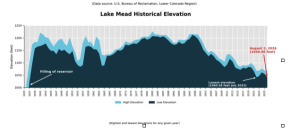
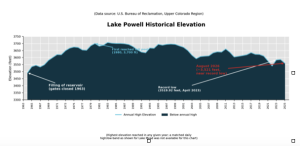
In July, Lake Mead and Lake Powell together dropped to their lowest combined levels since the reservoirs were filled. The two reservoirs that store roughly 80% of the water in the entire Colorado River system have not been this depleted in the memory of nearly anyone alive today. Federal hydrologists expect the record to keep falling through the rest of this year and into the winter. The federal government recently created a framework for future operations with a 10% cutback in California’s Colorado River allocation, a first in U.S. history.
That river is not some abstract policy talking point for us up here in the foothills. The Colorado River is one of two pillars of our imported water supply, alongside the State Water Project, and together they serve somewhere between 40% and 60% of La Crescenta’s annual water demand, depending on the year. For all the severity of the droughts we have lived through recently, Southern California has still received its full Colorado River allocation each time. That streak is over. We are in uncharted waters (no pun intended).
I understand the instinct to look away from a headline like this. We have heard “unprecedented drought” so many times that the words start to lose their weight. But this one is different. This is not a bad year. It is the accumulated bill for about a century of building our entire way of life in the southwest on the assumption that the river would always provide what our forebears decided it should provide rather than what the actual snowmelt delivers.
My dad spent his career in western water, working as a presidential appointee in the Reagan Administration and a titan of this industry. I grew up hearing about the compacts and allocations signed in the 1920s, built on river flow measurements taken during an unusually wet stretch of years. We inherited an entire civilization’s worth of infrastructure and assumptions from people who did the hard work of building it. And for a long time, the water industry’s job in places like La Crescenta was mostly just to maintain what our forefathers built.
That job is over. We are the first generation in this country’s history to watch these two reservoirs, the backbone of water storage for 40 million people, fall to a level not seen since before one of them was even built. Before I go further, our community deserves a real pat on the back. La Crescenta’s total water demand today is almost half of what it was at its peak about a decade and a half ago.
That did not happen by accident. It happened because our neighbors installed high efficiency indoor appliances, ripped out thirsty lawns and generally got smarter about how we use water day to day. That is proof our community can rise to a challenge like this one. It is also proof that conservation alone, even really successful conservation, is not going to be enough on its own. We are still dependent for 40% to 60% of our water from the Sierra via the State Water Project and the Colorado River.
So what does taking this moment seriously look like beyond conservation at the scale of a place like La Crescenta?
We need to get serious about building new, cost effective local water supplies, the kind that do not depend on a river a thousand miles away. Here is one small example close to home: I had the privilege of being part of the team that helped bring the Rosemont Preserve stormwater recharge project to life. Instead of letting winter storm runoff race down the concrete channels and out to the ocean, the project captures it and lets it soak back into the ground, recharging the very aquifers our region depends on. It is not flashy. It is dirt simple. But every gallon captured there is a gallon we did not have to import from a shrinking river. That also saves money.
We need more such solutions. CV Park offers the opportunity to capture stormwater locally at a scale of approximately 100 times the Rosemont Preserve bioswale. As CV Weekly has covered in the past, that project has been stymied by bizarre and byzantine water rights perspectives held by bureaucrats of the LA Dept. of Water and Power. That’s exactly the type of obsolete thinking we need to challenge. We can’t just accept our status quo institutions and ways of doing things simply because “that’s the way things have always been done.”
One of the best lessons I took from that week rafting on the Colorado River is that small corrections made early save you from catastrophe downstream. Read a rapid wrong by a few feet at the top and you can fix it with a single stroke of the paddle. Wait until you are already in the whitewater and that same correction takes everything you have got – and sometimes it is too late. It works for running a river and it works for managing a civilization. We are still at the part of the river where the small corrections matter most. Investing now in local supplies like stormwater recharge, backing the water agencies doing this unglamorous work, keeping up the conservation habits we have already built – these are the corrections available to us right now.
The Grand Canyon does not care about our five-year plans or our election cycles. It has been patiently recording the passage of civilizations for two billion years, long before the first drop of water was ever allocated on paper. What it teaches you is if you spend enough time down in it nothing is inevitable and nothing is permanent.
Our forebears built us an inheritance. The question in front of us now is whether we are willing to do the same hard work for generations to come or whether we are content to just keep cruising until there is nothing left to coast on.

Patrick’s a husband, father, son, brother, avid cyclist, fervent reader, enjoyer of adventures, lover of board games and the author of “A New California Dream.” He is a candidate for the Foothill Municipal Water District board of directors (see: bit.ly/future_of_our_foothills) and writes for CV Weekly in his personal capacity.

GUEST OP-ED <<< PATRICK ATWATER added by CV Weekly on
View all posts by CV Weekly →