





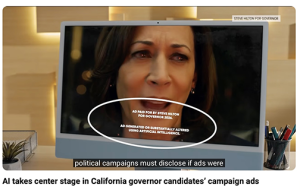
Screenshot found on YouTube
By Mary O’KEEFE
Both sides of the political aisle are aware that AI technology is rapidly developing. Many have commented on their concerns about how to monitor AI technology as well as the value and the dangers of data centers. The issue, which may not seem too surprising, is not looked at through the same lens by everyone so regulation continues to be debated.
In September President Donald Trump asked tech titans to come to Washington to a meeting called the White House Accord on Super Intelligence. They arrived at an agreement on the safety protocols for artificial intelligence labs to follow. It included internal teams – within the AI companies – that will monitor their own progress.
According to the White House executive order titled “Inaugurating the Era of Super Intelligence” the term “artificial intelligence” is being replaced with “super intelligence.”
The President announced that the heads of the largest U.S. tech/AI companies had signed a “morally binding” agreement on controlling AI, now referred to as SI. This agreement has four layers of controls and audits, which include implementing internal controls, having an internal team from the company to ensure that internal controls are being followed, partnering with an independent external auditor and designating an independent committee of the board of directors to oversee and receive reports, according to the release.
However, this is self-policing meaning that AI companies will be trusted to monitor themselves and report any problematic issues.
“I think what you saw at the White House with the gathering of all these tech CEOs was window dressing. None of it is enforceable,” said Senator Adam Schiff. “It’s a complete permission slip for industry to do whatever it wants and whatever it thinks is best. We’ve seen in social media what happens when an industry is completely unregulated and all the harms that have occurred as a result of social media. So it’s … a call to action for the Congress.”
Internet tentacles seemed to reach out slowly and Congress was slow to react to possible warning signs.
“This can’t be like social media. We need to step in and regulate. It’s also a cautionary tale that Congress has been very incapable of regulating an industry that has the kind of resources that these technology companies have,” he added.
He said that lawmakers must act now before “we have some kind of catastrophic harm.”
Tech companies do not exactly agree on their responsibilities. Recently Sam Altman, OpenAI CEO, told Decoded co-author and Politico senior tech reporter Brendan Bordelon, “I think there’s a lot of daylight” when asked about the differences between Anthropic and its CEO Dario Amodei.
He added, “We believe that the world should accept some bad things happening for the benefits of this technology and people having the agency.”
Schiff said he has heard that type of statement in the past from leaders in the tech industry.
“There is an ethic in Silicon Valley among some that the technology is an inherent good and the quicker advances [are made] the better and they’re willing to accept the negative consequences,” he said.
He added that the thoughts are that positive consequences outweigh negative impacts. However, tech companies are representing their economic interests.
“Someone needs to look after the interests of the whole society and the country with something other than a profit motive,” Schiff said.
Senator Schiff has introduced and is working on legislation that deals with AI and its impacts, including a legislative package to reassess the tax code to plan for the consequences AI will have on unemployment and job displacement.

Part II: A Discussion About AI with Senator Adam Schiff added by CV Weekly on
View all posts by CV Weekly →