





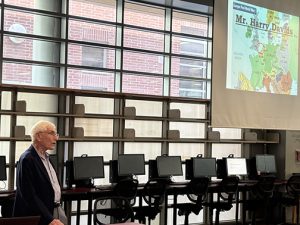
Photo by Mary O’KEEFE
By Mary O’KEEFE
Imagine being a child, living with people you think are your parents in a country you thought you were born in. Then in first grade your whole world turns upside down.
“It was my first year at school and my parents came up to me one day and shocked me with one question: ‘Are you aware we are not your real parents?’”
That is how Harry Davids began his recent talk with students at Burbank’s Burroughs High School. Davids was part of a discussion with other Holocaust survivors in a program organized and led by David Meyerhoff, whose parents and grandparents escaped Nazi Germany during WWII.
Davids’ story shows how WWII affected so many – not just beyond the days of the war but for generations after its end. The question posed to a very young Davids happened in 1949 – four years after WWII ended in Europe. He was 6 years old and living in South Africa.
He was told the people he thought were his parents were actually his biological uncle and aunt. They asked him if he remembered being brought to Africa about a year and a half earlier. At that time he was brought by his uncle and told he was born in Europe.
Then the question was asked that was the most difficult to consider.
“Do you recall you had been told that your parents were killed at the time of the big war that happened in Europe?” Davids’ uncle asked.
“I was completely shocked because I had no recollection of that at all,” he said. “That conversation took place well over 75 years ago. I am 83 and even today I have no personal recollection of any experiences in Europe at that time.”
Like most who received this news, he was curious about his past and his biological parents but his “new” parents did not talk about it again.
His adoptive mother/aunt was born in Africa almost a century prior so she did not know the story of how he ended up with them; however, he later found that his uncle knew quite a lot.
His uncle did not live in Europe at the time of WWII and the rise of the Nazi Party but he knew what was happening to the Jewish people.
“He didn’t like to talk about it,” Davids said. “In those days, nobody did.”
As Davids got older his uncle would share small portions of information about his family but never enough to satisfy Davids’ curiosity.
“What I’m going to be sharing with you is based on the research that I’ve had to do, which has to substitute for my lack of memory,” he told the high school students.
His uncle had moved from Germany at the height of the Depression around 1931. He had some friends who had moved to South Africa searching for work so he went to be with them. His uncle’s friend had opened a small business and needed someone to speak German, so the uncle went to work. He later was able to persuade his younger brother to come to Africa. His father and his five sisters stayed in Europe. One of the sisters died between WWI and WWII.
“She has a proper gravesite, which I’ve actually visited,” Davids said.
Davids found that two uncles and two aunts had been living in countries that were safe during the war.
“We’d all be alive when the [WWI] was over,” he said. “[They would] all go on to [live] full lives, all [live] into their 80s. [They would] all go on to be to be buried with proper dignity by family members in cemeteries around the world.”
Of the rest of the family members who stayed in Europe, about 65 of them had died – killed during the war. None of them have graves.
“It took me many years to find this out. Without the internet, I would not have a chance to know even half of what I’m going to be sharing with you,” he said.
He found that both his parents had left Germany before WWI and moved to the Netherlands to a very small village. They moved there, along with several other family members, in search of work. The Netherlands had been a neutral country in WWI and did not have the economic problems Germany did.
He found where his parents had worked prior to meeting each other. They met in Amsterdam and married.
“We know, of course, that WWII began with the invasion of Poland by Germany coming in from the west and the Soviet Union [Russia] coming in from the east,” Davids said. “That happened in September 1939. They [Germany and the Soviet Union] made a secret deal that they were going to invade Poland together and divide Poland between them. And that’s exactly what happened in September in 1929 triggering World War II.”
The following year Nazi Germany invaded the west coast of Europe starting with Norway.
“Then to the Netherlands, Belgium and … France. It took very little time,” he said.
He added it took five days for Nazi Germany to conquer the Netherlands.
In one of the battles there was miscommunication with German pilots as to where they were supposed to bomb. Rather than bomb the port of Rotterdam, one of the largest ports in Europe, they instead bombed a large residential area leaving about 800 Dutch residents dead and thousands homeless.
“You want to realize that was a major mistake for [Nazi Germany] because they considered the Dutch people to be fellow Aryans, members of the so-called Aryan or superior, race. After all, the Dutch people are Germanic people,” he explained.
But the Germans used this mistake to their advantage, warning the Dutch people to surrender. As Germany took over the government, it fired anyone it felt was neutral toward the war. All the Jewish people working in civil service were fired. At that time only about 1.5% of the population in the Netherlands were Jewish, he said.
Restrictions went into effect immediately, including the confiscation of bicycles, which was the primary form of transportation. So everyone took public transportation – everyone but Jews.
Jewish children could no longer attend school and Jewish adults could no longer be teachers. They were not allowed to attend the theatre, not allowed to go to concerts or to any sporting events.
“But no major physical harm [happened] at the beginning [of WWII],” Davids said, “but that all changed in 1942.”
Davids wanted to share the history so students would realize how quickly things changed and how freedoms were so quickly affected. He wanted them to understand why his parents decided to hide him, to give him to another family.
Mass murders of Jews was taking place throughout the Netherlands, and many Jews were transported to camps where they faced the gas chambers. His parents ending up hiding in a building close to where Anne Frank had hidden.
“My parents were living up on the third floor. There were many Jewish people who’d been forced to move into this area,” he said.
His parents, along with cousins and aunts, were hiding in this building. They were hiding because the “Germans are hunting down Jews.”
“That was a really bad time for my parents. My mother had entered the third trimester in her pregnancy with me,” he said. “She could no longer hide her pregnancy and for that reason no one was willing to take my parents into hiding.”
They stayed in that building until a few months after Davids was born. They were lucky because the Germans had not yet come into their area of Amsterdam so his parents and some of his relatives stayed hidden in the building. A few of the relatives stayed to help his mother with his birth; there were no nurses or resources for them.
At some point, Davids said, people who had been hiding his family said his family had to leave. They could not continue to hide the family.
“So they had to leave and my parents realized that the best chance we had for us all to survive was for me to be separated from them,” he said. “As long as I was with them I would be a burden.”
His father found someone who worked for the Resistance. A woman dressed as a nurse came and took Davids away. It was not easy to get him out of the area safely and he was moved from place to place. Finally the Resistance found a family who was not Jewish and willing to take him in, despite the danger. He was lucky; he learned there were many who just stood by while the Jews were being taken away while others quietly fought back.
His parents, in the meantime, tried to find a hiding spot but someone betrayed them and the Germans came.
“The police came; I should tell you this was not the German police. The Germans did not have police in the Netherlands. It was Dutch police. They were collaborating with the Germans,” Davids said. “My parents tried to run away. They sent a dog out [to get] my parents. They fired at them from behind while they were trying to escape, they caught my father on the upper back/lower shoulder area and he went down. My mother stopped running. The two were arrested on the spot.”
His parents were sent to Westerbork, a labor camp where most Jewish people from the Netherlands were sent.
“My parents were brought there on March 23, 1943. They were there for exactly a week and then shipped out on March 30 to Sobibór [extermination camp],” he said, “one of the smallest of the six gas chamber operations that Germany was running in occupied Poland. This was a small and efficient camp. The day you arrived in that camp was the day you died.”
According to Davids’ research, he is pretty certain that his parents were murdered on Friday afternoon, April 2, 1943.
Davids’ journey was not over though. His uncle came to take Davids to Africa. There was a legal battle and in the end it was decided Davids would be taken to Africa. He learned that he had lost two families: his “real” family and the one that had taken him in. In the end he found that although he was grateful those around him worked so hard to save him, he had to face the dreadful truth that his biological parents were victims of the Holocaust.
He ended the talk with a request and a warning.
“I just want to say … what you have heard today is very important not just now but for the future. The lessons of the Holocaust can never be forgotten because right now in this country we’re facing some major situations and problems. It’s going to take people like you, the next generation, to make a difference,” Davids said. “So you have to make a decision about what future you want for this country. You cannot just ignore it. You can’t turn your head away because it’s going to affect you. I’m talking about your civil rights … your education … the environment – these are things that are going to affect everyone in this country and you have to decide. Are you going to just let it go or are you going to do something about it? You can speak up, you can write, you can march, [and when you get older] you can vote.”

Jewish American Heritage Month: A Talk with a Child of the Holocaust added by CV Weekly on
View all posts by CV Weekly →