





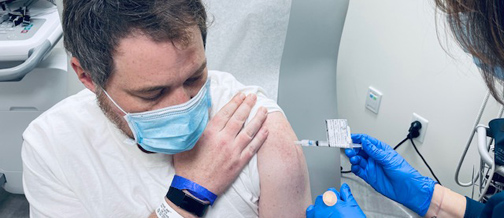
Photo provided by City of Hope
By Mary O’KEEFE
City of Hope in Duarte is continuing its vaccination studies and is looking for more people to volunteer for the trials.
Dr. John Zaia, director of City of Hope’s Center for Gene Therapy, specializes in vaccine research. He said the results of the study have been encouraging thus far.
“It’s been very safe and that’s really all you can hope for,” he said.
He explained the study begins with a few volunteers, called sentinel volunteers, being given the trial vaccine, which they know they are receiving. The hospital is now moving into the randomized phase in which some volunteers will get the vaccine and others will receive a placebo. Neither the volunteers nor the hospital staff knows who is getting the vaccine and who is getting the placebo.
“This is a double-blind [study],” he said, “and then we are randomizing the doses.”
The volunteers will get two vaccines, 28 days apart. Some volunteers will get one vaccine dose and then will receive a placebo; some will get two vaccine doses and a very small percentage will get two placebo shots. This way researchers can tell if the vaccine works after just one shot or if two are needed. Those who get the two placebos will get one of the approved vaccines after the study is completed.
Researchers are hoping to get this phase completed in six to eight weeks, which is why they are reaching out for more volunteers.
The City of Hope’s vaccine is unique in several ways, Zaia said.
Researchers are looking to convert two proteins, not just one spike protein, a difference from vaccines that are currently available to the public. Zaia said this would be helpful against the new variants that continue to present themselves and would be good for long-term immunization.
“The second thing that makes this unique is we decided to use vaccinia, which has a long history as a very well established vaccine,” he said. “[The vaccinia virus is the active constituent of the vaccinia vaccine and] has a long history of safety and has a history of long-term immunity.”
It can also be stored easily without needing extreme cold storage like the Pfizer vaccine.
Researchers have used vaccinia in their cancer research as well so they are very familiar with it.
According to the National Library of Medicine, the vaccinia virus has been used more extensively for human immunization than any other vaccine. For about 200 years vaccinia virus was used to cross-protect against variola virus, the causative agent of smallpox, until the disease was eradicated in the late 1970s.
Researchers at City of Hope have proposed a vaccine trial that could help those who have health issues who do not respond well to the current COVID-19 vaccines. For example, renal transplant patients did not respond well to the current available vaccines.
There are three vaccines currently approved for use by the Centers for Disease Control and Prevention: Pfizer-BioNTech, Moderna and Johnson & Johnson/Janssen. Though more vaccines available mean more people can get inoculated, Zaia sees the City of Hope’s vaccine as the next improvement.
Vaccines are constantly being studied and improved upon. Zaia pointed out that the vaccine for shingles that was given in the past, for example, is not the same vaccine that is administered today because improvements to the original vaccine were made over time.
Improvements on existing vaccines and the exploration of the next phase of vaccines are important to keep people safe. This is why it is so important that the study continues and volunteers step up to help.
There is a potential for getting sick, Zaia acknowledged, but that risk is very low.
“We’ve already given it to 45 people without any adverse effects,” he said.
He added that vaccinia, which is the foundation of the study, has been given to thousands of people over the years.
Josh Jenisch volunteered to be part of the City of Hope trial. He works as the director of content at City of Hope and was the second person to receive the trial vaccine.
“We were sent home from work in March of last year. I was sitting in my house with my two kids for almost a year just feeling so frustrated with my inability to do anything about this pandemic,” Jenisch said.
He added he worked with some of the most well-known and brilliant doctors/ researchers at the City of Hope and had confidence in what they were doing. He wanted to do something to help so in December he signed up as a volunteer. Because he had seen the work these doctors have done over the years he had no fear when he signed on to be a test subject.
“I have just had my 90-day checkup this last Saturday. It started in December [2020] when they checked me to make sure I was healthy,” he said. “I got my second injection before Christmas.”
Jenisch has been monitored ever since the vaccinations and he has had no adverse reactions.
For him, this is more than just helping to find a vaccine; it’s a teaching moment for his children.
“[Being part of the study] means a lot to me,” he said. “I’ve watched [my children] sort of wither like a plant without sunlight, without human contact, for the past year. More than anything, if I could do something to help and see my 8-year-old be able to play with his friend I am happy to do it.”
He also wants his children to see that one person can make a difference.
“I hope what they are taking from this [volunteering] is that, during a pandemic or any time of crisis, everybody needs to pull together and do their part,” he said. “My hope is that if there is another pandemic or a blood shortage or fire, [my children] will be the first ones to raise their hands and put their names forward to help.”
City of Hope is looking for at least 70 more volunteers to be part of the study. Volunteers need to be healthy people who do not take medication for any cardiac problems or issues like chronic obstructive pulmonary disease or have any other significant health issues. They need to be between the ages of 18 and 55. To join or for more information call (833) 908-4673 or visit https://tinyurl.com/zbd5vejs.

City of Hope Puts Out Call for Vaccine Trial Volunteers added by CV Weekly on
View all posts by CV Weekly →