
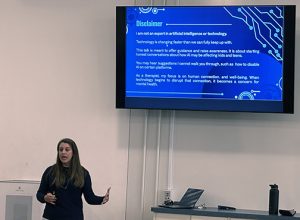
Photo by Mary O’KEEFE
By Mary O’KEEFE
On Thursday those who braved the rain came to Crescenta Valley High School to hear Jamie Given, licensed therapist, give a presentation about Artificial Intelligence (AI).
The title of the talk – “Rewired and Overwhelmed. AI, Anxiety and the Price of Progress” – covered how AI can enhance people’s lives but also raise concerns for adults and students due to being a new technology.
Given started out by telling the audience that she was not a “tech person.”
“As much of this is going to be about AI, I am really more about relationships, mental health and wellbeing,” she said.
She added the information given at the talk was meant for people to have an awareness – and some education – on how to navigate AI.
“AI and technology is really overwhelming for youth right now,” she added. “There are so many different aspects to technology and artificial intelligence that are shifting our generational landscape.”
Although there is no way to predict exactly how AI will affect youth due to its rapid advancement in technology, there has been some research on what it has done thus far.
“We are going to start understanding how AI is shaping childhood and adolescence. We are trying to create awareness about emotional and mental health,” she said.
She shared that AI is not “the enemy” and instead it can be a helpful tool.
“We [should] see it as a tool rather than a reliant factor,” she said.
AI is technology that, by design, is able to think, learn and help with decisions similarly to humans. AI is everywhere and many think can do anything – from running autocorrect programs to completing people’s thoughts as they write. It may appear to be human-like but it is not human.
“However, AI tries to be human-like whenever possible,” Given said. “This [presentation] is extremely important because over the last two decades we’ve had a rise in youth mental health [issues]. Anxiety and depression have skyrocketed since the time, really, that smartphones and the internet has become more prevalent in our everyday lives.”
Young people use technology at school and through their cellphones. There is a constant connectivity providing so much content, which can be overwhelming.
“We’re raising children in an experimental digital world,” she said. “What I mean by that is that we really don’t know how what we are doing today, to youth, will affect them as adults.”
She said that what researchers have seen, and what she has seen in her own practice, is a rise in youth of mental health issues including significant depression and anxiety. Technology is changing so fast it is difficult to gather timely data; however, the trends of depression and anxiety cases are increasing.
Given added that though there is no way to escape AI completely it is important for adults to understand the technology and how it is affecting kids whose brains do not fully develop until the age of 25-26.
“Digital influence can truly change the trajectory of how you interact with the world,” she said.
Studies have found that digital influence can affect the attention span and sleeping patterns of children – and adults.
“Who here sleeps with their phone in their bedroom?” Given asked.
Everyone, including the students in the room, raised their hands.
“Right, we all do. And we often check our phones before we go to bed and use it as an alarm [to wake up],” Given said. “It is the first thing we see in the morning.”
Many times people begin by looking at one thing on their phones and then continue scrolling until oftentimes they discover they have been spending a lot more time on the device than they realized. That, Given said, is designed by internet platforms including AI.
“The stimulation you have [when scrolling] continues after you put the phone down. It’s in the brainwaves and in the brain,” she said. “We also have a decreased ability to regulate and manage our emotions.”
AI is not just about finding out what program it thinks a person would be interested in, it also becomes a type of companion that is always positive. For example, when writing something using AI, or having AI review something people have written, it will usually let them know how “great” they are doing … even when it may not be that well written.
Next week, CVW will continue writing about Given’s talk and how this technology is affecting kids and adults. The article will also relay information on how being aware of what AI can do is the best way to use it as a tool.

Raising Children in an Experimental Digital World added by CV Weekly on
View all posts by CV Weekly →