





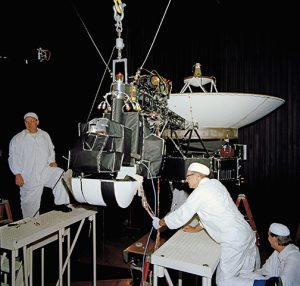
NASA’s Voyager 1 spacecraft will be 16.094 billion miles (25.902 billion kilometers) away from Earth – or the distance light travels in 24 hours, also known as one light day. Voyager 1 will be the first human-made object to reach this distance from Earth, adding to a long list of historic firsts for the mission. Voyager 1 and its twin, Voyager 2, are the only spacecraft to ever operate outside the heliosphere, the protective bubble of particles and magnetic fields generated by the Sun.
NASA/JPL Caltech
By Mary O’KEEFE
The Jet Propulsion Laboratory (JPL) is celebrating its 90th year of exploration, innovation and daring “mighty things.”
Many of us drive on the Foothill (210) Freeway and see the buildings on the hill to the north, between La Cañada Flintridge and Pasadena. As drivers pass by they probably do not realize what amazing explorations are being planned, what astonishing developments in technology are being achieved and what wonders of the universe will be made clearer thanks to those who work on that hillside campus.
From exploring beyond the heliosphere with Voyager I and Voyager II to creating a ventilator to help humans breathe on Earth during a pandemic, those who work at JPL are always working toward the future.
“I think the biggest contribution [JPL has made] is probably the nature of the scientific quest that we embark on,” said Jordan Evans, director of flight projects. “We have, throughout our history, explored beyond where humans have explored [including] many of the first in planetary exploration and the first spacecraft to have left the solar system and is exploring interstellar space.”
JPL is managed by Caltech and is NASA’s only federally-funded research and development center, according to jpl.nasa.gov.
The motto of NASA’s JPL is “Dare Mighty Things.” This quote is actually from President Theodore Roosevelt in a speech he gave in 1899 when he stated, “Far better to dare mighty things, to win glorious triumphs, even though checkered by failure, than to take rank with those poor spirits who neither enjoy much nor suffer much because they live in the gray twilight that knows neither victory nor defeat.”
Although it would be over three decades before JPL was conceived, these words from President Roosevelt fit JPL to a tee.
“I think [it is] this notion of really big ideas,” Evans said. “You ask a scientific question and we design and build a machine to answer it. I think that is … JPL’s biggest contribution and legacy in the past 90 years.”
JPL can trace its heritage to a group of Caltech graduate students that began to conduct rocket-propulsion tests in Pasadena’s Arroyo Seco on Oct. 31, 1936.
“The origins of the Jet Propulsion Laboratory date back to the 1930s when Caltech professor Theodore von Kármán oversaw pioneering work in rocket propulsion. After unsuccessful and sometimes hazardous experiments, several graduate students, led by Frank Malina along with rocket enthusiasts from the Pasadena area, moved their work off campus. They chose the Arroyo Seco, a dry canyon wash north of the Rose Bowl in Pasadena, California – and the future home of JPL” according to jpl.nasa.gov.
Initially JPL was a contractor with the U.S. Army. It launched its first satellite, Explorer 1, in 1958. While the Soviet Union’s Sputnik satellite orbited the Earth … JPL took it a step further (as is its way) and conducted science with an onboard Geiger counter and discovered the protective radiation belts that encircle the Earth.
This “we can go farther” attitude has served JPL well as most of its missions have gone much longer than initially planned and like Voyager I and II went farther into space than ever expected.
JPL also made space exploration not just for science fiction geeks but has been able to capture the imagination of thousands around the world.
“I think in addition to improving our understanding of other worlds, which helps us understand our own world, we end up applying technologies that we develop here to problems right here on Earth,” Evans said.
He added that during the COVID 19 pandemic medical ventilators were in short supply.
“A group of JPL engineers, within 30 days, came up with a design for a COVID ventilator … that supported a COVID patient and designed it in such a way that it did not compete with the parts that were needed for medical ventilators. Basically using a supply chain of essentially local hardware store types of materials and then just put the design out there for countries around the world to start building these ventilators,” Evans said.
In addition, Evans added, is the microwave technologies that have been developed at JPL, called FINDER (Finding Individuals for Disaster and Emergency Response). This is portable radar technology that can detect heartbeats in a pile of rubble, like after an earthquake.
JPL has faced some very difficult times including massive lay-offs and the Eaton Fire of 2025. Hundreds of JPL employees were affected by the devastating Eaton Fire.
JPLers quickly mobilized to support their fellow workers. They held food and clothing drives and even offered free babysitting so parents could work the phones to get answers on how to move forward; however, there was a technical side of their support as well – they developed technology that can help in the next fire.
“We developed detector technologies that go on satellites that really are helping pave the way for being able to get first responders to respond to fires much more quickly,” he said.
JPL’s Mars exploration is legendary and has been so successful many think that landing on the red planet is easy … .it is not. There are challenges to putting an autonomous robot on the surface of Mars and other planets.
“In many ways it feels a lot like what we do on Earth when we launch something into space and then the astronauts come back via parachute, land in the ocean and [they are picked up],” he said. “On Earth, we’ve got such a thick atmosphere that you can softly come all the way down to the surface on parachutes, but the moon has no atmosphere – you can use thrusters and gently work your way to the surface of the moon. Mars has this atmosphere that’s about one one-hundredth of ours, so it ends up being far more challenging than either of those other bodies. You can’t take a parachute all the way to the surface. You have an atmosphere that’s going to disturb you and heat you up as you’re coming in. And so you can’t just come screaming in and fire thrusters to land. The challenges are really the worst of both worlds.
“But obviously, time and time again, we have found ways to let ever more capable robotic systems, robotic geologists, explore Mars, to learn more about it and to learn more about Earth in the process.”
Next week CVW will explore what the future at JPL looks like.

PART 1 <<< Happy 90th Anniversary to JPL added by CV Weekly on
View all posts by CV Weekly →