





Epic But Uneven: ‘The Uprising’ is Pertinent to Our Time But Sometimes Falls Short
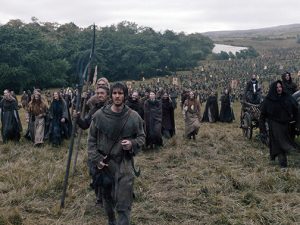
Photo provided by Jackson TOYON
By Jackson TOYON
History is rife with moments when ordinary people finally decide they’ve had enough and few are quite as dramatic as the Peasants’ Revolt. In “The Uprising,” director Paul Greengrass (of Jason Bourne fame) brings a dramatized version of this infamous rebellion to the screen, putting us in the shoes of the farmers and other common laborers who rose up against an English ruling class that had pushed them to their breaking point. Greengrass stumbles, but ultimately mostly succeeds at bringing this bloody chapter of history to life.
By the year 1381, England has been decimated by the Black Death – with some sources estimating that half of the population has been wiped out. Those who survive are left behind to grapple with their losses – and more trouble is just on the horizon for them. Embroiled in the Hundred Years’ War with France, the government is running out of revenue and essentially ruled by the council of the 14-year-old King Richard II (Woody Norman). King Richard himself is too young and traumatized by nightmares to rule so he is mostly a figurehead while his council makes all the real decisions. When his council determines that raising taxes on the merchant class is not, in their opinion, a tenable option, they conclude that commoners should bear the burden instead. We join the story through the perspective of Ploughman (Andrew Garfield), a beaten down farmer who lost his wife and children to the plague and now merely refers to himself by the work he does, ground down by grief. When the tax collectors come to collect more than the people of his village can afford to give, something snaps within him. He attacks the collector and ends up killing a soldier who attempts to bring him in, not realizing that his actions would inspire other acts of revolt across the country. Leading the rebellion with figures like John Ball (Jamie Bell) and Wat Tyler (Cosmo Jarvis), the peasantry marches on London to demand change and better working conditions.
For a historical period piece, this film has some strange camerawork that somewhat undermines it. Paul Greengrass is rather known for his employment of shaky cam, but in this film it ends up looking a little too much like the camerawork from a sitcom such as “The Office.” The film also struggles with rushed pacing, glossing over the formation of the peasants’ army to the point that they’ve already amassed tens of thousands not very long after Ploughman first sparks the revolt. The most clunky aspect, though, is how the film trips over its own feet in the last 10 minutes with a contemporary-feeling, slapdash epilogue to establish a Robin Hood-like character – presumably to make the ending a tad less bleak for general audiences.
Despite these troubles, there’s still much to like here. Andrew Garfield does an admirable job elevating a movie that could be much less interesting to watch without him, even if his character isn’t particularly deep. The film exhibits solid production design and cinematography (aside from the shaky camerawork), and the action is suitably thrilling from start to finish. You can’t help but feel how effectively the film touches on the very real and rising feelings of wealth inequality in this country – but it also makes an effort to include an important note about how easy it is for bad actors to hijack a movement beyond its peaceful roots and exploit it to turn things violent.
Despite some shortcomings in the directing and a rushed ending, “The Uprising” is a pretty entertaining and watchable historical drama about populist rage, systemic corruption of power and the perils of mob resistance. Greengrass’ stylistic choices and uneven pacing hold it back from living up to its full potential, but Garfield’s performance helps to buoy the film and the strong action delivers where it needs to. The film succeeds in making the grievances behind the Peasants’ Revolt of 1381 feel relevant to today while simultaneously warning audiences of the unstable nature that comes with armed revolt.
If you’re unfamiliar with the story and interested in the history, it can be a satisfying watch if you can look past how the movie wraps up.
Rated R.

MOVIE REVIEW <<< JACKSON TOYON added by CV Weekly on
View all posts by CV Weekly →