





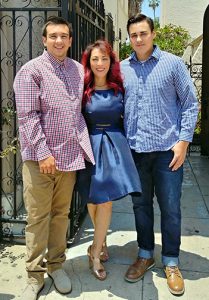
Photo provided by Victoria MALONE
By Mary O’KEEFE
There are many non-profits that are so busy performing outreach, finding ways to support their community and raising funds to keep on their lights that their origin stories – the reasons they are working so hard – have been pushed to the side. But that inspiration is what gives these non-profits their heart and their drive for the work they feel is so important.
iMPACT Foundation LA is one of those organizations that began with a mother’s loss and has evolved into the Crescenta Valley Substance Misuse Prevention Coalition, aka CV Cares.
The full title of the organization is The Chace Taylor Malone iMPACT Foundation. The foundation is based on Chace and how he struggled with addiction until he died.
“Honestly, I didn’t notice right away – and looking back, I’m not sure Chace fully understood what was happening either,” said Chace’s mom Victoria. “We didn’t have the vocabulary or the understanding to talk about what he was going through. By the time the signs [of his addiction] became clear – the isolation, the mood shifts, the new crowd – he was an adult and had moved out. Then COVID hit. His depression and anxiety intensified and [his] self-medicating became harder to ignore. A few of his CV friends tried to reach out, but he was already feeling defensive and abandoned. Within months, [his addiction] pulled him farther from everyone who loved him. We simply didn’t have the tools to help him in the way that would have made the difference – and that is exactly why this work matters.”
This is a common thread among parents who see their children struggle with mental health and addiction issues. Wanting to help their child and not knowing how to do that or how to get help are the reasons Victoria wanted to start her organization. Chace’s childhood friends felt as helpless as Victoria about how to help; however, they wanted to do something that would prevent others from not finding needed resources.
Chace did acknowledge his struggles; there were times when he would rally and his true self would come out. It was during these times Victoria had hope and thought his issues were situational.
“That was easier to hold onto. He agreed to [attend] therapy, but COVID eliminated the in-person connection he really needed,” she said.
The family finally identified a Los Angeles County treatment facility.
“We drove deep into LA,” Victoria recalled.
They were turned away though because Chace had been sober for a few weeks and therefore didn’t meet the facility’s criteria.
“We walked out with nowhere to turn and no one to guide us. No referrals. No resources. We were completely on our own. Chace gave us every impression he was moving forward. And when I expressed my fears about his sobriety, he would say, ‘Mom, don’t put your fears on me. I cannot carry them for you.’ Looking back, that was him protecting me the only way he knew how,” she said.
Chace had dealt with medical issues since he was young. Between the ages of 11 and 17, he had three major surgeries resulting from sports injuries; each time he was prescribed medical-grade painkillers, including morphine. At the time Chace’s family didn’t realize this introduction to the drug could affect him. Victoria has since learned a lot about these types of drugs.
“I’ve learned that pediatric exposure to opioids carries significant long-term risks that are rarely communicated to families. The developing brain is far more vulnerable to dependency than an adult brain. Early exposure changes the way pain, pleasure and stress are processed – sometimes permanently. Chace wasn’t weak. He wasn’t making poor choices for the sake of it. His brain had been altered before he ever had a chance to understand what that meant,” she said. “Not once did a doctor or medical staff member explain that this exposure would significantly raise his drug tolerance. No one told us that if he ever experimented, he would need far more than his peers to feel the same effect. No one warned us of the danger that created – not for me and, more importantly, not for Chace. That silence had consequences we couldn’t have imagined.”
Victoria realizes this doesn’t completely explain Chace’s choices; however, that exposure could have been a factor that, had it been shared with the family, would have made them better prepared for signs of addiction.
Chace’s family and friends continued to reach out as he continued to pull away.
“It was New Year’s 2021 – a night that was supposed to carry promise. Chace couldn’t make it to his brother’s so he spent it with people who weren’t really for him. Something happened that night that troubled me but when I asked he told me it would blow over. Later that evening, he and his father had a serious argument. We showed up to help, but without the right tools to de-escalate, we did the only thing we knew – we called the Glendale Police Dept. Chace went to the station that night. The next day, he was alone. He got hold of something he didn’t know was laced with fentanyl. He had no idea it would be the last thing he ever took. Jan. 1, 2021 was the last day Chace was on this earth,” Victoria added.
Victoria heard about the loss of her son a couple of days later but she had already had a bad feeling.
“On Jan. 2, [2021] early in the evening, for 22 minutes, I experienced an excruciating, consuming sickness I couldn’t explain. When it finally passed, I went to bed early and fell into a deep sleep. Just after midnight, my phone rang. It was my ex-husband. He told me our Chace was gone,” she said.
The official cause was of death was “accidental overdose.” The pill Chace took was laced with fentanyl.
“The coroner confirmed the evidence showed he was not trying to take his life. He simply did not know what was in it. And that lack of knowledge killed him,” she said.
Victoria wants people to know that he was “magnetic” and he was loved.
“If someone needed help, he showed up – fiercely, fully, without hesitation. He befriended the new kid at school, stood up for those being bullied and long after finishing a plumbing job [he] still checked in on the elderly woman he had worked for. He rooted for people. He saw the best in everyone around him. So many stories poured in after he passed – from classmates, coworkers and elders – all saying the same thing: Chace made them feel seen and cared for. And yet, toward the end, so many only saw his struggle. They forgot who he truly was,” she said.
Chace’s death affected his entire family, including his brother who watched his brother struggle and although he didn’t approve of many of Chace’s choices he knew Chace was his brother and was there for him.
The death of his brother seemed to make his calling to serve others as a firefighter even stronger. He now supports his mother through iMPACT.
“I’m very proud of him,” Victoria said.
The loss of a child is devastating and Victoria has, and continues, to work through her grief. She has also turned to helping other families going through the same frustrations when looking for resources. She is driven by her sons and said she made a promise to them at birth to do good and to be loved.
“Death does not end that promise,” she said.
She wasn’t really looking to start a non-profit but she began talking to Chace’s childhood friends and they wanted to do what they could to help other families from facing this type of tragedy. iMPACT just seemed the natural next step in her journey.
Since being formed, iMPACT and CV Cares have helped hundreds of people get the resource information they need; and the organizations continue to support families. CV Cares has established a Youth Ambassador Club at Crescenta Valley High School where students support one another and work to educate their peers on how they can help themselves, family members and friends.
iMPACT and CV Cares is something that has the support of the community and continues to perform outreach to let families know there is someone available who cares.
“The grief never leaves – but it transmutes. There is no right or wrong way to grieve, and no right or wrong way to find your way forward. The first two years, I barely slept. I would spontaneously collapse into gut wrenching screams and tears, each time feeling like my heart was being ripped out. I kept asking myself why I hadn’t seen it sooner, why I couldn’t course correct. That is the blame and shame this kind of loss carries,” she said. “But I was given grace by those around me – and instead of fighting the weight of it, I let it sit with me. Slowly, I found more truth in Chace’s goodness, his love and the lives he touched. I allowed a support system that was cultivating to come forth. I started researching, asking experts, and learning what I hadn’t known to ask before. And then I remembered something Chace said to me when he was a little boy: ‘Mom, I chose you.’ If he chose me – and showed me through his life how to care for others – how could I waste that gift? That would have been my real tragedy. Instead, I chose to take everything he gave me and share it with the community that helped raise him.”

How a Mother Turned Tragedy into Creating an “iMPACT” to Help Others added by CV Weekly on
View all posts by CV Weekly →