





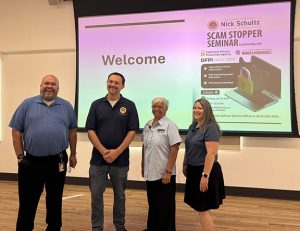
Photo by Mary O’KEEFE
By Mary O’KEEFE
On Tuesday Asssemblymember Nick Schultz hosted a Scam Stopper Seminar in partnership with California Privacy Protection Agency, California Dept. of Financial Protection and LA City Councilwoman Monica Rodriguez. The event was held in Tujunga.
Schultz started the event by reminding the audience that the California annual budget has been approved and signed, and goes into effect this month.
“Even amid really challenging economic times where we’re seeing less and less federal dollars coming to California we still found ways to make pretty good investments in health care and human services, and really building out that social safety net to help our community right now,” he said.
He then told the audience that he is the chair of the Public Safety Committee.
Prior to serving first on the Burbank City Council and then in the State Assembly, he worked for over 10 years as a prosecutor and prosecuted a lot of people on mortgage fraud, financial fraud and organized retail theft.
“I can tell you that this year we’re taking fraud very seriously in the state – not just looking at our own programs but adding more tools so local law enforcement can go after fraudsters,” he said.
He added that a lot of the ideas for bills come from constituents who have contacted him concerning specific crimes, like scams.
Melissa Rosser from California Privacy Protection, aka CalPrivacy, was the first to speak.
“You may not have heard of our agency. We’ve only been around since 2021 when voters approved us in 2020,” Rosser said. “We protect the personal information of Californians.”
She spoke about how people can exercise their privacy rights.
“Californians have a lot of privacy rights. California is actually the only state that has a dedicated agency to protecting your personal information,” she added.
Other states do have privacy rights; however, they are enforced by an entity like the attorney general’s office instead of a dedicated agency. CalPrivacy has lawyers and technologists who can look at websites and find out where personal information is going, she explained.
Rosser said that many people have an attitude that “My information is out there already” so there is nothing anyone can do about it – but that is not the case.
“You’re really good at protecting your physical safety, right?” Rosser asked the audience. “You don’t leave your house with the door unlocked and you definitely don’t leave your key in the door so somebody could just let themselves in.”
She added that even though a lot of personal information is on the web and accessible it is still important to protect personal information from bad operatives.
“Personal information … is basically any information that can identify you and can be connected to you. It can include your email address or more sensitive information like your Social Security number, your health information and your financial information. Under California law you have the right to limit what information businesses can collect about you,” she said.
She said the best way people can protect themselves is to take their time whenever a business or application asks for information.
Rosser advised that when a company asks for information the question should be asked, “Why would they need this information?”
“Do they need this to do business with me?” Rosser asked.
She said lately she noticed that when she is shopping businesses will ask for her email address.
“They even offer you a discount if you give them your email,” she said. But since she started working at CalPrivacy she has learned to stop and think, she said.
People should ask themselves, or the business, what they are going to do with the information.
“The executive director of our agency says personal information is the new oil. It’s the currency that drives the marketplace. And so what do they do with it? Maybe they’re trying to serve you targeted ads to get you to buy something and other personal services,” she said.
Sometimes that type of targeting can be advantageous; for example, if people buy diapers and are sent a notice when diapers are on sale that could be advantageous. But sometimes the information requested is a bit invasive.
“And so you just have to decide what you are comfortable with,” she said.
Companies will also use information on purchase and spending habits or for market research. So there is good and bad with releasing information; people could begin getting contacted or be targeted by advertising, not by their familiar stores but from more sources. That is because companies can sell your personal information, she said.
She also spoke about cellphones and how they can not only track buying habits but locations as well.
“How many of you have ever downloaded an app and then used it once and never used it again?” Rosser asked the audience. Several hands went up. “You may have forgotten about it but it hasn’t forgotten about you. It’s still tracking you, still collecting information depending on the permissions that you have [allowed].”
She said it was a good idea to got through the phone often and delete apps that are not being used any longer. When an app is being used it can look and see what information people are using; for example, not every app needs access to the phone’s camera or a person’s location.
“You can tailor access based on the benefit that you’re getting from the app,” she said. “When [the app] starts off they want everything [location, camera, information] but you can scale that and always opt out of selling and sharing [your information].”
She also advised to delete browsing data from whatever browser is being used, like Safari or Chrome.
“One thing that you can do is delete browsing data and delete third party cookies,” she advised.
By doing that it limits how much data is being collected and used by companies.
Next week CVW will give examples as to how people can protect themselves from sharing too much information.

Part 1 How Much is Too Much? Seminar Offers Tips on How to Stop Scams added by CV Weekly on
View all posts by CV Weekly →