





Photo by Mary O’KEEFE
By Mary O’KEEFE
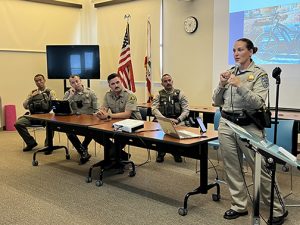
On Monday the Crescenta Valley Town Council hosted law enforcement in a talk about e-bikes and e-motors.
The talk began with officers from California Highway Patrol explaining the difference between e-bikes, e-scooters and e-motors and the laws that apply to each classification.
“Our big thing is that we are looking to provide safety, security and a service to the communities,” said CHP Officer Katherine Hendry.
She told the audience not to be afraid to ask questions – and the audience did ask questions including teens who wanted to talk about their e-bikes.
“There are three different levels of e-bikes. Level three is the one that’s considered the one that goes really fast and is considered to be the most dangerous right now,” she said.
The three different class levels of e-bikes are:
- Class 1 – Pedal assist bike: This is a bicycle equipped with a motor that provides assistance only when the rider is pedaling. It ceases to provide assistance when the bicycle reaches the speed of 20 miles per hour (mph).
- Class 2 – Throttle assist bike. A Class 2 electric bike or low speed throttle assisted e-bike is a bicycle equipped with a motor that may be used exclusively to propel the bicycle and is not capable of providing assistance when the bike reaches the speed of 20 mph.
- Class 3 – Pedal assist bike. A Class 3 electric bicycle or speed pedal assisted e-bike is a bicycle equipped with a motor that provides assistance only when the rider is pedaling. It ceases to provide assistance when the bicycle reaches the speed of 28 mph. It is also equipped with a speedometer.
Hendry referenced stories in the news media about accidents involving e-bike riders. She mentioned a fatal accident in April when a 13-year-old was struck and killed by a train while riding an e-bike in Simi Valley. The preliminary investigation indicated the e-bike rider failed to stop at the railroad crossing in time to prevent the accident. She also showed footage of a young e-bike rider who, while in traffic, was attempting to stand on the seat of the e-bike, and footage of another young rider who struck a parked vehicle.
She added that because of the speed of the e-bikes, drivers can’t see the bikes coming and many don’t expect the bikes to be traveling that fast.
There are also riders who modify the e-bike to go faster than intended, which is considered an illegal modification. Some of those modifications include adding batteries that have been known to explode.
Office Bryan Bay is stationed out of the Altadena Office of the CHP and knows the Crescenta Valley area well.
Some in the audience shared stories of seeing e-bike riders speeding through neighborhoods and down streets, including riding on sidewalks along Honolulu Avenue in the Montrose Shopping Park.
There were many parents and kids in the audience, who were praised by other members of the audience, showing a willingness to understand the laws and how to keep riders safe.
The youth in the audience knew quite a bit about the classes of e-bikes and the rules that needed to be followed. Among the questions they asked were about the best helmets for e-bikers. (Everyone on an e-bike must wear a helmet if they are riding a Class 3 e-bike.)
Bay and CHP Community Outreach Officer Keller stated they would advise that riders wear a helmet that covers the head – not a “novelty” helmet.
Bay spoke of how emergency departments are seeing an increase in e-bike accidents and stressed how important it was to have a good helmet – and to wear it.
CHP does offer an online course on electric bicycle safety and training. Its website also provides a lot of information on e-bikes, safety and laws. Deputies from the Los Angeles County Sheriff’s Dept.-Crescenta Valley Station were at the event as well and spoke about issues they are seeing in the area, including kids on e-bikes who attempt to outrun patrol units. As a policy, the deputies do not give chase due to their concern for the safety of riders and those on the roads; however, they usually can find the e-bike riders who are attempting to ride away.
There was also discussion on drivers and how it is not just the responsibility of e-bike riders to be safe on the road and to follow rules and regulations; those behind the wheel of vehicles also need to follow rules and regulations.
One member of the audience said parents are responsible for teaching good driving habits to their children via example. She said she has seen women putting on makeup and seen other drivers on their phones when driving their children to school. She stressed again that children learn through the example of their parents.
For more information on e-bike safety and training, go to https://tinyurl.com/uuanb3zv.

E-Bike Discussion Hosted by CVTC added by CV Weekly on
View all posts by CV Weekly →