





Planes, Trains, and Automobiles – Part 2
I took a deep breath to satisfy olfactory desires as I leaned over my custom Fritas Fries at the Big White Hut in Tujunga. Sitting at the rear table, before digging in I took in the map covering its back wall. It’s an old map from 1926 of Sunland and a portion of the San Fernando Valley. As I dined, I continued my examination … and that’s when I noticed it. Following the railroad tracks that lie alongside San Fernando Road, about halfway up the wall, was the word “Wahoo.” There a spur of the rail line embarked off to the east, heading into the Big Tujunga Wash. From that beginning, a history hunt began.
As I drove home, I recalled a man who had come into Bolton Hall years ago with a story about finding what he believed was a train tunnel out in the wash. We made our way over to the museum’s map and he pointed to the approximate location of his purported discovery. While intrigued after many other guests had come and gone, the memory was relegated to some empty brain cells and promptly forgotten. Now the recollection had returned as the 1926 map had revealed the Wahoo Spur coming to an end near the spot the guest had identified.
Arriving home, I eagerly accessed satellite imagery of the area and lo and behold! A large structure was apparent there. And it wasn’t just large; it appeared to be huge. What was this big thing? The next step, of course, was to head there to see it for myself and try to determine what it was. The hike was not difficult; I arrived in perhaps 30 minutes to find a truly amazing site. It is indeed a train tunnel, some 330 feet long, built of reinforced concrete. All along the top are a series of loading portals, which reveal its purpose. A train would pull into this tunnel and would be loaded from above with gravel and stones. A deeper dive into the tunnel and the Wahoo Spur was then required.
That deeper dive came in the way of an introduction to Jock Scott, a man who could provide some of the answers. I was introduced to Jock, who is a mining expert who knows a great deal about the history of mining in Los Angeles. After describing the quest I was on, he promptly invited me to meet him at the Durbin Rock Plant in Baldwin Park.
“There is something I’d like you to see there,” he said.
This past January, I met Jock at the vast worksite. We entered a boardroom where the walls were covered with historic photos of numerous rock plant operations. He led me to one image and said, “There it is – that’s your tunnel. It used to be the bottom floor of the three-story Sheldon Rock Plant, which began operations in the early 1920s. The upper two floors were made of wood and no longer exist.”
The Wahoo Spur separated from the main line near the intersection of Truesdale Street and San Fernando Road and followed the path of the Hansen Dam spillway to the east. Reaching the Hansen Dam Golf Course, the tracks would have passed through the center of the 18th green and headed into the wash through where the dam sits now. The length of the spur was a little over two miles to the loading tunnel.
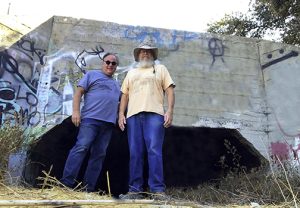
This was the only train that ever penetrated the Tujunga Rancho. At one end of the tunnel, 1923 is stamped. Flooding was a regular problem and operations ceased in the 1930s. A tremendous amount of cement was required to build Los Angeles, especially during the boom of the 1920s. Most of the gravel pulled from this plant served to make cement and helped our city rise. The final step was to take Mike Lawler to visit the site: 34 15’56.37”N, 118 22’13.28”W.

VIEW OF THE VERDUGOS <<< CRAIG DURST added by CV Weekly on
View all posts by CV Weekly →