




Planes, Trains, and Automobiles – Part 1
The sweet, fruity scent of baked apples and cinnamon filled the air as the oven door opened at Rice’s Café on the edge of Sunland Park. Plates were laid out that soon were filled with slices of steaming hot pie and large scoops of ice cream. Out in the park, a couple dozen people were gathered. Among them was a handful of Los Angeles City officials, members of the Los Angeles Police Dept., local leaders and a cadre of aviation experts, pilots and enthusiasts.
This was a time in 1927 when aviation was all the rage. Just four months prior, on the streets of New York, Charles Lindbergh had inspired an estimated four million people to attend the ticker-tape parade in his honor. They celebrated the first solo flight across the Atlantic Ocean. Only one month prior, MGM’s Leo the Lion, the first beast to roar on screen, survived a plane crash near Gisela, Arizona and was returned to Hollywood to much fanfare.
On Friday, Oct. 14, 1927 this group had arrived for a presentation in support of the Sunland Airport. The City of Los Angeles had begun the process of identifying a location for a new municipal airport. Several locations were put forth, but the Sunland Airport had an ace in the hole: less fog.
After enjoying lunch in the park, the assembly headed east down Foothill Boulevard and made a left turn on Mt. Gleason. They were transported to the top of the hill overlooking the Big Tujunga Wash. They exited their autos and climbed a nearby peak to the west. These hillsides were barren then but days before a crew had constructed a wooden platform upon which chairs had been spread. From there, the party could see the proposed airport laid out before them.
Among the officials there that day were Van Griffith, son of Colonel Griffith J. Griffith, the eccentric benefactor of Griffith Park in Los Angeles, and Charles Randall, the former U.S. Congressman, then Los Angeles City Councilman. Randall’s history was notable as he was the only Prohibition Party candidate ever elected to the U.S. House of Representatives. WWI aviator and stunt pilot “Daredevil” Henderson, stepped forward to address the group.
Henderson had arranged for a pilot of the Aero Corporation of California to buzz the crowd and circle the proposed airfield and the plane arrived just as he began to speak.
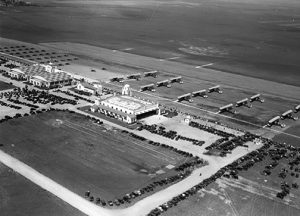
“The City of Los Angeles must have a municipal airport,” he pointed his finger at the aviator flying by. “This 660-acre site is a rare spot; while a haze of fog covered the city this morning, here in Sunland, this valley below was clear and fogless.”
Next up was Otis Burton Curtis, speaking on behalf of the Airport Committee. He pointed out the boundaries: “The field would be 2600 feet wide and 10,000 feet long.” At that moment, the aviator flew by at the same level as the gathering and they all instinctively waved as he passed.
Otis continued, “The land included in this proposed site extends from the foot of the hill to the south to a line about midway between Hill and North streets (Hillrose and Wentworth Streets today) and from Walnut Drive (Mt. Gleason) to the Big Tujunga Bridge.”
Shortly after this hilltop assembly, despite Councilman Randall’s assurances that the Sunland site would receive serious consideration, a final choice was made in the southern part of Westchester. This site had been promoted by real estate agent William Mines and Mines Field, as it was known, was leased by the city in August of 1928. The airport opened on Oct. 1 and was renamed the Los Angeles Municipal Airport on June 7, 1930.
Come back and visit with me next time. I’ll take you for a ride on the Wahoo Railroad Spur in Part 2 of Planes, Trains and Automobiles.

VIEW OF THE VERDUGOS <<< CRAIG DURST added by CV Weekly on
View all posts by CV Weekly →