





The Black Panthers Visit to Glendale … in 1969
This column touches on some currently controversial subjects. I’m not taking a stand, just reporting what happened, and reflecting on how the present is often a mirror image of the past.
1969 was a tumultuous year, particularly on college campuses. Even tiny Glendale Community College was subject to controversy. Early that year the student-led Human Relations Council had submitted a list of proposed on-campus speakers for the next year. Included in the list was a representative from the Black Panther Party. That request was immediately denied by GCC officials.
Needless to say, the students fought the denial. There was much back-and-forth on the issue in early 1969 with some incendiary public meetings. Ultimately the matter went to court and, with the backing of the ACLU, the students prevailed on a free-speech basis. The Black Panthers were to speak at GCC.
As a history writer, I am constantly amazed by the contrasts and ironies of the past versus the present. Here are some examples. Recently, conservative activists protested the denial of some far-right speakers to speak on college campuses. In the 1960s the opposite was the case. Recently, right-wing activists have openly carried firearms in some high-profile demonstrations, including armed protesters entering the Michigan State Capitol. In 1960s California, the exact same thing happened, but on the opposite end of the political spectrum.
A quick historical “lesson in irony” to show how much has and hasn’t changed: In the 1960s it was legal to openly carry a loaded gun in California. The Black Panthers took advantage of that by carrying firearms. They formed “police patrols” in which they would follow police cars. If a black driver was pulled over, the Black Panthers would quietly stand nearby displaying loaded weapons. There was a strong backlash in Sacramento, and Republican Don Mulford introduced a bill in 1967 that prohibited openly carrying loaded firearms. Black Panthers, carrying loaded rifles and handguns (still legal at that time), entered the capitol building to protest the bill. They were disarmed and escorted out. But as a result the bill, ironically with the strong backing of the NRA, passed and has been the law ever since. Gov. Reagan commented that there was “no reason why on the street today a citizen should be carrying loaded weapons.”
In October 1969, the now disarmed Black Panthers were invited to speak in the GCC auditorium. They chose as their spokesperson Elaine Brown, a relatively new member of the Panthers. About 800 GCC students attended. Elaine Brown opened with a bang.
“All power to the people! Death to pigs!” She greeted Glendale as the “home to Birchers [the John Birch Society] and the American Nazi Party.“
“Our (Panthers’) purpose is not to run through Glendale and Orange County and kill all the little white babies. Our purpose is to create a human arena that will bring about changes in this system. Our purpose is to create a climate where we can all be humans,” she said.
She further advocated for a redistribution of wealth. She predicted authoritarian changes to the Constitution that would bring about further oppression, but she advocated strong resistance.
“The power belongs to the people. The streets belong to the people. It’s up to the people to take them!”
She chastised “little pig Nixon and lesser pig Reagan.”
The audience was politely quiet through the 45-minute talk, but she lost many of them when she called the recent moon landing a hoax filmed on a Hollywood stage. About 200 students left at that point.
She ended the speech by quoting Eldridge Cleaver.
“We shall have our manhood. We shall have it or the world will be leveled in our attempt to gain it. All power to the people!”
Wow, in Glendale of all places! And what became of the fiery Elaine Brown? She was instrumental in many of the Panthers’ social welfare programs and rose to the position of chairman of the Panthers from 1974 to 1977. She resigned due to misogyny she perceived in the leadership. Today she is an author and activist for prison reform. But in 1969 Glendale, she was the cutting edge of the Black power movement.
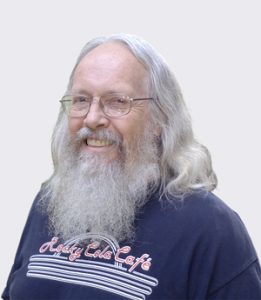
president of the Historical
Society of the Crescenta Valley
and loves local history.
Reach him at lawlerdad@yahoo.com.

Treasures of the Valley <<< Mike Lawler added by CV Weekly on
View all posts by CV Weekly →