





Continuing on the America 250 Trail
In recent weeks, we’ve embarked on a trail of historic discovery: the Sunland-Tujunga America 250 Trail. Created in 1976 by a handful of local historians for the country’s bicentennial, we can now enjoy the journey anew for America’s 250th birthday.
Entering the Crescenta Valley from the west on Foothill Boulevard we’ve passed the former sites of the ancient indigenous village of Tujunga, Mason’s Ice Cream, an early one-room schoolhouse and a home of early Hollywood silent film hunk Francis X. Bushman.
Continuing east from 9600 Foothill Blvd., you’ll quickly enter the bridge that crosses the Big Tujunga River, commonly called The Wash. This bridge, although not included on the 250 Trail, appeared along with Jack Nicholson in the 1974 film “Chinatown.” Coincidentally, some decades later one of the greatest golfers of all time – Jack Nicklaus – designed the Angeles National Golf Course just adjacent to this bridge. Consequently, I refer to it as the Nicholson/Nicklaus bridge. You won’t find that moniker on any maps!
Soon after passing over the bridge, take a right turn onto Wentworth Street. The entrance to today’s final destination – Rock City – is now less than a mile down the road. I must divert from the 250 Trail again as you first pass a very special place in our community at 9545 Wentworth St. Independent Studio Services, I. S. S., is the largest full-service prop house in the world! Certainly worthy of a story all on its own but not on this current tour. I’ll circle back in the future to share some of that amazing history.
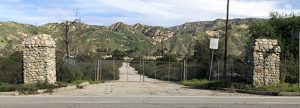
Before you know it, on the right-hand side at 9801 Wentworth St. you’re confronted by two large pillars of stone striding a long driveway. This was the entrance to the City Rock Company, fondly remembered as Rock City. This was a small rock crushing and gravel business that was started in the late 1920s. After the stock market crashed in 1929, business was hard to come by and Rock City went up for sale.
It was then that the hero of this story emerged. The old timers remembered the young man: Peter J. Admadzich. Peter was able to see opportunity despite the difficult times. So with seven original employees and a lot of hard work he purchased the City Rock Company and developed a sales volume that eventually ran into millions of dollars.
Maps and photos show some 20 structures once existed here, most engaged in the process of crushing rock and processing gravel. Several of the buildings appeared to be housing units, most likely provided to select employees. Cement was made and distributed via their many trucks. What Peter was remembered for was providing desperately needed jobs during the Great Depression as well as the unfailing support given to many community enterprises during those tough years.
Today all that exists of Rock City are the two nicely made stone pillars at the entrance and the scars of numerous cement pads, visible on the ground and in satellite images, where buildings once stood. There are also remnants of several old quarry pits nearby. One day while passing by I found the gate open so I took the opportunity to drive in. As I reached the end of the long driveway, I encountered a gentleman whose job was to monitor the site. He said that he came often to assure that the grounds of old Rock City remained undisturbed.

VIEW OF THE VERDUGOS <<< CRAIG DURST added by CV Weekly on
View all posts by CV Weekly →