





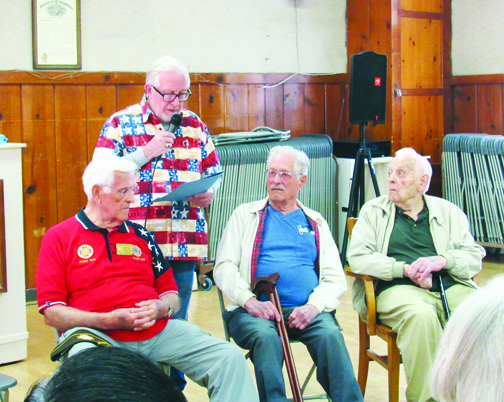
Vietnam veteran Mike Baldwin (standing) talks to WWII veterans (from left) Andy Gero, Don Norbut and Don Bonk about their service during WWII.
Local veterans share their memories of being part of WWII.
By Mary O’KEEFE
Tuesday marked 80 years since the attack on Pearl Harbor, which ushered the United States into World War II. It was just before 8 a.m. on a Sunday morning at the harbor located on the island of Oahu, Hawaii when the Japanese attacked.
Each year there are fewer individuals who remember the day President Franklin D. Roosevelt described as “a date which will live in infamy” in a speech he delivered on Dec. 8, 1941 when he requested Congress declare war.
“I was home, lying on the couch listening to the radio,” said Charles Tucker who served in WWII in the Army Air Force. “I was 17 then.”
Tucker was part of a gathering of WWII veterans at a luncheon on Tuesday. The event was co-sponsored by the Glendale Burbank Republican Assembly, American Legion Post 288 and Veterans of Foreign Wars Post 1614. The program included not only the WWII veterans sharing their memories but the reading of a letter by late Senator Bob Dole, also a WWII veteran. The letter recognized the Glendale Burbank Republican Assembly and its efforts in calling attention to the WWII veterans and their service. He also praised his fellow veterans.
Tucker was assigned to the China Theater and flew 17 missions as a “tail gunner” in a B-25.
Fellow veterans at the luncheon were Don Norbut, who served in the U.S. Navy and was in the battle of Okinawa, Gordon Reynertson, who served in C-Company 411 Infantry U.S. Army 103 Cactus Division, Don Bonk, who served in the U.S. Navy in the Navy’s amphibious force aboard the USS Gerald #174 in the Pacific Theater, and Andy Gero, who served in the U.S. Army in the later years of WWII. He was stationed at a hospital in Hawaii and continued to serve in Korea.
Dec. 7, 1941 changed everything for these veterans, as well as for the world.
“I was in the backyard chopping wood when my dad came out and said they just bombed Pearl Harbor,” Gero said.
He added at that time he had no idea where Pearl Harbor was or even where Hawaii was.
Reynertson also wondered where Pearl Harbor was located; he was home eating lunch when he heard about the attack from the radio reports.
“I was 15 living with my aunt in Illinois when I heard it on the radio,” shared Bonk.
Norbut was 15, born and raised in Los Angeles, when Pearl Harbor occurred. The fear of another attack, this time on the California shore, was very real. According to reports, there were sightings of Japanese planes over Los Angeles. In February 1942 a Japanese submarine surfaced off the coast of Santa Barbara and attacked an oil field; it inflicted only minor damage. Then military tracked what it thought was the enemy just 120 miles off the coast of LA. Air raid sirens began to wail and anti-aircraft guns shot into the sky.
“It was supposed to be enemy aircraft but turned out it was a false alarm,” Norbut said.
Gero added the fear people felt after the attack was real.
“Too many things scared the life out of me,” he added.
All were in their teens when Pearl Harbor was attacked and, like so many of their era, knew they would be signing up to help defend their country.
Gero spoke of living in a small town at the time and how, within days, so many had joined the fight.
“All the young men were gone and about one third of them didn’t return,” he said. “We must remember that we owe a lot to those [men].”
In typical “greatest generation” style, the veterans underplayed their service while focusing on others. All felt at home – and grateful – to be sharing stories of their 80-year-old memories.
“I am so blessed to be in the company of these WWII vets,” Norbut said.

Remembering the ‘Date that Will Live in Infamy’ added by CV Weekly on
View all posts by CV Weekly →