





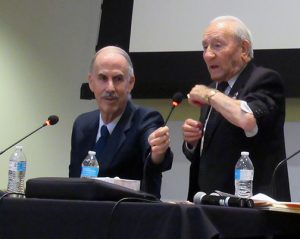
Photo by Mary O’KEEFE
By Mary O’KEEFE
This November Joseph Alexander will be celebrating his 103rd birthday. To have such a long life and to be so active is an amazing thing – just on its own – but Alexander’s life goes beyond amazing and moves into awe-inspiring.
Alexander is a Holocaust survivor who has been sharing his story for decades with others. He is part of an outreach program that has been to Burbank and Glendale schools.
CVW wants to wish Joseph Alexander a Happy Birthday and thank him for continuing his brave outreach to teach others of what hate can bring.
Below are excerpts from interviews CVW has done in the past with Mr. Alexander. It is important to continue to share his story:
“Most U.S. adults know what the Holocaust was and approximately when it happened, but fewer than half can correctly answer multiple choice questions about the number of Jews who were murdered or the way Adolf Hitler came to power …Nearly three-in-10 Americans say they are not sure how many Jews died during the Holocaust while one-in-10 overestimate the death toll and 15% say that 3 million or fewer Jews were killed,” according to a 2020 Pew Research Center survey.
This is what makes Alexander’s outreach so important.
“So this is what I hope: When I talk to them they [receive] the knowledge …they are our future,” Alexander said in a past interview with CVW regarding speaking to students about the Holocaust.
During WWII Alexander had been held in 12 different camps; one of them was Auschwitz and then Birkenau and Dachau. He was in camps for five years.
Alexander was born in Poland. When the Germans entered his village in Warsaw in 1939, they separated people into restricted and non-restricted areas. A couple of weeks after the invasion, the Germans ordered a group of people to the town square.
Alexander said in an earlier interview that he did not know why but neither the family in his home nor in his uncle’s home, both of which were located in the town square, were in this first gathering.
He saw people taken away who had been ordered to the town square. Alexander said rumors were spread that the Germans would be coming back to take the rest of the Jews.
“My dad said, ‘We are not going to wait.’ My father had three sisters who lived 25 kilometers [away],” he said.
His mother, father, one sister and one brother left the area, leaving Alexander and two other sisters at home. The plan was for them to follow the family shortly.
However, soon after the family was reunited, they were placed in their first work camp. Jews were allowed to return home on weekends.
“And off I went to the camp,” he said.
The work done included digging a canal. They had to work in standing water up to their knees and did not have boots. These camps were called ghettos.
He worked first at that camp then two or three camps were combined into one and he moved again. By this time he was going from camp to camp – seven in total –until a train arrived.
“It wasn’t a passenger train, it was a cattle car [boxcar],” he said.
The boxcar was packed with Jewish people. They traveled for three days without food, water or bathroom facilities. And then they arrived at Auschwitz.
Alexander said when they arrived about 30% to 40% of the people had died who had been in the boxcar.
When he arrived in Auschwitz he met Josef Mengele. Alexander got off the train and lined up with others.
“Whoever could walk would line up in rows of five and we met Dr. Josef Mengele,” he said. “And Dr. Mengele said, ‘There’s six kilometers to walk to the camp’ and he was selecting people [who lined up, directing some] to the left and they would be taken on trucks. So he went through and picked out the sick people, old people, young kids … I was a little guy and I was a young kid and he told me to go to the left.”
But Alexander had already been in several camps by the time he arrived at Auschwitz and he was learning how to survive.
“Every camp I was in I had to work. I tried to get in with the biggest, strongest men. And here Dr. Mengele was telling me to go the left. I looked around and saw sick and old people and young kids … that’s not the kind of people I should be with. It was after midnight [when I got off the train]. If it would have been daytime I don’t think I could have done this … I ran back to the other side. If I didn’t run back to the other side I wouldn’t be here talking to you today. The people who were on the [left side] were taken on the trucks and were taken straight to the gas chamber,” Alexander said.
Alexander was able to survive despite the unimaginable hardship and loss. And he has made it his mission to share his stories, to be the voice who was there, who saw and experienced Hitler’s “Final Solution.”
“I tell the students, I tell everybody, that six million Jews, one and a half million children, were murdered. They weren’t murdered because they were criminals or did anything wrong. They were murdered because they were Jews. And today we have a lot of Holocaust deniers and a lot of antisemitism. I call the Holocaust deniers crazy because the evidence is still there in existence today. You go to Auschwitz, Majdanek, Treblinka, Dachau – the gas chambers are still there,” he said.
He added in 1933 Germany everything started right away. Jews couldn’t go to school or practice law or medicine.
“And that’s how it started,” he said.
When asked why he continues to go back to these camps he said, “Because I survived and Hitler didn’t.”

Holocaust Fighter Joseph Alexander Turns 103 added by CV Weekly on
View all posts by CV Weekly →