





By Eliza PARTIKA
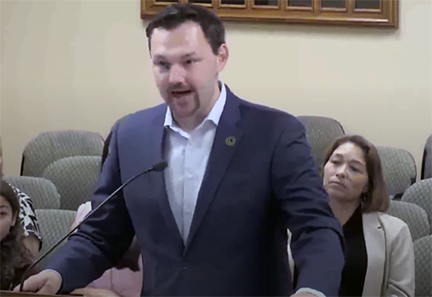
The Glendale Unified School District (GUSD) board of education meeting held on Nov. 4 included a presentation from California state representative Nick Schultz, the representative for California’s 44th District who covers the cities of Burbank, North Glendale, La Crescenta, Sunland-Tujunga, North Hollywood, Sherman Oaks, Studio City, Toluca Lake and Valley Village. Schultz presented new and changing legislation from Capitol Hill that affects GUSD students and the school community.
Education Bills
When a school district is bidding on a contractor, the district is required by law to select the lowest bidder for a project. Sometimes, said Schultz, the lowest bidder is lowballing a bid and don’t deliver a project on time or well done. His bill, AB 361, protects school districts from bad contracts by allowing them to choose bidders based on other factors.
“Say, for example, the second-highest bidder has [done] prior work for GUSD,” Schultz said. “This would allow you to choose that bidder, if they were the best for the school community.”
For about a decade, LAUSD has taken part in a best value procurement program, which allows the district to award a contract based on more criteria than just money. Schultz said that in this program, LAUSD could also consider experience, quality of work performance and prior work done with the district.
This bill does that – it allows districts like GUSD to expand the option to consider factors like experience, work quality and prior work with the district when choosing a bidder, making permanent LAUSD’s pilot program established in 2015.
“This is really about creating more flexibility and giving more discretion to our local decision-makers to pick the right fit for your district,” he said.
Schultz discussed a housing package that, when passed into law, allowed commercial property to be rezoned as residential. Schultz told school board members this could mean more housing for teachers and other working professionals in Glendale. AB 1050 extends existing state law allowing for the removal of covenants, conditions and restrictions on a property that is mixed use for mixed-income housing. Vacant commercial properties that could be used for housing the community’s teachers or firefighters, he said, would be able to become housing without the loss of local control, or changes to local zoning ordinances.
“In the Glendale community, as in other cities across the district, we are dealing with declining enrollment, we have a high cost of living here and we are seeing a population that is largely aging in place. And the high cost of housing is a significant driver in that,” Schultz said.
Schultz also reviewed important education funding changes. In the 2025-26 budget, Schultz said per pupil spending increases to $25,176. The budget also grows career and educational funding by $150 million. Funding will increase for school meals, homeless student assistance, after school programs, literacy programs and teacher recruitment and retention.
Schultz also reviewed bills he and his team co-authored including AB 49, which prohibits employees of a local education agency from allowing immigration enforcement to enter a school site without a valid judicial warrant or court order; SB 98, which requires K-12 schools, community colleges and CSUs to notify parents, guardians, staff and students when immigration enforcement is confirmed on campus; and AB 1128, which creates a teacher support grant to pay student teachers during their teacher placement.
Non-Education Bills
Before presenting the education bills he worked on throughout the year, Schultz gave an overview of each bill he developed to provide the board a “flavor of what we are working on” in Sacramento. Around 80% of the bills Schultz put before California Governor Gavin Newsom passed. Many of the non-education bills Schultz authored related to the environment and energy consumption, including AB 43, to safeguard California rivers removed from federal protection by including them on lists for state protection, and AB 1319, which protects California’s endangered species when federal protections are weakened.
AB 379, which also passed, is the most comprehensive response to human trafficking in Glendale, according to Schultz. The bill allows prosecutors to charge felonies against adult predators who solicit 16 and 17 year olds. In instances where an 18-year-old solicits a minor younger than s/he, the act remains illegal and is charged as a misdemeanor. In addition to this, the bill puts the CA DOJ in charge of enforcing the requirement that businesses post a notice about human trafficking and gives survivors a support network and empowers local law enforcement to step in if it sees a crime about to be committed.
The governor vetoed two bills Schultz authored: AB 44 and AB 734.
AB 44, which was vetoed by the governor, aimed to reduce an energy company’s need to purchase “dirty power” or electricity that has been distorted in some way. Had it passed, the bill would have significantly decreased energy costs for consumers and retail rate payers – up to $550 million a year, according to Schultz. Schultz said Newsom vetoed the bill due to concerns about a lack of clarity at the California Energy Commission.
“We understand that everyone, including GUSD, needs relief in this moment, so we are going to go back to the drawing board and address his concerns and bring back a version if it next year,” Schultz said of AB 44.
The other bill that was vetoed, AB 734, would have allowed the public to have access to biodiversity information when making decisions about contractors. This information is usually only seen by the governor and representatives. Newsom vetoed AB 734, said Schultz, due to concerns about compromising government assets.
Board Comments
Board member Telly Tse thanked Schultz, especially for AB 1128.
“I personally was lucky when I went to Cal State L.A. for my teaching credentialing program, it had an internship program that allowed me to be paid while finishing my credential. Obviously not all teacher candidates [have this], so having this, I think, is very important,” Tse said.
Board members Neda Farid and Kathleen Cross and board president Ingrid Gunnell thanked Assemblymember Schultz for his accessibility. In addition to the presentation, he hosted a roundtable within LAUSD, GUSD and Burbank, and attended a recent Glendale PTA event.
“Being a part of the government – being touchable, being accessible – I think is such a huge thing, and it reminds people that what we do matters, and they get to be involved, they can be involved, and we’re right here. I think that is awesome. Thank you,” said board member Cross.
To contact Representative Schultz, visit https://a44.asmdc.org/contact. To track bills currently in the California legislature, go to: https://leginfo.legislature.ca.gov/.

Education and Other Policy Changes Could Affect School District, Says Rep. Nick Schultz added by CV Weekly on
View all posts by CV Weekly →