





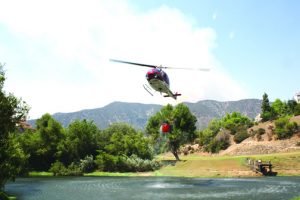
File photo
By Mary O’KEEFE
It has been 12 years since the Station Fire filled the foothill communities with fire and smoke. The time that passed between then and now has only seen an increase in the number of wildfires.
Prior to the Station Fire there were warning signs of dangerous fire conditions that included dry vegetation and drought conditions, much of what Southern California is now facing.
“We are in an extreme drought and [have] record low levels of rain,” said Sean Ferguson, Los Angeles County Fire Dept. spokesman.
Ferguson added that fires react to the conditions of the day. He gave an example of a recent fire that happened in Malibu about a month ago at 2:30 a.m. that firefighters were able to keep to 2.5 acres. The fire was in an extremely steep area but they were still able to restrict it to that small area.
“But that same fire with Santa Ana wind conditions would be a different [situation],” he said.
Due in part to the far-reaching damage of the Station Fire, which burned over 160,000 acres in the Angeles National Forest, the U.S. Forest Service changed its ban on night flights. Since then the LACoFD has increased its air operations and now has available five Sikorsky S-70 Firehawks, five Bell 412 helicopters and the recently added Boeing Chinook CH-47 [known as Helitanker 55]. On Wednesday, two super scoopers the department leases annually from Quebec were added to the department’s stable.
Firefighters have said this year is the worst they have seen for wildfires as the drought continues. It is important for all residents to be aware and to be prepared. Information on the evacuation plan LACoFd Ready!Set!Go! can be found at https://fire.lacounty.gov/rsg/.

Reflecting on the Station Fire added by CV Weekly on
View all posts by CV Weekly →