





Photos provided by Mikaela STONE, sent by Nicol FREEMAN
By Mikaela STONE
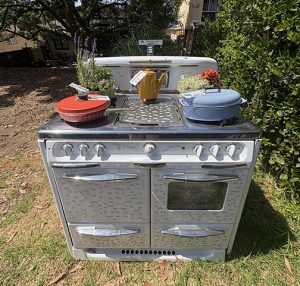
A labor of love turned bittersweet when the refurbished Wedgewood stove was stolen that housed grad student Natalie Freeman’s Little Free Library.
Upon Freeman’s acceptance into her Library and Information Science Masters program, her father gifted the aspiring librarian a charter sign for a little free library. While Freeman was initially unsure if the homeowner, whose back house she rents, would approve, the homeowner assured Freeman that she too was a lover of books.
Inspired by a Little Free Library Freeman had seen on the internet, a stove tucked away in a forest alcove, she decided to up-cycle a stove.
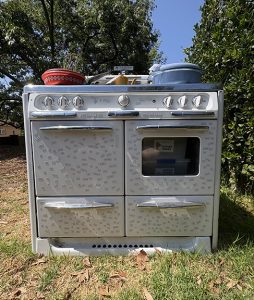
She responded to a listing from a woman in Los Angeles giving away a vintage Wedgewood stove. The family had cooked meals with it for over a decade but the stove, which the woman described as “well-loved,” no longer fit in their remodeled kitchen. She approved of the stove having a “second life” as a Little Free Library.
Growing up, Freeman had always worked on creative projects with her father. He was once again by her side to remove the stove’s heavy internal mechanisms. The end result? A place for over 90 books!
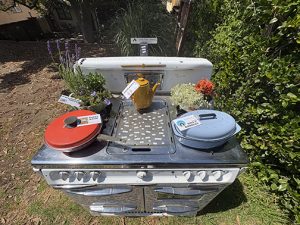
Freeman’s artistic aspirations did not stop there: she recruited the talents of her friends (who asked that only their first names be used in this article). As an events operation manager for the LA Zoo, Freeman was inspired to create the Little Free Library by working alongside ground teams building native gardens. For her own project, Freeman enlisted Cole, a botanist and fellow local, to help her select plants for a pollinator garden that would fit on top of the stove in thrifted vintage pots and pans.
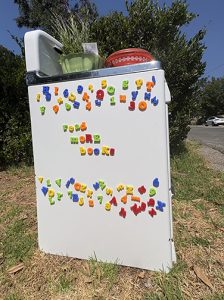
After realizing the sides of the stove were magnetic, Freeman decorated with colorful alphabet and arrangeable poetry magnets. She spelled out “read moRE booKs” in mismatched letter magnets and the rest were left for visitors to play with. For her magnet stash, friend Darby offered a set of “cryptid” magnets: a jumble of animal heads, legs, wings and more for children to make their own magnet monster.
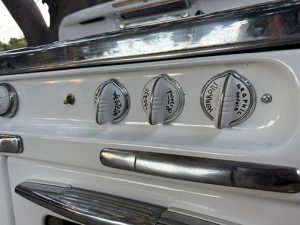
Calligrapher Lindsey lettered out book genres onto the oven’s knobs in fun fonts. For poetry, she styled in looping letters. For horror, she squiggled in a properly ghostly hand.
Ashley, whose talents lay in scrapbooking and paper crafts, turned her scrap paper into bookmarks for the kids to take. These went in a vintage tea pot. Beside it, in a retro sauce pan and serving dish, Freeman placed a guest book for readers to sign and dozens of knickknacks to peruse, which she affectionately named “bits and bobbles.”
Freeman labeled each of these pieces with a beloved picture book. For the pollinator garden, she chose two books. The first book was The Carrot Seed by Ruth Krauss, illustrated by Crockett Johnson – a classic first published in 1945 that has been in continuous publication ever since. Krauss and Johnson are best known for the beloved picture book Harold and the Purple Crayon. The second is Jan Brett’s Mossy, featuring Jan Brett’s famously lush artwork. For the bookmarks, Mina the reader mouse presented Mina by Matthew Forsythe. For the “bits and bobbles” she chose the whimsical picture book How to Walk an Ant by Cindy Derby.
“I’m so happy that I have pictures of [the stove] because every single thing that I thought about doing for it, every little flourish that I had … by the time we set it up, it came out exactly like I had imagined,” Freeman said.
Freeman gave this same attention to detail to the books inside, hand selecting books she had loved as a kid, books she considered part of the “children’s literature canon” and rare or antique books. She visits the La Crescenta Library every week researching, building and enjoying her reading. While doing research for her master’s degree, she used picture books to explore her fondness for folklore and her newfound love for alphabet books. One such alphabet book teaches children both the alphabet and concept of the passage of time: Tomorrow’s Alphabet by George Shannon, illustrated by Donald Cruz, uses examples such as “A is for seed, tomorrow’s apple,” encouraging children to imagine what things might become.
Giving her community the chance to learn and fall in love with books in a novel way allowed Freeman to meet and converse with neighbors she previously had only waved to. She was delighted to find out that one neighbor’s daughter also studied library science. Many children lived on her street. They quickly began to peruse the library.
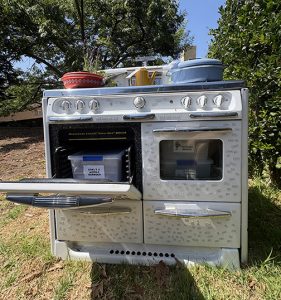
Unfortunately, the Little Free Library also caught the eyes of less well-meaning people. Freeman set the stove out on a Friday. By Saturday morning, everything on top of the stove was gone. Throughout the day the magnets disappeared. At one point a person opened the doors, emptied out the plastic box protecting the books and took the box, leaving the books behind.
“It didn’t look like my library anymore,” Freeman lamented.
When it became clear the entire stove was likely to next disappear, Freeman and her neighbors moved the books inside. She also took the calligraphed stove knobs, the only remaining piece of personalization.
The stove disappeared an hour later.
Her neighbors and the property homeowner of the former Little Free Library showed up to bolster Freeman, posting on social media to show off her hard work to those who had not been able to see it in person. What resulted was an “almost overwhelming” show of love, support and donations for any future library plans Freeman may make.
Already her neighbors want to know when there will be another library. For Freeman, giving up on her Little Free Library was never an option.
“The books that I have in here, they don’t want to be sitting in my apartment, they want to be in people’s hands,” she said.
Her future Little Free Library will likely be a little more traditional to discourage future thefts but her creativity will ensure that it will be anything but boring. Freeman plans to use the preserved calligraphed knobs as handles and incorporate the stove’s former gas line into it. She hopes to thank her donors in the design; her current idea is to put their names on book spine tiles to create a bookshelf of honorees. Her father already has a dynamic idea: putting the library on a Lazy Susan so it can spin!
Whatever form this new Little Free Library takes, it will showcase the creativity and love behind its creation and honor the Little Free Library that captured the community’s heart – for just one day.

Little Free Library – Here One Day, Gone the Next added by CV Weekly on
View all posts by CV Weekly →