





“One always measures friendships by how they show up in bad weather.
~ Winston Churchill
The past week’s weather was a welcomed reprieve; a light jacket was needed for our evening dog walk. The first day of school for the local kids dawned under cloudy and drippy skies. Without a calendar to remind otherwise it could have been mistaken for fall. Enough dreaming; summer – in all it’s glory and with all its heat – has returned. Rising temperatures mixed with monsoonal moisture are forecast into next week.
Looking back almost 70 years, I must share a weather-related reminiscence of a local veteran. Occasionally, I hear from Weather in the Foothills readers. After writing about weather balloons and the importance of military weather forecasting, I received an email from Jack Wunderlich. With his permission, I share…
Sue, I read your article in the CV Weekly, and sat down and wrote my experiences with
the balloons. I was in the Air Force in Japan during the Korean War 1952-1954.
I’m not up to emailing that much, but will mail it to you if interested?
Thanks for the article.
Jack
Interested? Let’s see … with a degree in history, being an amateur weather watcher and having respect and gratitude for all veterans … am I interested? Absolutely! The following is based on the memoirs of Jack’s time in Japan.
“I’ve had some experiences with weather balloons some time ago.”
After enlisting in the U.S. Air Force, Jack was sent to Chanute Field AFB in Illinois where he trained as a “weather observer.” He added, “Being from California I learned a lot of weather in Illinois!” From there he was sent to Japan.
“I was sent to a small air base in Niigata on North Honshu, and I became station chief of our weather station there. We used weather balloons each shift as directed by the forecaster on duty.”
The balloons, three to six feet in diameter, were filled with a specific weight of helium to determine altitude. They were tracked by a “theodolite” – an instrument with a telescopic sight for establishing horizontal and vertical setting.
“These readings were plotted on a map for the forecaster to use,” Jack wrote. His hourly observations of temperature, humidity, wind, height of cloud cover, precipitation info and barometric pressure were also recorded.
“This data was teletyped in a sequence with other stations in the Pacific Theater,” he wrote. The information was vital for troop movement and combat.
No sleep for the weary … or the station chief! Balloons were sent up around eight hours apart. The balloons at night had a small battery-operated light attached for tracking. If the light failed or you lost it: “Send up another!”
“Thanks for the memories,” Jack ended his note.
And thank you, Jack!
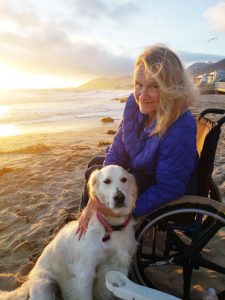
resident and Official Skywarn Spotter for the
National Weather Service Reach her at suelkilpatrick@gmail.com.

Weather in the Foothills <<< Sue Kilpatrick added by CV Weekly on
View all posts by CV Weekly →