





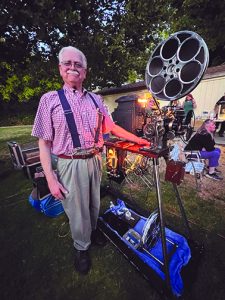
File photo
By Mary O’KEEFE
It’s a step back in time on Saturday at Two Strike Park in La Crescenta for Silent Movies night.
This annual event began in 2014 and since then has been a popular community event.
Silent Movies is sponsored by the Historical Society of Crescenta Valley (HSCV), the Los Angeles County Board of Supervisors chair Kathryn Barger and LA County Parks and Recreation.
Movies that will be shown on Saturday are “The Tantalizing Fly” starring Koko the Clown and produced in 1919, Charlie Chaplin’s “Payday,” produced in 1922, Buster Keaton in “Cops,” produced in 1922, Barney Oldfield in “Barney Oldfield’s Race for a Life,” made in 1913, Larry Semon in “School Days,” produced in 1920 and Laurel and Hardy in “Two Tars” produced in 1928.
The idea for having Silent Movies in Two Strike Park began with a discussion with members of the HSCV.
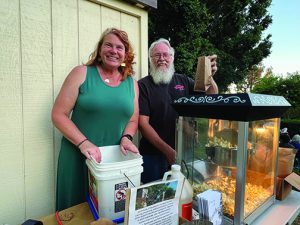
“When I was on the board of the HSCV Mike [Lawler] and I were talking about how to be able to show off our own Joe Rinaudo, his gorgeous machine and the work he does preserving these films,” said Joanna Linckhorst, “not to mention [Joe’s] knowledge. We finally decided on holding it in the park. Gary, Joe’s cohort, had a popcorn machine so I decided the Friends of Rockhaven should hold a bake sale to add to the experience.”
Silent film projectionist and historian Rinaudo restores copies of old silent films and plays them for interested groups. He does this in order to share the art form and help ensure the films are not forgotten and lost to history. He projects these films on a 100-year-old, hand-cranked projector.
The history of silent film can be traced to the Lumiére Brothers who debuted a collection of 10 short films on Dec. 28, 1895 in Paris. Despite the invention of the medium years prior, it was never put to use in such a way as did the Lumière Brothers. Their films set the world on fire and, within two years, production companies had opened shop around the world; in fact, the first movie studio was built for the burgeoning industry. These films had no recorded audio tracks until late 1927 when Warner Bros. released “The Jazz Singer” – the first film to utilize a synchronized audio track of dialogue and music. The industry changed and, with rare exception, the era ofsilent films was largely put aside by audiences. Some films, like many of the comedies of Buster Keaton and Charlie Chaplin and the occasional dramatic piece by Lon Chaney (“Phantom of the Opera,” “He Who Gets Slapped”) were preserved as cinematic treasures. But the majority of the film-going public is unaware today of the many hundreds of silent films that were produced during that era. America in the 1920s was producing its highest-ever output of films – roughly 800 films annually on average – yet most of those titles won’t ring bells for anyone but film scholars and enthusiasts.
In the early 1900s through the 1930s, silent film projectionists, called itinerants, traveled across the country carrying reels of film and projectors in convoy, bringing the cinematic experience to small towns and villages that didn’t have movie theaters. The itinerants brought their own dramatic flair, wearing colorful magician-inspired clothing. Since motorized projectors were expensive and heavy, the itinerants preferred hand-cranked projectors.
“The itinerant projectionist thought that he was a big part of the performance as he could speed up or slow down the action on the screen as he saw fit,” Rinaudo said in an earlier interview with CVW.
Silent Movies in Two Strike Park is on Saturday, July 26 beginning at 8 p.m.; it is advised that folks bring their own chairs, or blanket, to the park earlier to secure a good spot for viewing. Picnic dinners can also be brought and enjoyed at the park. There will be free popcorn, too.
Two Strike Park is located at 5107 Rosemont Ave. in La Crescenta.

Silent Movies Come to the Crescenta Valley added by CV Weekly on
View all posts by CV Weekly →