





Image provided by Mary O’KEEFE
By Mary O’KEEFE
It has been six months since the January extreme wind-driven Eaton and Palisades fires ripped through communities. Gov. Gavin Newsom held a press conference this week with other officials to speak on the response thus far to the fires and what the future response might be.
On Jan. 2 the National Weather Service (NWS) began warning about strong Santa Ana winds and extreme fire conditions. Alerts escalated from a Fire Weather Watch to a Red Flag Warning for Los Angeles and Ventura counties. This was “based on conditions highly conducive for wildfire growth with forecasts of a ‘life threatening, destructive’ windstorm” by Monday, Jan. 6, according to National Oceanic and Atmospheric Administration (NOAA).
That warning was upgraded to a “particularly dangerous situation” later that day.
The Palisades Fire was the first to be reported on the morning of Jan. 7. The fire spread very quickly due to the dry vegetation and strong winds. By noon LA issued evacuation orders and Gov. Newsom declared a state of emergency. The Eaton Fire began about 6:18 p.m. and expanded to 200-plus acres within an hour. By the evening of Jan. 7 the Palisades Fire had covered about 3,000 acres. Around 10:30 p.m. that night the Hurst Fire began in Sylmar.
The NWS reported 99-mile-per-hour gusts near Altadena.
Other fires, including Lidia (in Acton), Kenneth (in the Upper Las Virgenes Canyon Open Space Preserve) and Sunset (in the Hollywood Hills), ignited throughout the week. The wind warnings continued; however, the largest fires were Palisades that covered 23,713 acres and Eaton that burned 14,021 acres.
On Jan. 15, due to all of the fires in LA County about 88,000 people were under evacuation orders.
The Eaton Fire was contained on Jan. 31; reportedly 1,073 structures were damaged, 9,418 structures were destroyed, nine firefighters were injured and 17 civilians died. The Palisades Fire was contained on Jan. 31; reportedly 12,317 structures were threatened, 973 structures were damaged, 6,833 structures were destroyed, one firefighter was injured and 12 people lost their lives, according to CAL FIRE (California Dept. of Forestry and Fire Protection).
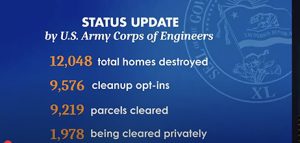
Recovery efforts began immediately; in fact, recovery planning began before the fires were contained. The U.S. Army Corps of Engineers was brought in to provide free debris removal. At this week’s press conference, Gov. Newsom shared an update by the U.S. Army Corps of Engineers: 12,048 total homes destroyed. Of those, 9,576 homeowners opted for cleanup by the U.S. Army Corps of Engineers, 9,219 parcels were cleared and 1,978 parcels are being cleared privately. Debris removal is 96% completed, according to the U.S. Army Corps of Engineers. About 2,000 homes a month had debris removed.
Gov. Newsom highlighted the cooperative work between local governance, emergency responders, state officials and federal offices. He spoke of this being the fastest recovery in terms of debris removal in “modern history.”
Hazardous debris was removed within 30 days after the Eaton Fire began. The second phase of debris removal began on Feb. 11. Newsom praised the Federal Emergency Management Administration (FEMA) and the regional administrator Robert [Bob] Fenton. He also praised Supervisor Kathryn Barger, chair of the LA County Board of Supervisors. He introduced Barger as a “great partner.”
“You want to go fast, you go alone. You want to go far, you go together,” he said. “In that spirit, we have a champion of partnership who’s just been extraordinary, without exception throughout the last many months, and we count on her going forward.”
“Today’s six-month anniversary is an opportunity to reflect and to really look ahead,” Barger said.
Most of the Eaton Fire area is within the fifth district – Barger’s constituents’ area – although as chair of the board of supervisors she covers all of LA County.
Barger thanked the governor and his office, as well as other entities that worked together. Since the fires, Barger and Supervisor Lindsey Horvath, whose area covers the Pacific Palisades, have worked to streamline the cleanup and rebuilding process.
Barger thanked the federal partners, the Environmental Protection Agency and, again, the U.S. Army Corps of Engineers for their swift and effective work to clear more than 10,000 properties.
“Rebuilding our communities is not and will not be the sole burden on our survivors,” she said.
LA County has worked closely with LA City on a number of programs concerning the Eaton and Palisades fires.
“As chair of the [LA County Supervisors’] board, my responsibility is to the entire County – but I want to make it clear, my heart belongs to the communities of Altadena and Pasadena [part of the Fifth District Barger serves]. I’m focused on supporting Altadena’s recovery with urgency, compassion and coordination,” she said.
She then introduced the next step in the process called “LA County Forward Blueprint for Rebuilding.” This plan breaks down into six core pillars; the first is making rebuilding financially possible. With this in mind the board of supervisors has approved the deferment of permit fees for homeowners rebuilding in unincorporated areas.
The second pillar concerns accelerating permitting and inspections.
“We’ve launched a faster permit review, self-certification for licensed professionals and deployed a public dashboard for transparency,” she said.
On July 15 a new AI-powered software will be launched, and additional staff is being added to keep pace with the demands.
The third pillar is expanding access to builders and materials. The county and the state are working together to set up a pool of builders and promoting pre-approved designs. They are also working to stabilize supply chains so that “no one is left waiting for a contractor or for their materials,” Barger added.
The fourth pillar is to invest in infrastructure.
“Again, in coordination with the state and utilities we’re going to [be] under-grounding over 150 miles of power and telecommunications lines. This is significant in the Altadena area. This is a generational investment in safety, reliability and resilience,” she said.
The rebuilding of other critical utilities, like Altadena’s water systems, will be explored.
The fifth pillar is to mobilize the workforce; once again working with state programs to make sure all workers are trained and have the logistics support they need.
The sixth and final pillar is to bring back community services.
“We’re working to restore schools, parks, businesses, services for seniors and child care,” Barger said, “everything that make a neighborhood whole.”
It was acknowledged that those recovering from the Eaton Fire still have a long way to go and have issues that need to be resolved. Barger’s office has been responding to concerns from individuals and businesses that are still struggling.
To find the Blueprint to Recovery go to https://recovery.lacounty.gov.
The LA County Public Works hotline is (844) 347-3332 and to reach the U.S. Army Corps of Engineers call (213) 308-8305.

Six Month Anniversary of the Eaton Fire – and What the Future Holds added by CV Weekly on
View all posts by CV Weekly →