





Updated Jan. 28
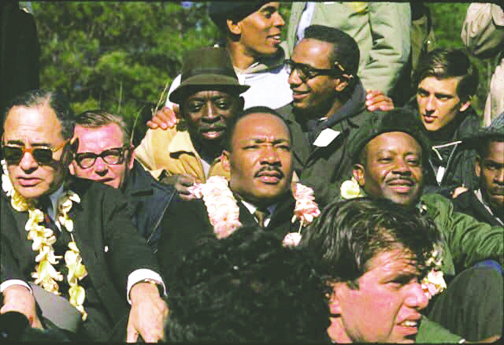
Photo taken by Al LOEB
Alfred Loeb was among those who marched with Martin Luther King Jr. in the Selma to Montgomery March.
By Mary O’KEEFE
Martin Luther King Jr. Day was declared a federal holiday in 1986. On Jan. 15 he would have been 92. He used his platform, as a minister, as a leader and as a powerful orator, to bring attention to discrimination and promoted nonviolence.
King was an admirer of the nonviolent teachings of Mohandas K. Gandhi.
“While intellectually committed to nonviolence, King did not experience the power of nonviolent direct action first-hand until the start of the Montgomery bus boycott in 1955. During the boycott, King personally enacted Gandhian principles. With guidance from black pacifist Bayard Rustin and Glenn Smiley of the Fellowship of Reconciliation, King eventually decided not to use armed bodyguards despite threats on his life, and reacted to violent experiences, such as the bombing of his home, with compassion. Through the practical experience of leading nonviolent protest, King came to understand how nonviolence could become a way of life, applicable to all situations. King called the principle of nonviolent resistance the ‘guiding light of our movement. Christ furnished the spirit and motivation while Gandhi furnished the method,’” according to the Martin Luther King Jr. Institute at Stanford University.
Often, however, his marches were anything but nonviolent. Many times those who marched were beaten, threatened and arrested and some even lost their lives.
Alfred M. Loeb, the father of local resident Judith Loeb Whitaker, had a front row seat to history as he marched in Alabama with Dr. King in the Selma to Montgomery March in 1965. The march was an effort to register Black voters in the South. The marchers were confronted with deadly violence from local authorities and White vigilante groups. The National Guard had to be called out to protect the marchers. The march took five days and covered 54 miles.
Judith Loeb Whitaker spoke about her father’s sense of fairness for all. Alfred was of Jewish descent and his family knew persecution due to religion and race.
“My dad always had a passion for civil rights,” Whitaker said.
“My family is Ashkenazi Jewish, and [her father’s mother] came to this country at 8 years old. She had lost both parents to a terrible illness, but the family was fleeing the pogroms at the turn of the [20th] Century,” Whitaker said.
Her grandparents were in America when WWII began but what was happening to the Jews in Germany was “very real” to them, she said.
Loeb had dropped out of school at 17 years old to join the fight against the Nazis during World War II. His father also joined the military during WWII.
Her dad later earned his GED and his Ph.D. in engineering. Her mother received her Ph.D. in biochemistry.
Whitaker’s childhood home in the mid-1960s was in one of the first neighborhoods in Philadelphia that was part of a special project to integrate suburban housing.
“There was no integrated housing in Philadelphia,” she added.
At one point her father tried to help a Black family purchase a home.
“Our family got death threats,” she said of the effort.
He was 38 when he decided to travel to Selma. Whitaker was just 4 years old, her sister was 6 and it was a few months before the family adopted her brother. It was before her baby brother was born. Loeb left to march because of his conviction for civil rights.
“We were all living in Pennsylvania,” Whitaker’s mother wrote of her memories of that time. “The Black residents of Selma [who] had been trying to register to vote had been turned back by the White authorities in Selma.”
She spoke of the violence, including the use of high-powered water hoses, that had been used against the Blacks who were attempting to register.
“This went on for months,” she wrote.
Residents organized a “peaceful protest” that included adults and children. This was met with extreme violence from law enforcement. However the news, especially the photos, captured the nation’s attention.
“The Black [organizers] appealed to the U.S. government to allow them to march peacefully from Selma to Montgomery,” she wrote.
The permit was granted and people from all racial backgrounds joined the march in Selma.
“Al flew down from Philadelphia,” his wife wrote.
She said there were famous people there but mostly ordinary citizens, like her husband.
Loeb joined the march in Selma, marching all the way to Montgomery. He was an engineer but his passion was photography and he took photos that captured the historic march.
Because it was over 50 miles long, the marchers would rest in tents pitched in fields along the way.
She added the Black people the marchers encountered along the way were very friendly and helpful, while the White people were “mostly unfriendly” and unhappy the marchers were there.
“Each night [Al] would manage to find a phone so he could call home and talk to [his family],” she wrote. “One night Al was able to use a phone in a farm family’s house. The family was so touched by Al’s conversation with his children they invited him for dinner. It was a very good dinner with some very nice people.”
Whitaker’s mother described the weather as being “chilly” and that the march was well organized and no one complained.
When Loeb returned home his feet were “a mess” and swollen. But he thought taking part in the march was well worth it.
Throughout the years he continued his support of equality including serving on the board of the local chapter of the ACLU. His support of others and for civil rights activism was handed down to his children, who have carried on his legacy with pride; however, it is the photos of the Selma March that have forever held that moment in time.

Memories of the Selma March added by CV Weekly on
View all posts by CV Weekly →