





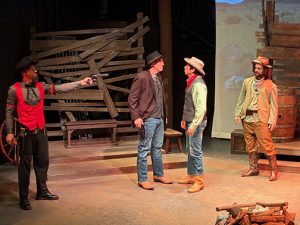
Photo by Steve MOYER
By Mikaela STONE
Audience members attending Casa 0101 Theater’s play “Eléctrico,” written by Josefina López, come face-to-face with a dark chapter of American history that early historians downplayed or even justified. Upon entering the theater’s Gloria Molina Auditorium, the first sight is a Día De Los Muertos Ofrenda – a shrine to the dead, mixing indigenous Latine and Hispanic Catholic traditions. Upon it, nestled among the marigolds and sweet bread, is the book The Forgotten Dead: Mob Violence against Mexicans in the United States, 1848 to 1928 by William D. Carrigan and Clive Webb. “Eléctrico” is a fictionalized exploration of one of the atrocities chronicled in The Forgotten Dead: La Matanza (The Slaughter) or Hora de Sangre (Hour of Blood), which was a period of violence from 1910 to 1920 against Mexican-Americans on the Texas-Mexican border.
“Eléctrico” explores the politics of belonging through an indigenous Mexican and Mexican-American lens via its lead characters Raymond Brown, a white passing Mexican electrician and widower from the East Coast, and Adela Borrego, the newly minted widow of Justino Borrego. Justino defended the existing deed to his family’s ancestral land only to be branded a thief and hanged from a telephone pole by a town sheriff-led mob. Both the basis for themes of changed identity and the fuse for these lynchings is the result of the Mexican-American War.
As described on the National Parks Service website, in 1846 America sent troops to occupy and blockade contested borderland and sea on its southern border. Mexico saw both this and the annexation of the then-independent state of Texas as an attack and opened fire on American forces. President Polk declared war in retaliation – a decision contested by then-Congressman Abraham Lincoln, who correctly suspected Polk’s actions would ultimately lead to Civil War in America. The 1848 Treaty of Guadalupe Hidalgo ended the Mexican-American War on the grounds that Mexico ceded over half its territory, including all of present-day California, New Mexico, Nevada, Utah and parts of Arizona, Colorado, Wyoming, Kansas and Oklahoma and additional pieces of Texas – resulting in financial and political upheaval felt in Mexico. While the treaty promised the Mexicans who suddenly lived in America that their land rights would be honored and they would be granted American citizenship, in practice Mexican-Americans faced both segregation and opportunistic murders by white settlers hoping to claim their uncontested ranches. Texas Rangers arrested and executed Mexicans without due process in raids such as the 1918 Porvenir Massacre, where Rangers took all the men and boys into custody and shot them point blank. Arlinda Valencia, descendent of a Porvenir Massacre survivor, reported to the New York Times her grandfather only survived because he was away buying supplies. The Rangers involved claimed the victims were bandits and they faced no legal persecution. The Refusing to Forget Project estimates that between 1910 and 1920, a tenth of the Mexican population would die and a tenth would return to Mexico. Of the 547 documented lynchings, 232 occurred in Texas and 143 in California.
While the electrician Raymond Brown is the titular character of “Eléctrico,” the driving force of the play is the widow Adela Borrego. Brown’s spirit has been crushed by the loss of his wife; his passive suicidal ideation leads him to take potentially deadly risks such as removing the lynched body of Adela’s husband from the telephone pole, left as a warning to other Mexicans. By contrast, Adela wishes she had defied her husband to prevent him from taking the risk that resulted in his murder. After his death, she embraces her fury and champions her vaquero heritage – the name of Mexican cowboys who preceded and inspired the better known Buffalo Bills and Annie Oakleys of the West. When Brown’s mixed race identity is discovered, she fights to rescue him from her husband’s fate – even against Brown’s wishes.
In playing Adela, actress Corina Calderon steals the show. As the leading lady in 2011 Sundance film “All She Can,” she was named “Breakout Actress of the Year.” As Adela, Calderon’s emotional performance is the axis the show hinges upon as she goes from being paralyzed by her loss to being empowered by it. Her impassioned performance made it hard to take ones’ eyes off her. Playwright and Casa 0101 founder Josefina López recognized Calderon’s “pathos” as something that cannot be taught: “She has fire that is very hard to fake when you’re a 20-year-old. Nobody can fake being on the streets or being in the hood. It’s easier to teach someone who is in the hood or has street smarts to act … than to teach someone who is a great actor and teach them … this rawness.”
Josefina López drew from the emotion of her own background to write “Eléctrico,” which she calls “a corrido told theatrically.” López spent 13 years as an undocumented immigrant before becoming a U.S. citizen and struggled for years with feeling neither Mexican enough nor American enough, which is reflected in the identity struggles the characters face. As a writer, she is best known for her play and movie “Real Women Have Curves” (she was a consultant on the musical), which she first wrote at the age of 18 in a bathroom stall in the sewing factory she worked in, drawing inspiration from her own life.
“All characters are based on a playwright,” López said. In Adela, she grappled with losses of her own, including a divorce, heartbreak and wanting to save a loved one who struggled with an alcohol addiction. “Writing catches you off guard. You think you’re telling a story about something that happened in history but you realize it is also me trying to process this heartbreak and pain.”
López writes to recognize that while Latinos are the majority in California, “We’re always made to feel like we’re invisible, whether that be [a lack of representation] in Hollywood or making us disappear in real life.”
López emphasizes unity in the midst of uncertainty.
“Right now I am a U.S. citizen and I have a U.S. passport … but now [the government is] taking away peoples’ citizenship. Belonging isn’t about papers, it isn’t about where you are living, it is about you and realizing you are a creation of God … and loving yourself.”
Her message is, “We’re here and we’ve always been here … this is how I affirm our place in history and herstory.”
She sees it as her job to uplift the stories of fellow Latinos: “I thought when I was young there were not enough Latino writers, but the truth is studios don’t invest in Latino stories.”
She recognizes that, as a light-skinned Latina, she has privileges and blind spots others do not and continues to strive to support Chicano literature to fight racist narratives. She sees Mexicans as “always portrayed as people who take instead of people who give.”
Casa 0101 highlights this principle with an exhibition called “My Experience y La Tuya” by painter Arthur Carillo. Carillo’s Milpa, or “cornfield,” that showcases the many contributions of the Mesoamerican people to food worldwide, including corn, chocolate and avocados among many other items. His other works display day-to-day life in Mexican American LA, recognizing how cultures in communities are interconnected – including the community of the viewers, whatever their background may be.
Josefina López’s new movie, “20 Pounds To Happiness” is a feminist romance comedy for lovers of “Real Women Have Curves” that highlights the experience of fat women in the age of Ozempic Chic. It can be seen at the LA Skins Fest on Nov. 21.
“Eléctrico” will run at Casa 0101 Theater, 2102 1st St. in Los Angeles, through Nov 2.

Dark Chapter of American History Explored in ‘Eléctrico’ at Casa 0101 added by CV Weekly on
View all posts by CV Weekly →