





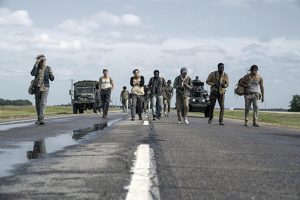
Photo Credit: Murray Close/Lionsgate
By Jackson TOYON
It seems it’s time again for a new film adaptation of an immortal work of author Stephen King. This time Hollywood has set its sights on one of the very first pieces he wrote.
While “The Long Walk” was not the first novel published by King – that honor goes to 1974’s “Carrie” – he originally began writing it in 1966, eventually becoming his first completed novel. Commonly regarded by readers as an allegory for the Vietnam War (and more specifically the draft), it’s a bleak but gripping tale with an atmosphere that starts casually but slowly becomes more oppressive and filled with dread. Having read the novel myself, I was interested to see if this silver screen rendition would elicit the same feelings and carry a similar tone as the book.
Set in an alternate, dystopian version of a 1970s-era United States ruled by an authoritarian regime, the story centers on the titular Long Walk. It’s a grueling annual bread-and-circuses competition of endurance where 50 teenage boys who volunteered for the opportunity must walk continuously, with no finish line, until only one walker remains. Participants must maintain a constant pace of three miles per hour, earning a warning if they fall below that threshold. Each walker has a total of three warnings and if someone drops their speed below that limit beyond the three times they are eliminated – unceremoniously shot dead by accompanying soldiers.
The reward for such a challenge? The lone winner will be made fabulously rich and be given a wish that the government must grant them, earning them the chance to also have something that money cannot buy.
Overseen by the strange and unreadable Major (Mark Hamill), we follow our stocky protagonist Raymond Garraty (Cooper Hoffman) as he bonds with other competitors like Peter McVries (David Jonsson) and navigates the road ahead.
And that road, while brutal, is balanced out by a wonderful camaraderie between the boys. While a few walkers like Billy Stebbins (Garrett Wareing) keep their eye on the prize and focus on winning at all costs, many of the boys participating in this year’s event, like Hank Olson (Ben Wang), talk among each other and even attempt to make friends despite their circumstances. Jonsson and Hoffman provide a pair of strong performances at the film’s center with Jonsson in particular holding much of my praise. The film does compress things compared to the novel, combining certain characters into one for a tighter experience than what the book offers – but some of the major changes were, to my surprise, interesting and appreciated. The ending is significantly different, though just as compelling and potentially ambiguous.
The largest missing element that may disappoint a book reader will likely be the lack of crowds cheering the walkers along the route. What might seem an arbitrary detail to someone who’s viewing this story for the first time is actually a fairly major part of the original novel. In the book, in just about every town the walkers pass through, people gather along the roads to cheer their favorites and witness the spectacle. Crowds that begin as encouraging fans slowly morph into a desensitized and uncaring entity that almost taunt the contestants as their numbers dwindle. The film elects to save a large crowd for the end and keep the boys mostly isolated along their journey through a desolate countryside with an occasional eerie and silent observer.
Even with these changes, however, the film greatly succeeds at bringing King’s harrowing and sometimes heartbreaking story to life. The kinship between the boys makes it difficult to say goodbye to each character who goes down and it’s sobering to watch the once proud and confident teenagers from the starting line turn into scared children who now want only to go home. Readers of the novel may be a bit bothered by some of the changed details in this adaptation but director Francis Lawrence has created an experience that is certainly worth the price of admission.

Trimmed But True: ‘The Long Walk’ Makes Bold Changes But Stays True to King’s Deadly March added by CV Weekly on
View all posts by CV Weekly →