





Photo by Jon von GUNTEN
By Eliza PARTIKA
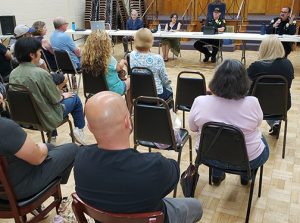
The Sunland-Tujunga Neighborhood Council’s (STNC) Safe Traffic & Safety Committee recently held a town hall at the Sunland-Tujunga Elks Club on Commerce Avenue that focused on traffic safety.
Several City of Los Angeles officials were invited to provide information about traffic safety and answer questions from the community. Among the officials present were Steve Rostam, LA DOT East Valley District; LAPD Traffic Officer Salvador Venegas; LAFD Captain John Ignatczyk, Battalion 12; and Ricardo Flores senior area representative for LA City Councilwoman Monica Rodriguez District 7.
Approximately 30 people attended the meeting, raising concerns about night-time visibility, fireworks, e-bikes, speeding and traffic stops in the Sunland area.
Pat Kramer, chair of the STNC Safe Traffic & Transportation Committee, said the purpose of the meeting was to educate the community about traffic safety.
“We are constantly trying to reach people through social media including Nextdoor, [distributing] flyers and [holding] meetings like this,” she said.
Traffic and speeding on Foothill Boulevard and on Tujunga Canyon Road remained a primary concern for community members, especially speeding cars and e-bikes that impede traffic.
“For vehicles, there is a minimum safety standard, but regulations haven’t caught up to e-bikes,” Venegas said.
Rostam outlined measures LADOT is using to curb speeding including adding speed humps on smaller arterials and speed cameras on Foothill Boulevard.
“Narrow lanes give drivers the impression they can’t really go too fast because [they’re small traffic lanes],” Rostam said. “Tree overhangs make the street feel smaller, so [drivers] don’t feel comfortable speeding.”
“We’d like to let the community know to just [drive slower], to slow down your speeds at night because it’s darker at night; there’s less traffic but also [a driver’s] visibility decreases and that’s where a lot of our issues come in,” said Flores.
Rostam and Venegas promised to return to the Council with updates on the exact locations of speed camera installations along Foothill. They also clarified confusion about newly installed flashing yellow traffic signals.
Venegas and Rostam said data from a joint LAPD–LADOT traffic signal repair initiative showed that replacing solid yellow signals with flashing yellow lights reduced speeds in busy areas such as Foothill Boulevard.
“[LADOT] decided which streets throughout the city need to change their phasings of the lights to flashing yellow. As drivers, we should know that any flashing yellow light means to slow down,” said Rostam.
Concerns about a lack of street racing enforcement on Tujunga Canyon Road, Mount Gleason Avenue, and the 101 and 118 freeways dominated a portion of the discussion. Venegas acknowledged concerns from several attendees, noting that funding cuts have impacted the specialized task force that once targeted street racing across LA County.
“We are reduced to one unit for the whole city,” Venegas said. “Throughout the summer, we will have one detail throughout the Valley.” Even so, officers monitor social media for information about upcoming street-racing events.
“They infiltrate Instagram accounts to see when and where the next meets are going to be,” he said.
When asked whether to call the non-emergency line or 9-1-1 to report a street racing incident, Venegas said calling 9-1-1 emergency services is the best option.
“Treat it like a DUI. Don’t wait until it becomes an emergency,” he said.
Ignatczyk asked not to call emergency services if street racing is merely heard as fire and police services need a specific location in order to respond.
Ignatczyk said that when a 9-1-1 call for racing or another emergency is submitted, 9-1-1 dispatch operators will be the first to respond and they will ask specific questions for the location and details of the emergency.
“The more details, the better,” said Ignatcyzk.
Many complaints about speeding and fireworks go unanswered because officers need a precise location and detailed information in order to respond, Venegas said. Online reporting portals help ensure those details reach enforcement staff. Venegas, the only officer assigned specifically to traffic enforcement from Glendale to Tujunga, said the system allows limited personnel to respond more effectively to community concerns.
Venegas said residents should report traffic violations and streetlight issues through MyLA311 on the city website (https://lacity.gov) and fireworks activity through LA Crime Stoppers. When submitting a report, he said, residents should include photos or video documenting the violation.

STNC Meeting Addresses Traffic, Safety Concerns added by CV Weekly on
View all posts by CV Weekly →