





Little High House on the America 250
The Sunland-Tujunga Bi-Centennial Trail, developed in 1976, is now the America 250 Trail … and you’re on it! Today, we arrive at location #10, the McGroarty House, located at 7570 McGroarty Terrace. Let’s begin once again with the words left to us from half a century ago about this historic house.
John Steven McGroarty and his wife Ida came to Tujunga in the early 1900s. Their first home was a small wooden-framed bungalow located on the side of the hill, just southwest of the present house. For his editorial work with the Los Angeles Times, McGroarty commuted downtown in Model T Fords, each nicknamed “Henry.” There was “Henry the First” and on through “Henry the Eighth,” after which, for some reason, he purchased an Essex.
The house you see today caught fire shortly after its completion in the ’20s and the whole town turned out to save the furnishings. Tragically, McGroarty’s fine library of rare manuscripts and books burned. Once rebuilt, Mr. and Mrs. McGroarty were friendly hosts and enjoyed meeting everyone who visited this house they called Rancho Chupa Rosa.
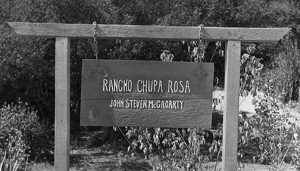
Much can be learned about the storied career of John S. McGroarty. He was a U.S. Congressman, a poet, a historian, a dramatist, a journalist and perhaps the most beloved Tujunga resident of all time. My focus today is not the man but the houses he built on his little Hummingbird Ranch in the Verdugo Hills. That’s right: houses – three to be exact, and you might even say three and a half.
Not many people are aware that John and Ida’s original house was a much smaller affair, perhaps 60 yards or so further up the hill behind the present house. They lovingly called this first cabin the Little High House.
In a matter of years, they began construction on their second, slightly larger house just down the hill in about the same location as the house you can see today. After moving into their second house, John McGroarty began using the Little High House as his office. It’s said that many of his early writings were penned there. According to Bolton Hall records, in December 1922, John and Ida’s second house caught fire and burned to the ground. They most likely retreated back to the Little High House as they began to rebuild in 1923.
Their third house would be quite large and built mostly of stone in the expanded footprint of their second house. After the beautiful new residence was complete, the McGroartys invited a great number of guests to join them for a housewarming party on Dec. 11, 1924 to show off their lovely new digs. Late that night, after all the guests were gone, an ember jumped from the fireplace and a new inferno arose. This was the fire referred to above by the originators of this trail. John and Ida were safe but much of their new house was destroyed. Some of the structure did survive, and it was rebuilt. This was number three and a half, and the house you can visit today.
The Little High House disappeared sometime along the way. I’ve been unable to find any mention of its demise. When Ida’s mother Mary arrived in Tujunga, the Little High House became the mother-in-law quarters for a time. I found an ad that McGroarty placed in January 1925: “FOR RENT – Our upper house, fully furnished. Apply at our residence. John S. McGroarty.”
Today, the big, beautiful house on the hill is house to the McGroarty Arts Center. Its mission is to provide access to the arts, community and history by offering arts instruction and a wide range of creative experiences and events. It’s a very special place in our community and well worth a visit. Information can be found at mcgroartyartscenter.org.

VIEW OF THE VERDUGOS <<< CRAIG DURST added by CV Weekly on
View all posts by CV Weekly →