
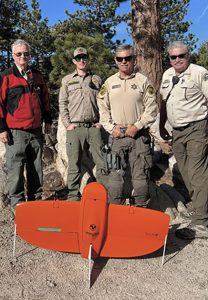
Photo courtesy of MSAR
Jan. 26, 1969 was the “End of Watch” for Reserve Sgt. Charles [Chuck] Rea.
By Mary O’KEEFE
“During an El Niño storm, Reserve Sergeant Charles Dudley Rea drowned in Big Tujunga Creek. Sergeant Rea served as a member of the Montrose Search And Rescue team working out of Crescenta Valley Sheriff’s Station. He and fellow team members were making their way toward 30 people stranded in the La Paloma Flats area above Montrose when the tragic accident occurred which claimed his life.
“Reserve Sergeant Rea, 35, worked for the Los Angeles County Assessor’s Office as an appraiser and was recently promoted to the rank of reserve sergeant before his death. He lived in La Crescenta with his wife Terri and their four daughters: Christine, Debbie, Lori and Kathleen,” according to Los Angeles County Sheriff’s Dept.
This was the one, and only, on-duty death of a Montrose Search And Rescue (MSAR) member. The story of Rea’s death is something team remembers share with new trainees.
There is an award that is given to MSAR members who show “exceptional service to the team and to their community.” The most recent award was given to Steve Goldsworthy, who has served as a MSAR volunteer for 14 years.
Presenting the award began one year after Rea’s death and in its 56 years has only been given to 28 recipients.
“It’s a huge honor,” Goldsworthy said. “It’s a remembrance of Chuck and the fact that he gave his life helping others.”
Goldsworthy added each member of the team understands the risk of what s/he does.
Sgt. John Gilbert, MSAR coordinator, said Rea’s is the only on-duty death in the entirety of the Los Angeles County Sheriff’s Dept.’s Search and Rescue teams.
“Thankfully the program has not had any other fatalities but in my time as coordinator over the years we’ve had injuries and incidents happen because it is an inherently dangerous job that [team members are] doing,” Gilbert said.
He said the risk is completely dependent on the type of incident being responded to.
“Some of the problems we inherently have with the Angeles National Forest and San Gabriel Mountains is that they’re extremely steep,” he said.
The mountains are often cited as the steepest terrain in the United States.
“But at the same time the [ground] is also crumbling. A lot of it is decomposing granite; the footholds are not great,” Gilbert added. “So you combine how steep the mountains are with the fact they are falling apart – literally underneath you – and it’s very challenging to get a good foothold or good handhold and really trust it.”
A lot of times these rescues take place in the middle of the night.
“That’s just the nature of the way life works,” he said. “You don’t always get your search and rescue missions on a nice, clear sunny day when its 72 degrees.”
Goldsworthy said the high risk can lead to complicated situations at times.
“I’ve been in and out of a helicopter 200 times,” he said.
Air rescues or over-the-side rescues can be taken for granted because they are done so often, which is why training is so important to the team.
The team trains … a lot. They train in every terrain and in every type of weather. Gilbert added that training, and the equipment used, has changed considerably since 1947 when the program was founded. The team continues to work with new technologies.
“The amount of equipment, technology and knowledge that the average rescuer has nowadays is significantly better,” he added.
One of those new tech tools the team is using is an Unmanned Aircraft System (UAS). It is being used to search for hiker Monica Reza, who went missing in late June 2025. Although the official search has ended, MSAR members have continued to search the area she was last seen in Angeles National Forest. Reza was last seen hiking in the Mt. Waterman area.
“The Civil Air Patrol has a new UAS, a new drone, that is capable of flying like an airplane that can cover a large area,” Goldsworthy said. He added MSAR and Civil Air Patrol will be using this new technology to search the area. The UAS will take “tens of thousands of photographs” and then run that data through a software program that will help the team identify any anomaly.
“We had success with [the drones] for an over-the-side car,” he said. The vehicle was found over the side of the road about 650 feet down. “The drone picked up abnormal colors,” he said adding that identification led rescuers to the vehicle.
In addition the drone can fly fairly close to the ground, about 200 feet above the ground.
After the software’s AI reviews the photos, MSAR team members will also look for any abnormalities.
There is also a chance that, regardless of where people are hiking, things can go wrong and people will need MSAR’s help; however, there are things that can make a dangerous situation safer for both the hiker and MSAR.
The first thing hikers should do is to make certain to tell someone where they are going, when they will return, what vehicle they are driving to the location, where they plan to park and what supplies they have with them.
The next thing is to make certain they have the Ten Essentials with them, which includes navigation equipment – including a compass, a GPS device and a map – a headlamp with extra batteries, sun protection, first aid, a knife, matches or lighter, shelter, extra food, extra water and extra clothes.
Goldsworthy said hikers can get all of these items into a small pack.
And then they should make sure not to hike alone. When hiking with others it’s important they stay together.
“In my seven years as a coordinator, the [number] of times I’ve seen a group [that stays] together and get hopelessly lost is zero,” Gilbert said. “When people stay together as a group they can work collectively and often make better decisions collectively.”
Being prepared for a hike can save lives. MSAR continues to train in ice, snow and swift water to be prepared for future rescues. Rea’s sacrifice is never far from their minds.
“We had our trainees and a few team members [go] to Chuck [Rea’s] gravesite [on Jan. 26] and we put some flowers on his grave,” Gilbert said. “We are [with the trainees] to impress upon them the importance of his sacrifice, that it wasn’t in vain and that we learn from the lessons [of his death] and that is why we hold ourselves to a [high] standard.”
MSAR is always looking for individuals who are interested in joining the team. It invites anyone interested to visit its website www.montrosesar.org or come to its monthly meeting, which occurs the first Wednesday of the month at the CV Sheriff’s Station, 4554 Briggs Ave. in La Crescenta at 7 p.m.
MSAR members are volunteers; most of the costs of their uniforms and equipment are paid by the volunteers themselves. To donate, visit their website at www.montrosesar.org.
For more information on Chuck Rea visit https://tinyurl.com/yf8kkz9h.
To learn more about the MSAR team, read historian Mike Lawler’s book “Thrilling Tales of the Montrose Search and Rescue.”

MSAR Remembers One of Their Own added by CV Weekly on
View all posts by CV Weekly →