





Photo by Julie BUTCHER
By Julie BUTCHER
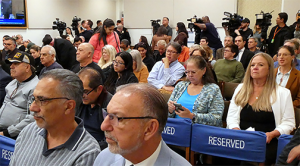
TV news vans lined up along Broadway in advance of Tuesday night’s meeting of the Glendale City Council expecting a decision on a five-year water rate hike proposed by Glendale Water and Power (GWP). Residents protesting the dramatic increases spoke to reporters and cameras outside of Glendale City Hall.
Once again, the council voted to delay a decision on the rate increases, this time until Tuesday, Dec. 1. The council opted to formally close the public hearing, which means that no more Prop. 218 protests will be accepted.
City staff announced that an unverified 9,605 protest petitions had been submitted, falling short of the number required: half plus one of the total properties, reported to be 44,757. Last week, the number of protests submitted was 4,351 of the 22,738 that would be needed to overturn the increases.
The city began developing an in-depth master water plan and commissioned a comprehensive cost of service rate analysis (COSA) in late 2024. On Sept. 26 of this year, the council authorized the required Prop. 218 notices needed to implement new rates for the next five years.
The first year increase slated for Jan. 1, 2027 would be 53%, on average, followed by increases of 11%, 10%, 10% and 7% on Jan. 1 the following four years.
Glendale residents once again lined up and dialed in to address the council.
“Last week’s display of malice – not just indifference, actual malice – you despise us. You look at us with disdain. You didn’t care that people were begging you not to pass this. And you pretend as if you had no choice and you knew better than we did,” council regular Beth Brooks spoke early in the meeting. “You’ve been lying to us. You’ve given us half-truths. After a triple-digit heat wave, to stick us with a 50% – 145% water rate increase for infrastructure you have neglected for decades … Previous councils? Guess where you were four years ago! You act like it was somebody else.
“SB 79 will potentially bring in 160,000 housing units. I called the planning department. Not all at once; they’re not coming tomorrow. But that’s the potential number: 160,000,” Brooks emphasized.
Dr. Carolyn Kaloostian told the council that she had raised the issue of water insecurity during the last council election and that other candidates scoffed and brushed it off as irrelevant.
“Today we face a proposed 53% first-year increase and water rates revenues with further increases that compound to nearly 120% over five years,” she said. “I raised this issue because I understood that increased density mandates put pressure on our water supply. Glendale imports approximately 65% of its water; the cost of imported water has gone up 34% since July 2022.
“Glendale is a mountain city and it needs to strengthen its own water security.”
Kaloostian advocated delaying action on the pending water rate increases pending a study of stormwater capture.
“Our mountains are an asset; our water is a resource and our responsibility is to ensure both serve the people of Glendale.”
GWP Assistant General Manager of Water Chisom Obegolu responded to questions asked by the public and from each council member and shared that staff had truly listened to public comments and worked to adjust the first-year increase from 53% to 45% by making a variety of moves.
“Beyond the numbers, we heard from our community, we heard real concerns about affordability and the financial burden that these rates will place on households. And at the same time, we do have a responsibility to ensure we continue to provide safe and reliable water service,” Obegolu shared.
“The work proposed to be done over the next five years is the bare minimum what was recommended by the Master Water Plan but will allow us to begin to address the critical infrastructure and improve the reliability of our water system,” he said.
GWP General Manager Scott Mellon added that the initial draft of the water plan called for $277 million in infrastructure spending over the five years. However, the first-year rate increase can be adjusted without needing to reduce the cost analysis or reissue Prop. 218 notices by moving back the phases of automated meter replacements and reducing the reserve requirement from 180 to 90 days of operating expenses.
The new total compounded rate increase would be 108% over the next five years.
“Marina” said she was attending the council meeting to “express my opposition to the proposed GWP water rate adjustment” and that she appreciates the change.
“It’s amazing what happens when people try – I understand that upgrading the municipal infrastructure is necessary but it’s really untenable for you to foist this on us,” she said. “Residents shouldn’t be mandated to shoulder the consequences and costs of expanding capacity, primarily to accommodate a massive influx of high density, multifamily dwellings.
“Upgrades required for new dense developments should be funded by the developers and those driving that growth,” she said. “As a resident and a school district employee, I am being priced out of this city.”
“Cynthia” was “born and raised” in Glendale.
“I’ve watched the city change tremendously,” she said. “I remember Glendale as a community of single-family homes where families planted roots, raised their children and hoped to grow old. Today we see more apartments, higher density developments and growth.”
Shane Lee “fully supports the rate hike.”
“We’re over-consuming water,” he said. “Keeping water rates artificially low acts as a subsidy for suburban lifestyles without which suburban houses would be less attractive as a living option and as an investment asset. Therefore, raising water rates would not only fund necessary infrastructure upgrades, it will encourage the habitation and construction of dense, water-efficient multifamily buildings.
“Wasting water is bad and suburbs are the primary culprit. Raising water rates discourages both water waste and wasteful suburban land us patterns,” Lee concluded.
He was assaulted in the lobby of city hall following his remarks and shared a video with the Crescenta Valley Weekly:
https://drive.google.com/file/d/1nuCCaZQrb3wYMZhC83yro_hl5zfKyoIX/view?usp=drivesdk.
Glendale police officers at the council meeting immediately took a crime report.
Dr. Jackie Gish served on the stakeholder water advisory group and was briefed on the status and the water supply and infrastructure.
“The upgrades are needed because the water system is very old,” she said. “Without doing it now, more will be needed. Glendale can’t afford to kick the can again on infrastructure upgrades as has been done by the council for decades.”
Gish calculated her Zone 3 bill will increase by $30 per month in winter and $60 per month in summer.
“While I would prefer lower costs for everyone – including me – I realize that Glendale water needs more money to start the infrastructure upgrades now. But please figure out how to help the residents who need the most help,” she implored.
“Mayor Ardy, you spoke recently, in eloquent Armenian, about the complicated relationship between pain, pleasure and time. You asked, ‘Shouldn’t we pay steep costs up front rather than spread the cost out over time and end up with a higher number in the long run?’”
Glendale researcher Allen “Dish” Dishigrikyan addressed the council.
“But with all due respect, Mr. Mayor, in the long run we are all dead,” he said.
He went on, following a laugh of the full room.
“Moreover, Forest Lawn is against this proposal,” he added. “The cemetery arguably speaks on [behalf] of all of us.
“More seriously, it is not the lack of transparency nor that we have to repair the infrastructure – of course we do – but that the costs are not being distributed equally among corporations and developers. The most disappointing part of last week’s meeting was that so [many] of you were given to the interests of Forest Lawn and to the Americana.
“When push came to shove, it was the corporate interests of Forest Lawn and the Americana that forced the city council to pause and revisit this plan and this should worry us all,” said Dish.
Randy Stevenson called in. His family has been in Glendale for 65 years and he noted that given the enormity of the water plan, calling for almost $1 billion, that an intensive, independent engineering and financial review should be required “to determine the minimum water rate necessary to maintain a safe, reliable water system, complete all necessary infrastructure improvements and maintain adequate reserves over the next 30 years.”
“I’m a bit shocked the way we’re handling this water rate issue,” another caller commented. “The conversation has become very emotional instead of factual information.
“People are quick to shout their opinions but when you ask them for basic facts, it’s a whole different story. Everyone can tell you what their total GWP bill is, but when you ask what their water portion actually costs, all I hear is crickets.
“My last utility bill was over $2,000. The water portion was $90. And that was covering two months.
“People keep repeating 45%, 50% or 145% like they’re talking points but actually looking at their own bill and doing the math and realizing that 50% is an extra $45 [over] two months.
“Facts matter. The GWP is not for profit.
“I hear my neighbors attacking the city council, forgetting that this is real. I went to school with Elen [Asatryan]. Ardy’s mom was my chemistry teacher. The people on this council aren’t career politicians from Sacramento or Washington, D.C. They are our neighbors, friends and family. They grew up here. They want what’s best for our community. Even when it hurts.
“Glendale isn’t a new city. Brand started building it back in the 1900s. This city has grown and thrived, and our water system is old. It needs upgrades and it belongs to all of us. We either pay to fix it now or we pay a whole lot more later,” concluded the 40-year Glendale resident.
Councilmember Asatryan expressed confidence in the GWP staff and reported that she had received a call from “CEO, from Corinne” (presumably Corinne Verdery, Caruso’s CEO) who offered the assistance of an expert “to see if there’s a different way to do this.”
Councilmember Asatryan agreed. “Let them go have a conversation,” she said.
Councilmember Alek Bartrosouf voted against the assistance from an expert consultant. “Everything about this doesn’t feel right,” he said.
The matter was postponed until the next meeting on Tuesday, Dec. 1.

Council Delays Decision on Water Rates – Again added by CV Weekly on
View all posts by CV Weekly →