





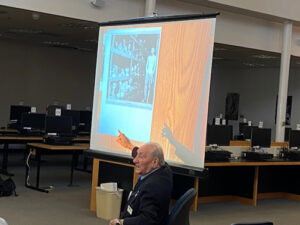
File photo
By Mary O’KEEFE
“For evil to flourish, it only requires good men to do nothing.” – Simon Wiesenthal
There is something about speaking to someone who was a witness to history.
Listening to the voices of those who were part of that history gives us an emotional background, a basis of humanity that is unavailable from the written word alone. This is never more true than with the survivors of the Holocaust. As the years pass and the voices fade there is still one – that of Joseph Alexander – that remains strong and determined not to let this part of the world’s history “go gentle into that good night.”
On Nov. 20 Alexander will turn 104 years old. Over the past several years CVW has had the privilege of interviewing Alexander on numerous occasions. The latest interview was on Tuesday and Alexander is still the voice that sounds for six million Jewish people, and other victims, of the atrocities that occurred during Adolf Hitler’s rein in WWII.
First, when CVW contacted Alexander he had to stop “mopping up” and cleaning his home. Despite slowing down over the past few years he has never turned down an opportunity to share his story because he knows how important it is to continue to tell the truth about what happened when the unimaginable became reality.
“I survived. I survived and six million people died,” he said when asked what he would like people to remember about his story.
Alexander survived 12 concentration camps, including Auschwitz-Birkenau and Dachau. Some people may have a movie idea of what concentration camps were like, where everyone is piled into rooms and left to die or taken away to gas chambers and other tortures, but the reality was that many in the camps were used as a free labor force. A prisoner of Hitler’s Third Reich could be used to build roads and perform hands-on labor without pay, not given enough food or clothing. Prisoners taken from concentration camps would be moved from camp to camp to work and if they died more would be used to replace them.
Alexander worked all the time. He built roads, he dug latrines, he performed hard labor for hours on end; however, when asked how he survived, Alexander said it was because of the help he received from citizens outside the camps – but mostly he survived because of his strong faith.
“I had hope, God was with me,” he said. “And I survived, I can tell people what happened.”
Alexander was born in 1922 in Kowal, Poland and grew up surrounded by a strong and supportive Jewish family. His life with his five siblings, parents and family was happy – until 1939 when Hitler’s forces invaded Poland. Very soon after the invasion his town became a different place. He saw Jews being taken away; they had been ordered to the town square. He and his family were not taken in this first gathering but the rumors were the Germans would come back for the rest of the Jews.
“My dad said, ‘We are not going to wait,’” Alexander recalled in an earlier interview. “My father had three sisters who lived 25 kilometers [away].”
His mother, father, one sister and one brother left the area, leaving Alexander and two other sisters at home. The plan was for them to follow the family shortly.
However, soon after the family was reunited, they were placed in their first work camp. Jews were allowed to return home on weekends.
“And off I went to the camp,” he said.
Part of his work included digging a canal that had Jewish workers standing in water up to their knees for hours without boots. These camps were called ghettos.
He was moved from camp to camp – seven in total – during those first few months. And then the train arrived.
“It wasn’t a passenger train, it was a cattle car [boxcar],” he said.
The boxcar was packed with Jewish people. They traveled for three days without food, water or bathroom facilities. And then they arrived at Auschwitz.
Alexander said when they arrived about 30% to 40% of the people had died who had been in the boxcar.
When he arrived in Auschwitz he met Josef Mengele. Alexander got off the train and lined up with others.
“Whoever could walk would line up in rows of five and we met Dr. Josef Mengele,” he said. “And Dr. Mengele said, ‘There’s six kilometers to walk to the camp’ and he was selecting people [who lined up, directing some] to the left and they would be taken on trucks. So he went through and picked out the sick people, old people, young kids … I was a little guy and I was a young kid and he told me to go to the left.”
But Alexander had already been in several camps by the time he arrived at Auschwitz and he was learning how to survive.
“Every camp I was in I had to work. I tried to get in with the biggest, strongest men. And here Dr. Mengele was telling me to go the left. I looked around and saw sick and old people and young kids [to the left] … that’s not the kind of people I should be with. It was after midnight [when I got off the train]. If it would have been daytime I don’t think I could have done this … I ran back to the other side. If I didn’t run back to the other side I wouldn’t be here talking to you today. The people who were on the [left side] were taken on the trucks and were taken straight to the gas chamber,” Alexander said.
Sharing his story is very important to him and he said he does have hope for the future due to recent protests and people not staying quiet about protecting their neighbors.
“[Joseph] told me last night that the difference between 1930s and today is that people speak up. They’re not afraid to speak up,” said Reeva Sherman, Alexander’s companion.
Alexander’s friends and family are planning on a multi-day birthday celebration, but when the festivities are done he will once again speak out and urge others to speak out, too.

Holocaust Survivor Celebrates 104th Birthday added by CV Weekly on
View all posts by CV Weekly →