





By Mary O’KEEFE
It wasn’t like we hadn’t been warned.
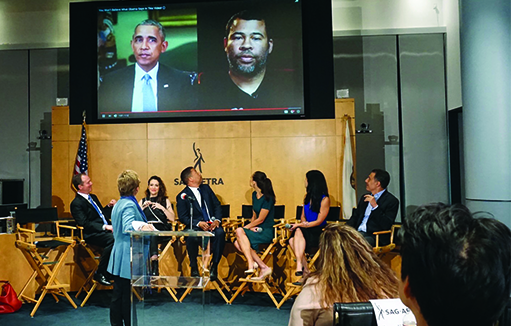
In 2019, CVW was at a panel discussion hosted by then-Congressman [now Senator] Adam Schiff.
“The T-1000 is the evil liquid metal robot from ‘The Terminator’ films that is so human-like that it is nearly indistinguishable from real people. Cylons are the human-like robots that invade the human factions in ‘Battlestar Galactica.’ Replicants are engineered non-humans poised to take control in ‘Bladerunner.’ The recurring theme in all the best science fiction properties is of technology being used to imitate humans so that humans can no longer trust what they see to be real. The first step is now being taken to achieve this in the real world. ‘Deepfake’ videos are starting to surface in which famous people appear to do or say anything the video’s creator wishes. These deepfake videos are real threats – not only to the person who is being faked but also to the world at large,” Charly Shelton wrote in the 2019 article.
That 2019 panel discussion was held at the Screen Actors Guild in LA and was frightening and amazing.
“When you talk to psychologists about this, they will tell you that even if you were later persuaded that the video you’ve watched was a forgery, you will never completely shed the lingering negative impression of the person,” said then Representative Adam Schiff. “So your brain will tell you, ‘I shouldn’t hold it against Joe Biden or Donald Trump or Bernie Sanders or Elizabeth Warren because that video I saw that went viral I now know to have been faked; but I cannot shake the feeling that that person is … fill in the blank.’ So part of the damage is done when you see or you hear it. This is really what has me so concerned about how this technology may be abused in the context of the political process.”
However that technology of 2019 looks ancient compared to what is happening now.
According to the Wesleyan Media Project, since 2010 $80 million has been spent on about 170 unique political ads using AI.
This election season voters need to be hyper-vigilant that what they are seeing is real and not generated by AI.
At this time, there is no federal law requiring the producers of these AI generated ads to label it as AI or fake. Sen. Schiff has a bill on the subject that was introduced in July titled the AI Ads Act.
“[The bill] will try to attack these false and fraudulent ads that basically use AI to portray the ads as coming from people in organizations they are not coming from or portraying people saying things they never said,” Schiff said. “I think [AI] is a big problem. It’s one thing when something is clearly a parody, like what I introduced doesn’t impact the ads that were used in the [Los Angeles] mayor’s race by Spencer Pratt or in favor of Spencer Pratt. Those are clearly AI produced. But where you have representations of people saying things they never said or the AI misrepresents who’s supporting the ad or in other ways defrauds people – [that’s a concern].”
When Spencer Pratt was running in the March 2026 Los Angeles mayoral primary his team produced ads that were obviously AI generated. AI characters included those of LA Mayor Karen Bass portrayed as Darth Vader and Gov. Gavin Newsom as the Emperor Palpatine from “Star Wars.” Pratt was, of course, a Jedi warrior. This ad was AI generated but it is pretty certain that it was an ad more of a parody than reality.
“My bill would basically bring the law into the current century,” Schiff added.
The concern is that with new technology it is easier to create an AI doppelgänger and have it say anything the producer wants.
Schiff said if the AI is giving the impression that the generated characters are actually saying things they are not, parody or not, that is still deceptive.
AI brings to the forefront a series of issues and as they grow the issues will also grow. How it will influence the political landscape has yet to be determined; however, it will not just be a Democratic or Republican issue.
The legislation introduced by Schiff is still facing an uphill battle in Congress.
“The [current] Administration’s position is full throated support [of AI],” he said.
It is not certain if any of Schiff’s Republican colleagues will cross the President when it comes to AI regulations. It will take a change in the majority in Congress to put up any guardrails regarding this fast-advancing technology. Schiff is hopeful that this change will happen.
“There is bipartisan support and most AI bills I’ve introduced have been bipartisan,” he said. “I have a kid safety bill with Republican John Curtis of Utah.”
This is the SAFE KIDS Act that has advanced out of the Senate Commerce Committee and is a bill to protect children and teenagers from the risks of AI chatbots.
“It is making sure that AI chatbots aren’t telling young people how to commit suicide or how to keep [things] from their parents,” Schiff said. “Parents should have control over their kids’ use of AI and their kids’ data that may be accessed by AI. For those kinds of things there is bipartisan support but the heavier lifting is going to require a Congress that’s really willing to do it and willing to confront industry on it.”
Next week CVW will continue its conversation with Senator Schiff on the subject of AI.

A Conversation About AI with Senator Adam Schiff added by CV Weekly on
View all posts by CV Weekly →