





hotos courtesy of St. Luke’s of the Mountains Episcopal Church
By Mary O’KEEFE
Each year St. Luke’s of the Mountains Episcopal Church hosts a gala, and this year is no different – though there is a small change. This year it is called the Love Your Neighbor Gala.
“It is the same annual gala, with a new name and a new purpose. Two years ago we celebrated our centennial; last year we gathered again. This year we are calling it the Love Your Neighbor Gala because the evening honors our immigrant neighbors and the heritage of our Latin American families. It is on Saturday, Sept.12 from 6 p.m. to 10 p.m. in our parish hall. [It will feature] Latin American food cooked by our own parishioners, a Latin jazz quartet over dinner and a salsa band afterward,” said Guy Leemhuis, vicar of St. Luke’s of the Mountains.
The gala is not just a one-time fundraiser but kicks off a $100,000 campaign that will run through the year.
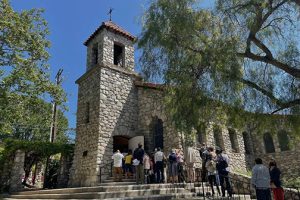
St. Luke’s of the Mountains was built in 1924 and requires a lot of maintenance each year. It is also home to the Fire House youth center, which was also built in 1924.
“Our building was [built] in 1923 and 1924 by neighbors who gathered river rock from these hillsides, by hand. It opened on Easter Day – April 20, 1924. It was built by the community before it was ever a place the community came to. That is worth remembering, because it explains what we think we are for,” Leemhuis said of the church’s community support.
According to Pew Research, a study showed that the number of Americans who identify as Christians has “leveled off” though this reflects many years of decline. St. Luke’s has seen this trend as well. Leemhuis contributes this change, along with fewer people joining and attending church, to a variety of issues including the fear for some to leave their homes due to immigration enforcement and the fact that younger people worship differently than past generations. They want more contemporary music, different themes, they ask different questions and “ask out loud.”
“Paul said he became all things to all people so that by all means he might reach some. That is the work. We meet them where they are and we are careful not to be so rigid in our traditional expression of worship that we turn away the very people we were sent to,” he added.
He also said some turn away from church because the “larger” church has been extremely judgmental and in many cases has traumatized the very marginalized community it claimed to serve.
“If we want them, we have to earn them back honestly. Jesus said you do not put new wine into old wineskins. We have to make new bottles for new wine – the same good news carried to a new generation in their own context,” he added.
Traditionally, the church has been a gathering place for the community, a place where a variety of organizations and clubs met and worked toward making their community a better place. St. Luke’s has been that center for over 100 years, from hosting Crescenta Valley Town Council elections to offering grief counseling after community tragedies.
“Something has been lost in American life; the ordinary places where people who are not alike end up in the same room – coffee shops, libraries, union halls, community centers – much of what replaced them [now] happens alone on a phone. A church that opens its doors becomes one of the last free rooms in town and we take that seriously. Indivisible meets here. Community concerts happen here. Our food distribution happens here. A quinceañera, a memorial, a teen center, a garden – none of that requires anyone to believe what we believe. It only requires us to unlock the door. That is also why this campaign matters.
“We are restoring a 1924 bell tower and finishing heating and air in the sanctuary — not because a building is holy but because a room nobody can sit in comfortably is a room that stops being used,” Leemhuis added.
The Episcopal church has changed over the years.
“The Episcopal Church was once called the church of presidents. In the last several decades it has ordained women, blessed and married same-sex couples, elected a Black Presiding Bishop and then a woman as bishop in this diocese, and now, here in Los Angeles, we have our first Latino bishop – the Rt. Rev. Dr. Antonio J. Gallardo Lucena, a Venezuelan immigrant, who happens to be St. Luke’s own former vicar. He will speak at our gala in both English and Spanish,” Leemhuis said. “Every one of those changes was contested at the time and every one of them came from the same conviction: that the table belongs to God rather than to us, and that we are not the ones authorized to decide who is turned away. What has not changed is the shape of the thing. The same prayers, more or less, for four hundred years. The same bread and wine. The same insistence that you can hold hard questions and deep faith in the same hand. Our Presiding Bishop, Sean Rowe, has said the church must now become an engine of resistance, putting the most vulnerable at the center of our common life. That sounds new. It is actually very old.”
There is an invitation to the community to join the Love Your Neighbor Gala, which will be held on Sept. 12 at St Luke’s of the Mountains Episcopal Church, 2563 Foothill Blvd. from 6 p.m. to 10 p.m. Tickets are $75 per person; tables of 10 are $750. There will be a Latin American dinner, live Latin jazz, a salsa band, dancing and a silent auction.
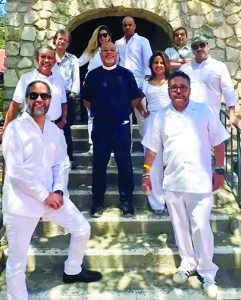
“This year’s Love Your Neighbor Awards go to the Rev. Canon Jaime Edwards-Acton and the Rev. Dr. Francisco García Jr., who have led our diocese’s Sacred Resistance ministry from its beginning – Know Your Rights training, rapid response, court accompaniment and sanctuary. We are also honoring two of our own parishioners – Sonia Gaitán and Donna Machado – whose faithfulness has held this parish together in a hard season,” Leemhuis said.
Although as an institution the role of a church in people’s lives has been diminished, the church is doing more than it has done in the past.
“People arrive at our doors at the hinges of their lives – a birth, a wedding, a death, a diagnosis, a job lost, a family separated. Those moments have not become less frequent. What has become scarcer is anywhere to take them,” he said. “A church offers what no app can: other people, in a room, who will still be there next week. Somebody notices you are missing. Somebody brings food. And for a good many of our neighbors right now, this church is also a place where they are not afraid – where nobody asks for papers and everyone gets a seat. If that is all we ever managed to be, it would be enough.”
For more information on St. Luke’s of the Mountains, visit https://www.sllc.church/ or call (818) 248-3639.

St. Luke’s Gala Kicks Off a Year of Much Needed Support added by CV Weekly on
View all posts by CV Weekly →