





Seeds, Exotic Breeds and a Melodious Flock
Cora Belle stepped into her backyard garden. Her little Cape Cod cottage had been built on Tujunga Canyon Boulevard shortly after her arrival in 1913. With a scoop and a pail, she started down a landscaped path as she had done so many times before. Arriving at the first feeder, she scooped some seed from her pail and filled it to the brim. On and on she went, filling the numerous bird feeders she had placed throughout her beautiful garden.
Cora Belle Linaberry had been drawn to the promise of the Little Landers Colony all the way from Jackson, Michigan along with her brother Frank and his daughter Mabel. Long before heading west, in 1876 she had attended the Albion College Conservatory of Music and was an accomplished musician. From the Colony’s early days through its transition to becoming Tujunga, Cora Belle was often seen playing music at community dances and festivals. She took prizes for her home-grown vegetables and flowers and otherwise was a valuable member of the community.
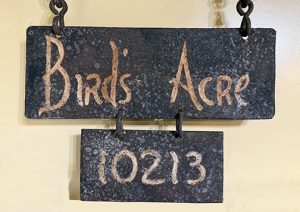
More than anything, Cora Belle loved the birds that came to visit her property. She was regularly seen filling her numerous feeders and tending to the large variety of plants she cultivated. Each month, she required a full 120 pounds of seed to keep the feeders full and the birds happy. In case there was ever any question as to whose property this was one could be directed to the posted sign, which read, “Bird’s Acre.”
Just across town on the south side of Foothill Boulevard, Ray Phillips had been hard at work for many years building his dream castle. In addition to his castellated stone tower, Ray had built staircases, fireplaces, grottos and fountains throughout his two-acre garden space on Redmont Avenue. All these amenities were the perfect backdrop for the interests in wild birds of his wife Mary. She established a wildlife sanctuary on site and by 1938 it had grown to include a large collection of wild birds in addition to terrapin tortoises, another of Mary’s interests.
The sanctuary was opened to the public and the couple named it “Hi-Yan-Ka Castle,” claiming it meant “welcome” in an unidentified Native American language. Over the years, it’s said the site drew more than 100,000 visitors to see Mary’s exotic birds. Sadly, Ray’s tower toppled in the 1971 Sylmar Earthquake, leaving only the round foundation walls behind today.
We come now to the primary birdbrain of the Crescenta Valley, the Birdman of Tujunga – Harvey Gatlin. Mr. Gatlin was well known for his expertise in breeding and raising rare and endangered species, particularly game birds and pigeons. He began raising chickens and Guinea hens when he was only 6 and by age 12 his birds were winning first prize in shows.
French ornithologist Dr. Jean Theodore Delacour, renowned for rearing some of the rarest birds in the world, once said that his friend Harvey Gatlin had an unsurpassed collection of exotic birds at his home on Zitto Lane in Tujunga. With over 100 bird species in outdoor aviaries, it was always his first stop, starting in the 1960s, whenever he visited Los Angeles.
Lastly, on a different note, a band prepared to close out their set on Aug. 24, 1990; the venue was the Nite Rock Club at 7179 Foothill Blvd. Mike Score, the New Wave band’s lead singer, started the keyboard riff to their ’80s synth-pop mega hit, “I Ran (So Far Away).” The Flock of Seagulls was one of many bands that performed at this foothills rock-and-roll club in the 1980s and ’90s. I was most impressed not by the bands but by a young woman who got her start at the Nite Rock who went on to become rock and roll royalty in her own right.
But that’s for next time in The Days When Tujunga Rocked.

VIEW OF THE VERDUGOS <<< CRAIG DURST added by CV Weekly on
View all posts by CV Weekly →