





By Mary O’KEEFE
The first case of West Nile virus infection was found in Los Angeles County early in July. This is the first case in the County for the 2026 season.
“The person is currently hospitalized after developing WNV encephalitis after symptom onset in late June. The individual lives in the Antelope Valley,” according to the Los Angeles County Dept. of Public Health (DPH).
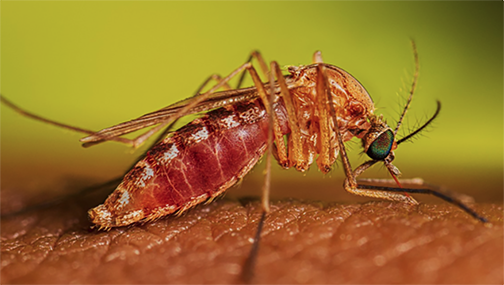
Recently, the Greater LA County Vector Control District (GLACVCD) confirmed the discovery in Montrose of a mosquito sample that tested positive for West Nile virus.
This WNV-positive sample was detected in mosquito traps in the local community on July 21. District staff will place notices in public spaces within a half-mile radius around trap locations to advise residents to take precautions when mosquitoes are present, according to a statement from GLACVD.
On the San Gabriel Vector (SGV) website there is a list of places that have been tested; Montrose is now on that list as are Burbank and Sunland, each with a listing of one positive, and Northridge, with a listing of four.
“When looking at our detection chart, the number refers to the sample that tested positive for WNV. Each sample is collected from a specific trap site and can contain any where [from] 20-50 mosquitoes. The sample is then made into a blend, and that is then tested for culex-transmitted diseases like WNV, St. Louis encephalitis, Western equine encephalitis, etc.,” stated Anais Medina Diaz, spokesperson for SGV.
Montrose and La Crescenta are considered unincorporated areas of Los Angeles County. Many times unincorporated areas get listed together.
“Unincorporated areas are included in our sampling, but La Crescenta/Montrose is specifically serviced by Greater Los Angeles County Vector Control District (glamosquito.org). The most north-western community within our district’s boundary is Altadena. However, our guidance and programs are very similar. When a detection is confirmed in an unincorporated community, we will add it to our webpage as it is designated,” Medina Diaz said.
Readers can follow cases in their area by visiting https://tinyurl.com/5yybpncd.
Most people (80%) who are infected with WNV are asymptomatic; however, the person who reportedly contracted the WNV infection in LA County was symptomatic and admitted into the hospital. The person was then diagnosed with West Nile virusNeuroinvasive Invasive Disease (WNV NID), according to Dr. Aiman Halai, medical epidemiologist, California Dept. of Health.
WNV NID is when the virus impacts the central nervous system. Only 1% of people are actually hospitalized with WNV NID. For those who do have a reaction to WNV they can develop a fever, headache, nausea and fatigue. Sometimes they also get a rash.
It is important for people to check with their medical doctor if they have any symptoms they feel could be caused by a mosquito bite.
Based on research DPH research, most people know that mosquitoes are attracted to water. It is important to check around areas to make sure there is no standing water.
“Other things you can do is wear long-sleeved shirts and pants to provide skin coverage. Mosquitos won’t be able get to the skin to bite. … Prevent mosquitoes from getting inside our homes. We can do that by making sure our windows and doors have screens and that the screens do not have any gaps or holes in them,” stated Halai in a previous CVW interview.
The Greater Los Angeles County Vector Control District advises:
Mosquito control is a shared responsibility, and residents can help reduce the threat of WNV in their neighborhoods by taking the following steps:
- Once a week, empty any items that hold water like buckets, planters, children’s toys, discarded tires, birdbaths, plant saucers or trash containers;
- Maintain swimming pools, spas, and ponds, and report neglected or green pools to vector control;
- Wear insect repellent when outdoors where mosquitoes may be present;
- Report dead birds to the California Dept. of Public Health online at https://westnile.ca.gov/ or call (877) WNV-BIRD.

West Nile Virus Found in Mosquitoes Tested in Montrose added by CV Weekly on
View all posts by CV Weekly →