





Forgotten Friendship of William and Moses
William took a moment to give his horses a few gentle strokes before hopping into the seat of his buckboard wagon. He’d spent a good part of the morning loading up crates of grapes, peaches and apricots for the long journey downtown. He’d grown this produce on his 80-acre ranch in Monte Vista (Sunland) and was headed to the bustling markets of Los Angeles to reap the benefits of his labor.
Down the road a piece in the distance he saw a familiar face. Standing near his barn, arms waving, was his friend and neighbor Moses. William pulled on the reins and brought his wagon to a stop in front of the crates Moses had stacked beside him. These were the fruits of his labor – literally – and the two men had developed a tradition of traveling together to deliver their goods to market.
The year was 1885. On their long dusty ride, I can imagine William sharing his tale of escaping Germany to avoid conscription into the army of Otto von Bismarck. Moses may have spoken of his prior life in New Hampshire and of his young son who had preceded him to Los Angeles. William probably chronicled his journey across the Isthmus of Panama and his trip up the coast to San Francisco. Moses may have expressed just how proud he was of his son Harry for recently landing a job at the Los Angeles Times.
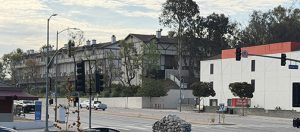
After delivering their goods to market and purchasing much-needed supplies, the two friends headed home. To gather where home was for William, imagine exiting the 210 Freeway today at Sunland Boulevard and turning left. Where Public Storage and the large apartment complexes on the hill are seen from the freeway to Newhome Avenue was the ranch of William Bernhard. For many years, this slope along the boulevard was covered with grape vines and fruit trees.
William had come to Monte Vista from Northern California in 1882. He was one of the earliest residents. For two years, he tended beehives and harvested honey until 1884, when he purchased the ranch land I referenced. He paid $1,000 for those 80 acres along Sunland Boulevard – $100 down and the rest on contract.
In 1890, local newspapers reported that Bernhard’s crop had reached 25 tons of fruit. Peaches, grapes, apricots, plums and berries made up the haul at his address: 10400 Sunland Blvd. He sold that crop for $750. The cost of production had been $70 for a profit of $680, the equivalent of approximately $25,000 in today’s money.
Back to Moses Knight Chandler, Williams’ friend and traveling partner. He was known for his relentless work ethic and entrepreneurial drive and he must have instilled those traits into his son. Harry Chandler was 21 in 1885 when he landed his job with the Los Angeles Times. Moses and his wife Emma watched their son become one of the most powerful newspaper titans and landowners in American history, becoming publisher of the Times in 1917.
William also watched Harry grow up, amazed by his accomplishments. But William had a very impressive relative as well. His nephew Theodore, who lived in Napa, California, came to visit his uncle for the first time in 1899. Although already a successful businessman, he arrived to assist his uncle William with the year’s harvest.
By the time of William Bernhard’s passing in March 1934 at the age of 97, he had acquired 200 acres of land in Sunland and, being a bachelor, his estate was divided among his heirs. Theodore Bernhard moved to Sunland after William’s death and in 1940 he built a beautiful, large home up on the hill next to his uncle’s orchard.
Theodore’s accomplishments were many and he became a very wealthy man. But that’s for next time in “When the Richest Man in California Called Sunland Home.”

VIEW OF THE VERDUGOS <<< CRAIG DURST added by CV Weekly on
View all posts by CV Weekly →