





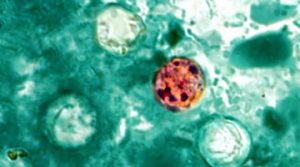
Photo courtesy of the CDC
By Mary O’KEEFE
There has been a lot of reporting regarding cyclosporiasis, an intestinal infection caused by the microscopic parasite Cyclospora cayetanensis.
Reports are warning about its symptoms and the number of people who have been found with cyclosporiasis. The Centers for Disease Control and Prevention [CDC] has confirmed over 1,600 cases of the infection; however, it is believed that number is much higher with more than 30 states reporting cases of the parasite – cyclospora.
The Los Angeles County Dept. of Public Health is monitoring a “domestically acquired multi-jurisdictional cyclosporiasis outbreak.”
“Although no cases linked to this outbreak have been identified in Los Angeles County at this time Public Health is providing information to help the public reduce their risk of illness and recognize symptoms if they become infected,” according to Public Health.
That finding is echoed by the California Dept. of Public Health.
“There are no known local outbreaks in the state, and no California cases are currently known to be linked to outbreaks affecting other states … To date in 2026, California has seen fewer cases of cyclosporiasis than in 2025. From January to June 2026, California has reported 41 provisional cases of cyclosporiasis, compared to 80 cases during the same period in 2025. Annual averages from 2015-2025 are 106 cases (range 15-240), and current counts for 2026 fall within expected ranges.”
So while cyclosporiasis is not new it has affected people – even in California – over the years but the recent reports are more about the outbreak with thousands being infected.
Neha Nanda, MD, hospital epidemiologist with Keck Medicine of USC and chief of Infectious Diseases, said she became aware of the outbreak a few weeks ago.
“We first heard about it from a group of people who were part of our conference in Michigan,” she said. She heard more about the cases throughout the Midwest.
Nanda explained that typically at the conferences she runs there will be attendees from the local area – not only local physicians – and those from other areas as well.
“[Cyclosporiasis] is a natural thing that happens,” she said.
The cyclosporiasis infection has been traced to a parasite that is on fruits and vegetables and although California is not part of the outbreak it could happen here because “[the parasite] could be anywhere.”
“It’s basically when you haven’t washed your produce – lettuce, greens, basil etcetera. If this parasite is on [the fruits and vegetables] and if they haven’t been washed that is how you would have acquired it,” Nanda said. “So we [recommend washing fruits and vegetables] thoroughly.”
This should be done especially if the produce does not have a peel. For example, bananas have a peel that protects the fruit but cabbage does not.
Nanda added that it is better to wash all produce.
“If you’re having berries, like blackberries or strawberries, you want to make sure you’re washing them … giving them a very nice shower,” she said.
Adding that is how people should think about the washing: to clean the produce under running water that will get rid of the parasite and its eggs.
The parasite and its eggs are microscopic so they will not be seen with the naked eye, only under a microscope. Although the incubation period varies, typically it takes anywhere from two days to two weeks for symptoms to present themselves after affected produce is eaten. Symptoms may include watery diarrhea, loss of appetite, weight loss, stomach cramps or bloating, nausea, fatigue and, in some, cases vomiting or a low grade fever, according to the LA County Dept. of Public Health.
Nanda said there are some who are more at risk for extreme symptoms, including anyone who is immunocompromised, who may take more time to recover.
“If you take [an antibiotic] you can abbreviate the [illness]. You can take the [medication] for a week and then you’re able to take care of the symptoms sooner but in some people where their immune system is not as good, it can linger for longer,” she said.
There are parasites all around, and especially on the food eaten, which makes washing produce so important.
“There are bugs everywhere and when we are able to associate a disease with a bug and we give it a name that’s when it becomes popular and famous,” she said.
She added giving the parasite illness a name shows the medical profession is aware of it and is treating the symptoms.
Anyone who is experiencing diarrhea that continues for more than a few days should contact their doctor and be tested. If a person is only experiencing symptoms for just a day it could be another viral gastroenteritis, she said.
“The bottom line is we’re not seeing an increase here in California but it is being seen in the Midwest and other places. Usually things end up coming here eventually,” she said.
Tips from the Dept. of Health:
Public Health recommends the following to reduce the risk of food borne illness:
- Wash hands thoroughly. Wash hands thoroughly with soap and water before preparing or eating food and after using the toilet or changing diapers.
- Wash produce properly. To avoid potentially contaminated food, thoroughly wash uncooked fresh fruits and vegetables under running water before eating, cutting or cooking them, even if they are labeled as pre-washed, or will be peeled.
- Prevent cross-contamination. Keep fresh produce separate from raw meat, poultry, seafood and their juices during storage and preparation. Use clean cutting boards, utensils and surfaces, and wash kitchen surfaces that come into contact with produce. Refrigerate perishable foods promptly.
- Cook foods. Heat can kill the parasites so cook foods to at least 158°F (70°C) when possible.
- Avoid water that may be contaminated. Do not drink water directly from streams, lakes, springs or swimming pools. Those who must drink from these sources should make sure to boil water for at least one minute or to use a filter with a pore size of one micron or smaller.
- Take extra care when traveling. When traveling to countries with poor water treatment or food sanitation, avoid raw fruits and vegetables, unboiled tap water, ice and food from street vendors.

Parasite Outbreak Not Yet Seen in California added by CV Weekly on
View all posts by CV Weekly →