





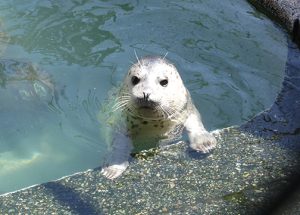
Photo by Jessy SHELTON
By Mary O’KEEFE
Sea lions and seals are cute – of that there is no debate. They are funny as they slide through the water along the beach. Harbor seals, with their big eyes, seem to look through to a person’s soul. However, the cuteness found in sea lions and seals can be a double-edged sword.
A few days ago two territorial seals lumbered onto a La Jolla beach, chasing away beachgoers and tourists. When looking at the video, which can be seen via ABC News at https://abcnews.com/video/134631613/, the sea lions looked like they had just had it and wanted back their beach.
On social media La Jolla locals have been pleading for tourists, and others, to not disturb the sea lion and seal population. There are scenes of people throwing rocks at them andmany who feel a selfie is worth separating a mother from her pup (mothers and pups can dart in separate directions when approached by a human).
CVW wanted to know what was happening to the California sea lions and seals. To get answers CVW went to the Marine Mammal Care Center in San Pedro.
David Bader, chief operations and education officer, walked CVW through its facility where sea lions and seals are rescued, treated and released.
“Almost all of our patients here, right now, were either born in January or they were born in June, so they [range from] a year to seven/eight months old,” he said.
The Care Center treats all types of sea life, from adult elephant seals weighing about 4,400 pounds to California sea lions that weigh about 700 pounds.
“We have a couple of harbor seal lions right now and [there is a colony of] northern fur seals on San Miguel Island,” Bader said.
He pointed out there is a large colony of northern fur seals that are not guests from Alaska but are true Californians.
“California is their home,” he added. “The [northern fur seals] can stay out to sea for a year. When they’re born, the females only weigh about 150 pounds, so they are small.”
The good news is San Miguel Island is protected; the bad news is that for 40 years NOAA has monitored the fur seal population annually but funding for that program has been cut.
This monitoring not only tracked the fur seals but also California sea lions and elephant seals. How does this affect humans?
Sea lions and seals are the oceans’ “canaries in the coal mine.” Scientists monitor northern fur seal populations to understand their health, diet and movement patterns. For example, the sea lion pup population declined as the ocean warmed.According to NOAA, scientists use population and survival data to balance sea lion protections.
“In a moment of extreme change, from the increase in harmful algal blooms that we’re seeing year in and year out plus the possibility of highly pathogenic avian influenza impaction [on the] population due to the El Niño and marine heat wave that we have right now, we’re not going to have the resources that we’ve had in the past to know what is the impact they have had on the [seal and sea lion] population,” Bader said.
Bader added that part of the job of the Marine Mammal Care Center is to help shape the narrative of sea lions and seals.
“We’re kind of at the point of the spear when it comes to understanding what’s happening with [seals and sea lions] and then communicating that out to stakeholders and the public,” he said.
Marine Mammal Care Center works with individuals and local representatives so it can continue to do its work and perform outreach. Bader said that many elected officials in the area are supportive of Marine Mammal Care Center efforts.
“One of the things we’ve recognized is that we serve a function that goes beyond animal welfare, and ocean conservation and advocacy,” he said.
Bader added that part of the facility’s function is to rescue sea lions that have stranded on beaches and spoke about one sea lion that had been stranded on a Santa Monica beach in the middle of summer. He said rescuing these seals and sea lions is not only important for their health but also for the safety of humans. For example, many times people get too close to the animals and take selfies. These animals are scared and some may be injured or sick and may lash out to protect themselves.
“People will get too close [to animals], especially with the harmful algal blooms that we’ve seen [lately]. These animals are neurologically impaired so they’re not going to be behaving [well]; they [can be] be lethargic and aggressive at the same time,” he said.
According to the internet, algal blooms create dangerous poisons that travel through the ocean food web.
The Care Center will send a team out to rescue animals at sea as well that have been reported as injured. Many times these mammals are entangled in gill nets. A gill net is a “vertical wall of netting suspended in water that catches fish by their gills,” according to NOAA.
California has banned the use of gill nets. In 2025, Gov. Gavin Newsom signed a bill that ended the use of gill nets in state waters. This stopped new permits from being issued but older permits are still being used.
“Gill netting still happens in Mexico and in international waters. It doesn’t happen in California waters but [those are] only three miles off the coast,” he said. “Sea lions still get entangled in them.”
Sea lions and seals that get entangled have deep cuts in their flesh as the thick net works like a dull knife that cuts into their skin. One of the sea lions that was at the Care Center during CVW’s visit had deep cuts around his neck. That sea lion that was rescued no longer had the net around his neck; it had lost so much weight the net had apparently slipped off. When the sea lion arrived he was suffering from starvation – malnutrition is commonly seen at the Care Center.
“We had another adult male [that was entangled] that was cut all the way through to his trachea. We thought we had an easy rescue,” Bader said. “We thought we would just snip the net off and let him go but then we saw bubbles coming out of the blood [around his neck].”
Ultimately, the story of the sea lion had a happy ending; the Care Center was able to save and rehabilitate him.
The sea lions and seals that were at the Care Center during CVW’s visit were mostly recovering from malnutrition; however, that is not the only threat to these mammals. Reports from up and down the coast of the Pacific have shared stories of seals and sea lions that have been shot.
Bader added this is an increasing problem for seals and sea lions that have been rescued though it may not have been the initial reason the mammals were rescued. The mammals are resilient, though, and some were able to survive being shot.
Why these mammals were shot is difficult to deduce. One reason may be people shooting them for fun or sport while others have reported that some fishing ships, both commercial and recreational, shoot at them to keep them away from their area.
Seals and sea lions are protected under the Marine Mammal Protection Act; however, it is difficult to find those who have shot the seals or sea lions, much less prosecute them.
The Marine Mammal Care Center does offer a $10,000 reward for information leading to the conviction of anyone who shot a seal or sea lion.
Bader said the best things people can do to protect the sea lions and seals is to not approach them, not take selfies and if a seal is found in distress to call the Care Center or another nearby care center.
In addition, things that can be done include people being up-to-date on laws and protections and supporting local California fisheries. Bader stressed that by supporting local fisheries that are following California laws, like observing the ban on gill nets, everything – from the fishing economy and the seals and sea lions – can benefit.
The Marine Mammal Care Center in San Pedro is open to the public for tours; however, reservations are required. It also participates in several outreach events. The Care Center is also a non-profit and is only able to continue its work through donations.
For more information on the Marine Mammal Care Center, visit https://marinemammalcare.org.
For those who find stranded sea life, contact the Marine Mammal Care Center at (800) 399-4253.
To report a live sea turtle, contact Marine Mammal Care Center’s toll-free hotline at (800) 39-WHALE. In Malibu, contact the California Wildlife Center at (310) 924-7256.
To report a dead marine mammal or a dead sea turtle, contact the Ocean Animal Responses and Research Alliance stranding hotline at (949) 276-2237. In Malibu, contact the California Wildlife Center at (310) 924-7256.
To report an entangled whale, call NOAA’s entanglement reporting hotline at (877) SOS-WHALE or hail the U.S. Coast Guard on VHF Channel 16.
For those who do not know what agency to call within LA County visit https://locator.lacounty.gov/animal/Shelters.

Working to Support Sea Lions and Seals added by CV Weekly on
View all posts by CV Weekly →