





History Hunt for the Monte Vista Dam
We’ve come to the end of the America 250 Trail. Originally developed for the bicentennial in 1976, this repurposed journey has taken us to 24 of the 25 historic locations that were highlighted in the Sunland-Tujunga area. It’s all come down to this: the hunt for the Monte Vista Dam. It’s #25, the final location on the trail, and it’s the only place I had never laid eyes on – until now.
Because this location is off the beaten path, I needed to have a companion to join me in the hunt. My friend Victor agreed to come along and I can assure you – he didn’t know what he had gotten himself into. The historians who developed this trail gave a vague account of the route required before presenting the following note: “In 1885, the Monte Vista Land and Water Company built this system. Water was taken from behind the Old Monte Vista Dam and was diverted to the homes, vineyards and orchards of Monte Vista (Sunland) before the turn of the century.”
Victor and I set off to climb down the embankment of the Big Tujunga River, more than three miles up Big Tujunga Canyon Road, near the bridge. As we struggled to find our way through the thick brush, Victor pointed out that we were surrounded by poison oak. Despite my short sleeves, we pressed on.
We slowly made our way to the bottom of the canyon and found ourselves standing along the bank of a rapidly meandering stream, otherwise known as the Big Tujunga River. Perhaps not so big at that moment but nevertheless it was difficult to cross as we made our way further upstream, according to the directions.
We were in a place where the walls of the canyon were steep, not too far apart, and consisted of bedrock on both sides. This was perhaps why the location had been chosen to build the dam.
Victor and I had lost sight of each other when I came across the first piece of the structure. Soon after, I saw another, and then another. These were large conglomerates of stone that were cemented together in various lengths and sizes, all of which had seemingly broken away from something larger. I was examining and photographing the various pieces on the north bank when Victor called out to me from the opposite shore, just a bit upstream.
“Hey, I’ve found something!” Victor said.
By this point, I had tired of searching for ways to cross the water so I just walked through. The height of the stream was just below my knees. The water was cold and the current was swift. Except for the occasional item of trash, this was a beautiful and serene place to explore. A few moments later, I came upon Victor’s discovery … and it was quite interesting.
A large rusted corrugated metal pipe rose some 20 feet from the ground. Next to it was a ladder that rose to a platform about halfway up the pipe. Once on that platform, there was a hinged metal door that allowed for inspection within. A sign was posted on this door but after many years of exposure, little could be discerned. It appears to refer to a pumping schedule.
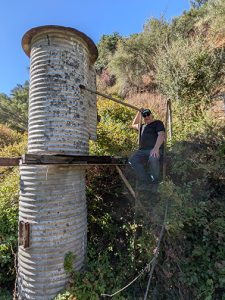
It’s difficult to determine with certainty what we had discovered there. The pieces that appeared to be part of a dam were right where the old-timers said they would be. This leads me to believe that they were remnants of the Old Monte Vista Dam from the 1880s; however, the pipe riser most likely was a later addition to these waterworks.
Upon arriving back at the car, Victor commented that he most likely won’t be joining me on any future history hunts. I’m also happy to report that very little came of all that poison oak.
Happy America 250 – we’ve come to the end of this trail.


VIEW OF THE VERDUGOS <<< CRAIG DURST added by CV Weekly on
View all posts by CV Weekly →