





By Julie BUTCHER
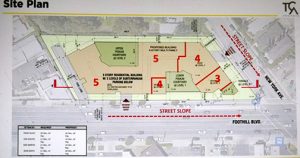
In this week’s issue of CV Weekly, we report on more comments shared at the June 3 meeting of the Glendale Planning Commission regarding the approved project at New York Avenue and Foothill Boulevard.
Appellants have raised concerns about potential soil contamination and report that the property shows up in a flagged database. Senior city planner Roger Kiesel responded that the site is not on the Cortese List, the list of hazardous sites maintained by the state Dept. of Toxic Substances Control (DTSC). Additionally, AB130 requires the completion of a Phase I environmental site assessment and this is included as one of the conditions of approval established by the hearing officer. This means that if there is a potential hazard, mitigation would be required.
In response to concerns raised by the appellants regarding risks associated with the potential breach of the potable water reservoir located immediately underneath New York Park, just north of the project site, Kiesel noted that the builder will be required to ensure the structural integrity of the reservoir and to protect and maintain it in its current condition.
Kiesel reported that community sentiment “weighed heavily in opposition to the project” and that the issues centered mainly around traffic, changing the character of the surrounding neighborhood and the dramatic size of the project compared to developments in the area.
“Acknowledging that it’s larger than other developments is not a basic for denial,” he said explaining that the project would still need to go to the city’s Design Review Board where the scope of review will be limited based on the project’s density bonus law status to determinations of design and detailing rather than of mass and scale or site planning.
The state’s Housing Accountability Act requires specific findings based on facts and evidence to disallow projects such as this. To be denied, the project must be found to cause a significant, unavoidable, specific adverse impact on public health and safety with no feasible mitigation. As proposed, this project complies with state and federal law as well as with local planning regulations.
Crescenta Highlands Neighborhood Association president Mary-Lynne Fisher explained the grounds of the appeal: the property is on the Cortese List, the property was likely contaminated by previous uses as a gas station and dry cleaner, and this fact removes the development from AB130 consideration for CEQA exemption and should be subjected to a full environmental review process.
Additionally, the appellants have volunteer traffic modeling that shows the addition of 151 vehicles to the intersection of New York Avenue and Foothill Boulevard would increase the time it takes residents on New York Avenue north of Foothill and the numerous cul-de-sacs off of New York Avenue to evacuate from a disaster, such as a wildfire, to levels that become a specific threat of adverse impact.
“In light of the high velocity winds that made the Eaton and Palisades fires so deadly, focusing solely on the severity zone designation ignores the fact that fires can spread quickly and embers can fly far,” Fisher said, adding the concept of reversing lanes in an emergency is “not feasible for New York Avenue, with its fire station south of Foothill. In Pacific Palisades, traffic lanes were swamped with parents driving to schools to pick up their children. We’re in the exact same situation, with Clark Magnet High School just four blocks north [on New York Avenue]. It’s not enough to have a plan. It must be a plan that works.”
Fisher asked the commission, “Would you buy a house about Foothill? On New York Avenue or one of those cul-de-sacs off New York? Would you want someone near and dear to you to rent an apartment, especially a first-floor apartment, if this project is built without an EIR? Just think about that and don’t think about the city’s housing numbers.”
Tim Tierney also shared the various traffic models he developed that show increased evacuation times ranging from an additional 45 to 65 minutes.
Developer Rodney Kahn urged the commission to deny the appeal. The existing site is an old shopping center that needs to be redeveloped, he said. This project adds much-needed residential housing and is based on “good urban planning principles, smart growth, encouraging high density residential housing along commercial corridors such as the Foothill Boulevard corridor. People can walk to restaurants, markets and shops and have easy access to public transportation.”
Todd Nelson, a partner with the Los Angeles-based law firm Rand Paster & Nelson, said that the project is fully compliant with state and local density bonus rules and is eligible to receive the concessions and waivers requested as well as being subject to the Housing Accountability Act, which sets an extremely high bar for the disapproval or reduction in size or density of a housing development.
Nelson reported that the state water board maintains a list of leaking underground storage tanks and that there were once underground tanks on the site and one was reported leaking.
“If there is a uniform closure letter issued to that site from the California Water Board [because] the site was briefly listed on the state’s ‘leaking underground storage’ database as an open case but the tanks were removed in 2008, all the impacted soil was removed, and the site was sampled for any remaining contaminants and no detections of petroleum-related contaminants or any other contaminants” were found, Nelson said. The water board issued a closure letter in 2014, pursuant to the exact health and safety code provision cited by AB130’s “safe harbor” provisions.
Nelson further noted that the law requires additional environmental evaluation before a certificate of occupancy can be issued, that “AB130 delivers exactly what the applicants are asking for – additional study, further assessment and any required remediation.”
One local resident told the commission, “I live on Fairesta [Street] and I’m worried about this five-story building in a residential area. My main concern is parking spaces. I counted cars while I was out walking and for every single-family dwelling, I counted two or three cars. So, 151 parking spaces for 87 units, if each one has two cars, is 174 cars, 23 spots short. They say there are one-and-a-half parking spaces for a one-bedroom, but nobody drives half a car. Especially on weekends, they play soccer at Clark Magnet and parents park their cars all the way down to my home.”
“Why are they so afraid to have an EIR?”asked longtime local resident Mark Weaver.
Sabin Silberman agreed. “I live at the top of Markridge [Road] and I’m at the back of the line getting down from the mountain if I have to wait for 180 cars to get out of that apartment and all the other cars coming down the hill. The streets clog up with people just picking up their kids from school.”
Phillip Chou spoke in favor of the project (and was booed); he said that Glendale needs more housing and that this project is not large enough.
“Kyle” also urged the commission to deny the appeal and move the project forward to follow objective standards. He recalled the city’s mishandling of the replacement of the Sears building, noting that the council rejected plans for the development but had to reconsider after being threatened with a lawsuit.
“If you don’t follow the objective standards, it makes all the gears of government run slower and it’s something that – in a small way – hurts all of us as residents. All residents have a legitimate valid interest in having a city government which follows state law and processes things efficiently and quickly,” he said.
Kyle riled up the crowd by adding that he thinks it’s a “beautiful structure – I like it and I hope that more people will get to live there.”
Beth Brooks said that she finds it “very disheartening to see the same David and Goliath thing all the time. People are begging you to save them and their families. Where’s the fire chief? The fire chief shouldn’t just protect you when there’s a fire; he should protect you before there’s a fire.”
She added, “I want to see the Glendale Fire Dept. here at these meetings protecting these people. I’m tired of people trying to protect themselves and they’re not getting professional help. This is a fire hazard, whether you like it or not, it’s a fire hazard. And if three more properties come on? That’s also a fire hazard.”
“People’s lives are more important than this developer. If you want to build housing, build it where people want you to build it, not where people don’t want you to build it. Do a survey. I’m sure there are plenty of neighborhoods that want this,” Brooks told the planning commission.
Developer Rodney Kahn wrapped up his response noting that this is “a state density bonus housing project. There is a Housing Accountability Act and we’re in a housing crisis.”
Listing the concerns that were raised during the public comments, most centered around traffic and parking, the reservoir, water, sewers, fires and emergencies, Kahn reiterated that every city department has reviewed the project in detail – including the fire department.
Commission president Edith Fuentes reminded everyone that further steps remain for this project, including the Design Review Board.

PART 2 <<< Appeal Denied in Foothill Boulevard & New York Avenue Project added by CV Weekly on
View all posts by CV Weekly →