





By Mary O’KEEFE
In the Crescenta Valley, as well as across the nation, electric bikes and electric motos are getting a lot of attention due to the number of accidents and, many times, the irresponsible driving by those who ride the micro-mobility devices. However, many times e-bike drivers are blamed for what drivers of e-motos have done.
Recent news has seen a spike in reports of injuries or fatalities caused by “e-bikes,” such as those suffered by 13-year-old Benson Nguyen. What is often missed is that most, if not all, of the vehicles being ridden are not legal e-bikes but are called (more correctly) e-motos (sometimes incorrectly called e-motorcycles).
“E-motos are high-powered, two-wheeled electric devices that look similar to e-bikes or more like a cross between an e-bike and a motorcycle,” according to a statement from Streets are For Everyone (SAFE).
Benson Nguyen died after he crashed his e-moto in Garden Grove. It was believed he was traveling at speeds of about 35 mph when he lost control and collided with a center median, according to reports.
And then there was a 14-year-old boy who, while riding an e-moto in Orange County, struck and killed an 81-year-old pedestrian. His mother, who had allegedly been warned by officials of the danger of this particular e-moto, is being charged in the death of the pedestrian as well as with child endangerment.
In a recent discussion on e-bikes and e-motos that was hosted by Crescenta Valley Town Council, law enforcement shared concerns about e-bikes and especially of e-motos. They spoke about the micro-mobility devices becoming so popular so fast that legislation to regulate them is far behind the curve.
SB1167, authored by Senator Catherine Blakespear of Encinitas, is trying to catch up with this new trend of transportation.
“It [the bill] directly addresses the problem of e-motos and other high-powered electric devices being marketed and sold as street-legal ‘e-bikes’ even when they do not meet California’s legal definition of an electric bicycle and are not street-legal. SB1167 would make it clear that these devices cannot be falsely advertised or sold as e-bikes and can’t be ridden on the roads without proper registration, rider training and safety features such as rear taillights, turn signals and [riders wearing] helmets,” according to SAFE.
Often when a parent or individual goes into a shop to purchase an e-bike the person who is selling the device will not be clear on the differences between an e-bike and an e-moto.
“So this bill would make it very clearly a fraudulent business practice in any way if [they mislead] about what is the legal classification of an e-bike,” said Damian Kevitt, founder and CEO of SAFE. “What is common right now is that parents are being told ‘these are the hottest e-bikes’ and ‘the kids all love them. These are what the kids are riding.’”
The kids are looking at what their friends are riding.
“And they’re going 30/40 miles per hour and all their friends are doing it,” Kevitt said. “The [e-motos] are being represented as e-bikes. I mean, they’re electric and they’re kind of like a bicycle so therefore they’re e-bikes. So parents are like ‘Okay, sure.’”
For anywhere from $700 to $900, parents buy what they may believe is an e-bike, though there are some distinct differences between e-bikes and e-motos.
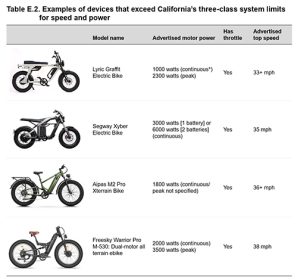
Micro-mobility devices, including e-bikes and e-scooters, are categorized into three levels: Class 1 and Class 2 have speeds that have a maximum of 20 mph, Class 3 e-bikes can reach up to 28 mph. E-scooters are motorized scooters powered by an electric motor and battery.
Regulations in California are as follows: There is no license required to operate an e-bike or e-scooter. A helmet is required for riders under the age of 18 and riders of all Class 3 vehicles with a maximum speed of 28 mph must wear a helmet. E-bike riders must follow the same traffic laws as regular cyclists, including obeying all traffic signals, speed limits and observing the right-of-way. Federal limits for e-bikes is 20 mph under motor power alone; California allows Class 3 e-bikes to reach up to 28 mph when pedal-assisted. Riders must still follow local speed limits. No passengers are allowed on Class 3 e-bikes. E-bikes can be operated in designated bicycle lanes and on roadways where it is legal for a pedal bike but riders must be able to move with the flow of traffic.
E-motos are classified as motor vehicles and cannot legally be ridden on public roads, sidewalks or bike paths. They are equipped with foot pegs, not pedals. Their motors range from 3,000 to 15,000 watts and can reach speeds from 30 to over 50 mph. They are throttle-controlled.
Kevitt is in favor of e-bikes and is supportive of anything that gets people outdoors to exercise.
“E-bikes, even though you don’t have to pedal as hard … they still show increased exercise. We have a problem with kids being stuck on computers, child obesity [and children] not getting outdoors,” he said.
Kevitt added that e-bikes can be helpful to those who used to bike but for one reason or another can no longer ride conventional bikes. He does feel there should be more classes offered for riding conventional bikes and e-bikes.
“I think it’s a good idea to have training for [riding] bicycles,” he said.
He said he doesn’t feel it should be legally required but it is a good idea for parents to have kids learn the rules of the road and bike riding safety, whether riding an e-bike or a conventional bike.
“A lot of schools are now requiring that if you bring your e-bike to school you have to have gone through training. There is a certificate [awarded] for a certain type of training that you go through,” he said.
Students at these schools are required to bring their completed training certificate to school administrators before being allowed to bring their e-bikes to school.
“It’s a way to make sure to get training – and let me tell you, when you get trained correctly on a bicycle you’re a better driver,” he said.
Under SB1167, e-motos up to 3,000 watts of power would be categorized the same as a moped, requiring the same registration, driver training and safety features (taillights, turn signals, front lights, etc.) in order to be legally ridden on the road. E-motos above 3,000 watts would be classified as either a motor-driven cycle or a motorcycle.
SB1167 was passed unanimously by the California State Senate at the end of May and is currently awaiting committee assignment at the Assembly Desk.

E-Motos Bill Passes State Senate added by CV Weekly on
View all posts by CV Weekly →