





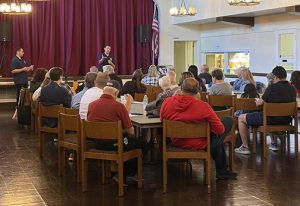
Photo by Mary O’KEEFE
By Mary O’KEEFE
Assemblymember Nick Schultz spoke to an audience of constituents on Saturday, May 30 at St. Luke’s of the Mountains. Among the topics discussed were some of the legislation he is working on. He left time for questions.
“I’m actually going to start with the state budget,” Schultz said as he started the morning talk. “In the state of California we have the world’s fourth largest economy, and one of the largest budgets in the world.”
The governor sends out a budget in January, then it is negotiated and a May revise is then released. In the next four weeks the California State Assembly and Senate Budget committees will be negotiating directly with Governor Gavin Newsom to establish a final budget proposal.
“We are going to have to find a balance. We can’t run a reported deficit the way the Congress has,” he said. “The impacts of House Resolution 1, HR1, that was passed by the Congress last year are just beginning to really be felt in California. We are seeing the ripping away of federal funding across multiple sectors.”
HR1, also known euphemistically as the One Big Beautiful Bill Act, was signed by President Donald Trump in July 2025. It includes numerous changes to Medi-Cal and CalFresh, including funding restrictions for the programs – and less money. The changes are phased over time, with some already in effect. The Legislative Analyst’s Office estimates that, with the new requirements, several hundred thousand people will no longer qualify for CalFresh. It is also estimated that between one and two million Californians could lose their health care.
“Cuts are going to be part of [California’s] budget,” Schultz said.
He shared what he felt were cuts in the budget that were “on the table.” He added that the state will have to find ways to generate revenue as well.
“The governor has been very consistent and I believe him and take him at his word that there [will] be no new tax increases imposed as part of his proposal or what is negotiated between the legislature and the governor’s office,” he said.
Schultz said he does believe there will be areas of tax loopholes being closed and “maybe” a reduction in some of the benefits that taxpayers are given.
“But I will tell you that there probably isn’t enough of that in this budget to avoid some of the cuts,” Schultz said.
He added that he thinks the vast majority of the budget cuts will come from health care, human services and education.
“Public safety, which [is a committee I] sit on, including the subcommittee, is very important to the state of California, and [is] only 12% of the state’s overall budget,” he said.
As far as education, the governor has talked about holding back some of the “constitutionally guaranteed Prop 98 funding from our public schools,” Schultz said. “That’s not something I support but it is something that has been done historically.”
There will need to be some difficult decisions made in the effort to balance the state’s budget. Schultz asked those in the audience to share with his office some of the things/programs that are working well in the area – perhaps the Meals on Wheels program – and share what is not working. He can then bring these comments when working on the budget.
He asked if those present feared the loss of a program due to budget cuts, including from HR1, and Schultz said he wanted to hear from constituents about those concerns.
He did not ask anyone what they thought should be cut. Instead, he asked what were their positive experiences regarding certain programs and why those programs should be saved.
Schultz said this year California has seen higher than expected revenue but it won’t be a constant.
“We have a projected deficit of nearly $10 billion,” he said.
Schultz is about to end his first term in the State Assembly representing District 44. He said what he found was legislators prior to his being elected spent more money than was taken in. This spending was affected by COVID.
“When we reopened our economy, people were buying with unprecedented wealth,” he said.
The Dept. of Finance projected that those spending habits would continue to double – but that is not what happened.
After being voted on by the Assembly and Senate the budget will be sent to the governor on June 15.
Schultz also highlighted several bills he has been working on, including AB1603.
“It was a bill that we introduced this year, working with the Environmental Working Group and other stakeholders. This is really addressing an issue of public health,” he said. The bill deals with PFAS (per- and polyfluoroalkyl substances) –pesticides that are widely used across California’s farmland.
The state has moved forward with removing PFAS and other “forever chemicals” from cosmetics but has not focused on the agricultural sector, which has more than 84 pesticides registered for use in California.
“Their use can contaminate produce, affect soil and drinking water and expose millions to hazardous chemicals that never break down. AB1603 will help put an end to the use of these forever chemicals on crops by requiring pesticides containing PFAS to be clearly identified and prohibiting state approval of new pesticides containing PFAS,” according to a statement by Schultz.
He highlighted other bills, including AB2319 that would give tax incentives to film post-production – similar to those that productions that shoot in California are able to apply for. This would benefit productions that may film outside the state to bring their post-production work back to California.
Schultz said many had reached out to him concerning the plight of Hollywood and film production leaving the state.
Next week we will continue with the talk with Assemblymember Schultz including him taking questions from the audience.

A Talk with Assemblymember Nick Schultz added by CV Weekly on
View all posts by CV Weekly →