





Photos by Eliza PARTIKA
By Eliza PARTIKA
The Crescenta Valley Sheriff Station held the first of two community meetings on May 7 to get input on new County policies guiding the use of drones by all L.A. County Sheriff stations, and to discuss the potential purchase and use of drones for policing in La Crescenta, La Cañada Flintridge and Montrose.
Sergeant John Gilbert, who will be in charge of the drone program, reviewed the department policy, FAA flight regulations and how a drone program might operate in their jurisdiction. Sgt. Gilbert and Captain Ryan Vienna gathered thoughts from approximately 30 community members in attendance.
Gilbert said the drones would primarily be used for disaster, search and rescue, and missing person operations. A “drone-out-of-the-trunk” policy, where drones are kept in the trunks of supervisors’ cars until officers sign them out with approval, would be enforced any time an officer needs a drone.
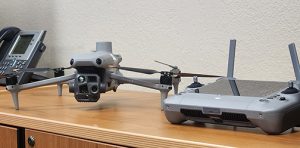
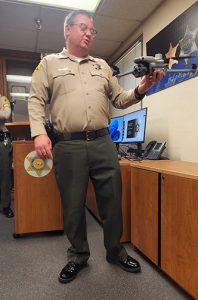
They displayed an example of a drone and demonstrated how it would be operated by sheriff’s department personnel. They also touted several examples of successful search and rescue missions involving drones.
“We’re hopeful that this type of technology will be able to help us be more effective at finding people more quickly,” said Gilbert.
In a search and rescue or missing hiker case, said Sgt. Gilbert, drones would be used to bring radios to people in hard to reach places to facilitate communication or drones would be used to provide food and water to people waiting for rescue. The drones can travel for miles, said Gilbert, as long as the drone pilot maintains a line of sight.
In response to privacy concerns, the department clarified that drones do not record unless they are at the scene for which they are being used, and during flight the camera is always pointed at the horizon, so as not to gather surreptitious data irrelevant to the incident to which the drone is being deployed. Supporters present at the meeting highlighted the benefits for search and rescue, while critics expressed fears of increased surveillance and potential misuse.
Sgt. Gilbert said that while he understood privacy concerns, the policy is written in such a way that there would not be opportunity for the levels of surveillance of which attendees worried. He said some LA County sheriff departments have policies that allow recording from the moment the drone lifts off to when it gets to a scene, and after, but La Crescenta’s policy was written differently to reflect concerns and to better use taxpayer funds for expensive data.
“From a taxpayer perspective, you have to remember each one of these things also translates to digital storage costs. So basically you would be talking about capturing flight data [and recordings] that are not really relevant to the ultimate case at hand, whether criminal or non criminal, or even a bear cruising around,” he said of the decision. “You know, at the end of the day you’d be storing a lot of data that really wouldn’t have any real interest, other than we captured it.”
One attendee asked what would happen if the drone loses signal or a line of sight during a rescue operation in a remote area, such as Mt. Baldy where the Montrose Search and Rescue team frequently aids missing and lost hikers.
“The question would be, ‘How do I know I’m going to lose reception before I do?’ The device itself actually has a signal strength meter. And once the signal strength starts reducing, it actually turns yellow. It lets [the operator] know when [there is] a strong signal versus when [there is] a weak signal, and normally there’s a little bit of a buffer. When the signal drops low enough, it will return to [the operator],” Sgt. Gilbert said. He also mentioned options for deploying multiple drones in the case when one loses battery so there is never a gap in coverage during a rescue operation.
Captain Vienna said funding is being sought for the drone program but the station is competing with 20 other stations for the resources to start drone programs. Even so, his department hopes to get the program up and running in the next 180 days.
There will be additional opportunities to weigh in for public comment at another community meeting, to be held at the end of May.

Community Learns About Drone Use at CV Sheriff’s Station added by CV Weekly on
View all posts by CV Weekly →