





Photo by Mary O’KEEFE
By Mary O’KEEFE
Come away, O human child! To the waters and the wild With a faery, hand in hand, For the world’s more full of weeping than you can understand. — The Collected Poems of W.B. Yeats
For centuries the belief in fairies have filled children’s imaginations and on Saturday, April 18 the love of everything fairies was on display at Once Upon a Time children’s bookstore.
The entrance to the store was transformed with fluffy purple drapes for people to pass through. Those entering then walked through a homemade fairy door. All of this was to meet the author of the “Fairy Door Diaries” series Megan McDonald.
Prior to the little ones entering the store McDonald spoke of how she had the idea for the “Fairy Door Diaries,” which began with a trip to Minneapolis. She had been walking along the sidewalk and noticed a small fairy door at the base of a tree. It seemed out of place … and yet exactly where it should be.
“People [kids] would leave notes to the fairies and they would get [responded] to,” she said.
This began her “what if” thoughts of a child who discovers fairies from different cultures.
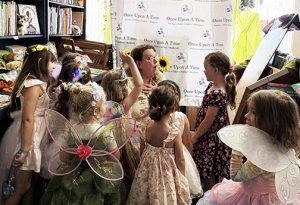
When the door of Once Upon A Time opened the little girls, dressed in their beautiful outfits – many of them with wings – began to walk in. At first the children were a little shy (well some of them were) and they stayed by their parent. They slowly began to sit down as McDonald made her way to a chair, decorated with sunflowers, that was located in the front of the store. She held her book up and began to talk about the “Fairy Door Diaries.”
“The book’s about a little girl named Eliza of the Elves. And Eliza goes through a tiny little fairy door in each book and every time she goes through the door, she enters a different magical world with different kinds of fairies,” McDonald told the girls.
In the first book Eliza went through the door to the world of flower fairies. That’s when one of the children at the reading at Once Upon A Time found her brave voice. She said, “I’m a garden fairy.” From that point on, the girls had no problem sharing their fairy dreams and stories.
McDonald spoke to them, relating to their true belief in fairies and all things magical.
“Well, in this book all the flowers are hard to see when Eliza first gets there but then she’s given a special bracelet, a bracelet made of thyme,” she said.
Then there was discussion of what thyme was. McDonald said it can be put in food but when it’s used to make a bracelet Eliza could see “every flower there is.”
She told the little girl fairies that each book begins the same way, with Eliza walking through a door.
“Imagine a door, a teeny tiny door, and now imagine it’s magic. Open the door,” she said. “Do you think you’d be afraid to open it or excited about it?”
All the girls were brave and said they would be excited.
McDonald read portions of the book, stopping every once in a while for some of the girls to share their fairy experiences.
There were instructions on seeing fairies and hobgoblins, which are in the second book. McDonald explained wearing green would be the best way to see a hobgoblin.
One of the fairy children was dressed all in green, including her wings.
“You would probably be the first to see the hobgoblin,” McDonald said. She added that all of the children would be able to see the fairies.
“Now hobgoblins are a funny kind of fairy friend because they are kind of mischievous,” she said.
She continued to read the book and the girls related to everything about the book – not just the magic of fairies but reality, including having a messy room.
McDonald then asked the girls if they would like to know their “fairy name.” Of course all of them couldn’t wait. She asked the girls their first name, their birthday (month and day) and then told them their fairy name.
Willow Dewdrop Ridington, Poppy Glimmer Twinklebottom and Iris Mist Windchime were just a few of the magical names.
The girls then joined the author in creating their own fairies out of paper and pipe cleaners (which have been rebranded as chenille stems by many manufacturers … however, everyone still calls them pipe cleaners).
One of the girls asked if boys were allowed to be fairies.
“Of course,” McDonald replied.
McDonald has been a writer for many years and has written many successful children’s books. She is well-known for her “Judy Moody” children’s book series. In addition to her new fairy series she has a new “Bunny and Clyde” series.
The girls continued to share their stories, with a couple of them telling McDonald they had written a fairy book, too. She listened to each child as they allowed their imagination to grow with each story they shared.
In a world that is in fact “more full of weeping than you can understand,” it was nice to spend a morning with a group of tiny fairies where magic and wonder was so alive.

Fairies and Hobgoblins at Once Upon a Time Children’s Bookstore added by CV Weekly on
View all posts by CV Weekly →