





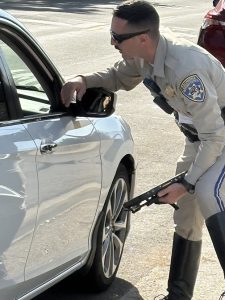
Photo by Mary O’KEEFE
By Mary O’KEEFE
CVW recently went on a ride-along with California Highway Patrol (CHP) Officer Bay along the Foothill (210) Freeway. The goal was to learn the behaviors of drivers and what officers are up against on a daily basis.
“We want drivers to be good defensive drivers and have a good sense of awareness,” he said when asked what advice he would have for drivers.
Bay added that when people see those flashing patrol unit lights behind them they should not panic and should find a safe place to pull over on, or off, the freeway.
Many drivers will just slow down when they are being stopped by an officer. Drivers should roll down their window and listen for the officer’s instructions over the public address radio of where it is safe to pull over.
When Bay is patrolling (usually on a motorcycle but for the CVW ride-along a patrol vehicle was used) he looks for aggressive drivers – those who are moving from lane to lane, speeding and/or following other cars too closely.
One of the issues on the 210 concerns semi trucks and trucks with trailers. These big rig drivers are supposed to drive in either lane 3 or 4, which are the far right lanes. But anyone who has driven along the 210, both eastbound and westbound, has dealt with big rigs being in all four traffic lanes.
There is also an issue with big rig drivers pulling over to the shoulder of the freeway to sleep or to get on their phone in areas that clearly state “Emergency Stopping.” It may seem like a safety action, which is important if drivers are tired or need to be on their phones, to pull over; however, as Bay pointed out, the “Emergency Only” areas of the freeway are exactly that … for emergencies like when a vehicle is having operation issues.
When big rigs, or other vehicles, are parked in these restricted areas it causes issues for those who actually have vehicular emergencies.
Bay added that many times he will find cigarette butts, food containers and other trash in this area signaling drivers who pulled over to rest or eat. Big rigs, as well as other vehicles without emergency issues, should find the nearest exit off the freeway, then pull off, away from the freeway, when there is a non-emergency need to pull over and stop.
Everything is about safety – both for the drivers and the officers who are patrolling, according to Bay.
“Keep your head on a swivel,” Bay said of officers being on constant alert after stopping someone on roadways.
Being outside in traffic makes officers vulnerable to vehicles in general and those that may specifically want to harm them. When officers do pull over a driver on the freeway, they normally go on the passenger side of the vehicle to speak to the driver.
One of the biggest changes regarding past citation enforcement is the use of technology. When Bay conducts a traffic stop, he has drivers pull their vehicles to a safe area, then asks for their information, including driver’s license and proof of insurance. At that point, he will take that information back to his patrol vehicle where he feeds that information into a computer. He has a laptop and computer pad. He confirms the information he was given by the driver, verifying the license for example, then creates the citation. He can then print it out from the pad or when he returns to the vehicle he can have the driver sign the computer pad.
Some officers still use a citation pad; however, the technology now offered helps keep things organized and can include notes regarding the traffic stop as it occurs.
Another area of concern along the 210 is the unhoused population who live along the roadway, especially in the Pasadena area.
There have been reports of unhoused tunneling, or using existing tunnels, underground to set up elaborate camps, including the one found at Los Feliz and Hollywood boulevards. In Pasadena camps are often created along the hillsides of the 210. There are fences around this area; however, the gates are often open or parts of the fence are cut allowing people to go in and out. The issue is when homeless pedestrians travel onto the roadways, to and from their camps, causing vehicles to swerve or slam on the brakes so as not to strike them.
April is Distracted Driving Awareness Month. Law enforcement nationwide is conducting a high-visibility “Put the Phone Away or Pay” campaign from April 6-13.
According to the National Highway Traffic Safety Administration, in 2024 distracted drivers claimed 3,208 lives and 315,167 people were injured by distracted driving during that same year.
Distracted driving is not just about using a cellphone – it can be anything that diverts attention from driving including eating, drinking, searching for a favorite station on the radio, talking to other people in a car or using a navigation system.
Bay said he has seen a lot of traffic collisions that result from a driver concentrating on the electronic mapping system rather than the roadway.
Speeding is a constant issue along all roadways, Bay said.
Police units have radar capability but officers also use the “radar gun,” which tracks the speed of vehicles. CVW was able to see how the radar gun works and also how, just by watching traffic for a short period of time, it is easy to notice those who are traveling faster than the posted speed limit. Bay said officers will often stop to conduct radar checks in areas where they know speeding is an issue, like the 210 Freeway eastbound near Angeles Crest Highway and all along the Glendale (2) Freeway.
A new speeding law in California increased fines. Those driving 11 to 15 miles per hour (mph) over the speed limit can face fines of $50; those traveling 16 to 25 mph above the speed limit will see fines of $100 and for those who speed is in excess of 26 mph over the limit can be fined $200. Those exceeding 100 mph can be fined $500. And these are the base prices; cities often tack on their own fees, which can increase the amount of the citation.
Bay said he does try to take into consideration the driver’s situation; however, when it comes down to it, all that matters is being safe on the roadways.

A Ride-along with California Highway Patrol added by CV Weekly on
View all posts by CV Weekly →