





Photo by Mary O’KEEFE
By Mary O’KEEFE
“Hollywood,” the term that references the entertainment industry, has always been about money. This dates back to the early 1900s when cost-cutting measures moved filming from New York to Los Angeles.
The weather in New York caused delays in filming, which cost production more money. Then there was Thomas Edison who imposed restrictive licensing fees and created legal headaches in New York for companies that used his camera equipment and patent licenses.
So off to LA producers went – or actually off to many places before Hollywood took hold. The story goes that director Cecil B. DeMille got off the train in Flagstaff, Arizona in 1913 to film and it was just too cold, dark and rainy – so he continued west and ended up in Los Angeles … sunny, warm and welcoming Los Angeles.
The bottomline budget issues that created a filming paradise – Hollywood – in California is what has devastated the industry as production continues to move to more financially-friendly areas. LA may still have the sun, close to perfect weather and versatile locations that can mimic anywhere in the world … but if there’s no money to pay for a production or to those working for companies that can’t afford rent, the dream that is Hollywood will go somewhere else.
According to the Hollywood Reporter, “Superhero movies have fled to London; three major studios (Netflix, Paramount and Lionsgate) have inked expansive deals to build or lease in new production bases in New Jersey. States like Georgia, Louisiana and New Mexico are fighting for their share of projects with generous tax incentives while Illinois is becoming a player in its own right. And that does not include California’s longtime rival New York, which has commanded a large share of the entertainment industry for decades and looks to grow its presence, too.”
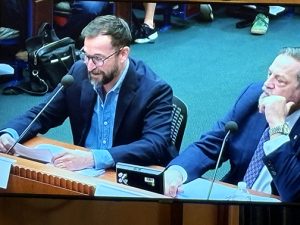
Senator Adam Schiff recently held a conference in Burbank to discuss production leaving California and expanded the conversation to include the entire nation.
“More than a thousand media and entertainment companies call Burbank home. These are our local businesses. They are an integral and essential part of the fabric of our community,” Schiff said. “They support local jobs, build small businesses and drive an ecosystem that extends far beyond the studios, from restaurants and retailers to vendors and entrepreneurs.”
The standing room only audience was filled with people who work, or worked, in the film industry.
For years there was a misconception that the film industry is made up of millionaires who do not need the state’s money or support; however, that is false. There are many in the industry who make a tremendous amount of money but what drives the industry are the crews that make up the majority of the workers.
According to a 2025 Indeed report, the national average annual salary for actors is $29,904, for a film crew member the average is an annual $38,187, for a fashion consultant it’s $33,530, for a music director it’s $35,512 and a producer earns about $82,575.
The jobs may pay well during the production season, but the majority of industry workers go from production to production, not finding steady work.
The discussion led by Schiff looked at not only how the decline in filming in Southern California is affecting those who work in the industry but those businesses it supports.
“This industry supports nearly 800,000 jobs nationwide in producing, marketing and distributing content, but even more impressive are the [other] jobs that the industry supports: more than two million caterers and carpenters, dry cleaners and lumber suppliers, hotel workers and equipment vendors. All those livelihoods are tied to a production shop setting up in their community,” he said.
The senator added the film industry generates over $200 billion in wages and is composed of 162,000 businesses located in every state in the country. Some of these are small businesses that employ fewer than 10 people.
“This is not a Hollywood story, its a Main Street story,” he said.
The film industry, like many other businesses, was hit hard during the pandemic but though there has been some recovery many of the productions have moved overseas.
“In the three months between July and September of last year, on-location filming in the greater Los Angeles area was down more than 13% from the year before. In the two years before that, Los Angeles County’s motion picture production industry lost more than 42,000 jobs,” Schiff said.
And that was the reason for the conference: the loss of industry jobs and how to entice production back to Hollywood – and to the U.S. in general.
Noah Wyle, award winning actor and star, executive producer, writer and director of “The Pitt,” was part of the panel discussion.
“The Pitt” is a television series that covers the “daily lives of healthcare professionals in a Pittsburgh hospital.” Wyle was on the panel because he, and his team, decided to film this series in Burbank at Warner Bros. Studios.
This may not sound like a Herculean act but it is. The costs of filming anything in California has increased steadily over the years. It is easier [and cheaper] to film in other states, especially those that offer tax incentives, as well as out of the country … where tax incentives have also been offered.
Schiff was joined by lawmakers Representatives Laura Friedman, Lou Correa and Sydney Kamlager-Dove. All of them were in favor of creating tax incentives for the industry in the state and nationwide.
Wyle thanked Schiff for his efforts to enact a federal tax incentive.
“As an Angeleno with generational roots to this city, and as a seasoned member of its creative community, advocacy for Los Angeles [and the] state’s production is something that is very close to my heart,” Wyle said. “Over the last six years, the aggregate effect of projects leaving the state in search of tax credits, the pandemic and last year’s fires has been a near cratering of our once thriving industry.”
Wyle admitted it is difficult and expensive to shoot a TV series in LA.
“Prohibitively so, unless you adopt an economic model that allows you to take full advantage of the California tax incentive to offset your gross costs,” he said.
In weeks to come CVW will be looking at the California tax incentives offered and if they are moving the needle for production companies to move back home.

Bringing Hollywood Back to Hollywood added by CV Weekly on
View all posts by CV Weekly →