





By Eliza PARTIKA
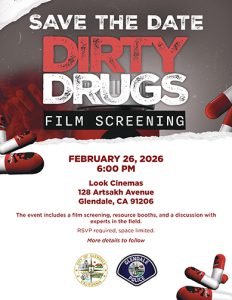
“Dirty Drugs,” a film about Glendale and La Crescenta families facing addiction, will screen at LOOK Cinemas in Glendale (128 N. Artsakh Ave, Glendale) on Feb. 26.
The film follows Glendale and La Crescenta families over two years and explores the impact of addiction on each of them. The film was born out of PSA campaigns Peter Bahlawanian, the film’s director and producer, was asked by the Glendale Police Dept. to complete as part of a 2023 initiative to address addiction problems in the city.
In 2023, Sona Hovsepian, who will moderate the event on the Feb. 26, was asked to create a program within the Glendale Police Dept. that helps individuals dealing with addiction and supports families and caregivers without stigma. Alex Krikorian, GPD captain, and GPD interim chief Robert William and others at the GPD recognized a need for such a program due in part to rising overdose rates. It received a grant from the office of then-Senator Anthony Portantino to assist with the cost of its outreach efforts. It just so happened, said Bahlawanian, that GPD was also interested in making a film and PSAs about addiction to assist with its initiative.
“So it started as several PSAs on addiction, drugs [and substance abuse] and the documentary took on a life of its own. It turned into a story with a powerful message,” Bahlawanian said.
“The driving force is to treat addiction as an illness and treat people with addiction as individuals,” Hovspeian said.
Bahlawanian, who has covered homelessness, addiction and the fentanyl crisis in previous documentaries, said his main goal is to spread awareness that this is an issue, even in communities like Glendale, which prides itself on being safe.
“So these things now are taking [on] a different level of urgency,” Bahlawanian said. “Regular drugs can be contaminated or tainted and with just [a] one time try, it can change your whole life drastically to the point where you know it’s either death or or close to it, if somebody’s not there. This is a fight we all have to fight, and we all have our role to play. My role is telling these stories.”
By treating addiction as an illness and providing support to individuals and families, Hovsepian said, GPD is creating community resources and outreach opportunities rather than just arresting people for drug use.
GPD’s program currently provides resources on housing, counseling and community training on how to administer Narcan. According to the internet, “Narcan (naloxone) is a life-saving, FDA-approved nasal spray or injection that rapidly reverses opioid overdoses by blocking opioid receptors in the brain, restoring normal breathing in minutes.”
Hovsepian works closely with Glendale Unified School District’s Student Wellness to raise awareness among parents about the signs of fentanyl and other drug use.
Hovsepian, who is now the clinical program director for the Substance Abuse Resource and Wellness Program at the Glendale Police Dept., was a clinician for a time and often received calls “when things were at their worst.”
“[By the time they get to the hospital] families are at their wit’s end or [they] found someone who’s overdosing, or they stole a car, or this happened because they’ve tried things they thought would work, but it didn’t,” she said.
Hovsepian emphasized continuum of care, beginning with social workers at the hospital to law enforcement to attorneys to policy makers.
“It’s all of us sitting around the table going where there are gaps; we need to think about what is patient-centered,” she said. Finding appropriate services that can address the addiction and assist families with care and support networks is one of the most difficult tasks, and one that needs to be improved, Hovsepian continued.
“The first 12 months are the most critical time for recovery, and not many places offer that along with family therapy, couples treatment and support networks that would address the family system. Every time I try to refer a patient to a facility, it is ‘If the family wants we can meet with them.’ No. This family needs help,” Hovsepian said.
“A lot of people feel this isn’t going to happen to them, not my family, not me. But this can happen to any of us,” she said.
Having a streamlined process from homelessness to treatment is vital, but funding for such programs is dwindling.
After the documentary screening, a panel of experts will answer audience questions, and booths will be available for families to receive resources. Panelists will include: Josh Luna, GPD; Peter Bahlawanian, producer; Marco Khan, parent; Victoria Malone, parent; psychiatrist Elena Hunanyan, MD; Azad Abed-Stephen, a person with lived experience who is now a mental health provider; and Hovsepian as moderator who is also a clinician and psychotherapist.
Hovsepian believes this documentary and resource fair, and the GPD’s substance abuse resource and wellness program in general, is a step in the right direction, assisting families navigating an already complex system littered with stigma, she said.
“I have been – time and time again – impressed at how human our officers are, how immersed and supportive they are. That is giving me hope that we [can] start talking about [addiction], and we [can] come up with better ideas so that we can have a discussion. Because even for someone like me, who has been doing this for 15 years, all the systems that are involved in all of this are complex and difficult to navigate.”

Film Explores Addiction and Its Effects on Families added by CV Weekly on
View all posts by CV Weekly →