





By Mary O’KEEFE
In recognition of International Holocaust Remembrance Day, which is on Jan. 27, David Meyerhof coordinated several holocaust survivors to speak virtually to Crescenta Valley High School students.
United Nations General Assembly designated Jan. 27 – the anniversary of the liberation in 1945 of Auschwitz-Birkenau – as International Holocaust Remembrance Day. The liberation gave the world visual evidence of what the Nazi regime’s Final Solution looked like in practice. When the Russian army, as part of the allied forces, entered Auschwitz concentration camp it liberated about 7,000 prisoners, most who were ill or dying. However, the true story of those imprisoned in Auschwitz was not revealed until survivors began to share their horrific experiences. As the Russian forces began to move closer to Auschwitz and the Nazis realized they were losing the war, German SS units (Schutzstaffel – German for “protection squad”) forced about 60,000 prisoners to march west from the Auschwitz camp system. Thousands of prisoners had been killed in the camps prior to these death marches.
The Nazis attempted to erase evidence of the atrocities committed against their Jewish prisoners while in the concentration camp system. Between 1942 and 1944, as part of the Final Solution of the Jewish Question, Auschwitz served as the largest Nazi center for the destruction of the Jewish population of the European countries occupied by and allied to the Third Reich, according to Auschwitz-Birkenau Memorial and Museum.
The Nazis attempted to rewrite history as to what happened, not only in the camps but prior to WWI. According to architectural historian Despina Stratigakos, a directive from Field Marshal Wilhelm Keitel, dated Aug. 12, 1940, conveyed Adolf Hitler’s order to Germany’s army high command to destroy World War I memorials in occupied Belgium and France. Hitler was trying to change history as his military began destroying evidence of their actions during WWII. But what couldn’t be destroyed was the holocaust survivors sharing their experiences while in the camps. They were witnesses to history and many have made it their mission in the last decades to share their memories of that time with a younger generation, not only to share historical truth but to act as a warning that if it happened then it can happen now.
David Meyerhof acted as moderator for the seven speakers who shared their experiences with CVHS students throughout the day on Friday. Meyerhof is a retired middle school teacher who taught in the Los Angeles Unified School District for 35 years. His parents and grandparents escaped from Germany and survived the holocaust.
Speakers included Raul Artal-Mittelmark who was born in hiding in 1943 in the Nazi concentration camp Bershad-Transnistria in Western Ukraine. He was 1 year old when he and his parents were liberated.
Henry Slucki was born in Paris, France in 1934. He and his parents escaped to Southern France in June 1940, shortly after the Germans occupied Northern France. In 1942, they avoided deportation by the Vichy government and escaped to Spain by crossing the Pyrenees on foot.
Eva Perlman was born in Berlin, Germany in 1932 just months before Hitler became chancellor. She and her parents escaped to Paris and survived WWII by moving several times.
Lya Frank was born in 1936 in Utrecht, the Netherlands. She survived with a family in Amserfoortas a hidden child with false identity. Her parents were deported to Westerbork and then to Auschwitz and did not survive the war. Lya and her sister Elly were the only ones of her family who survived the war. About 50 years after the war ended someone found a postcard from Lya’s father. Apparently he had thrown it from the train that was taking him and his wife to Auschwitz. It was dated May 1944 and it was addressed to a neighbor. The father asked that a friend take care of his girls and keep them safe.
Harry Davids was born in 1942, about a block from Anne Frank in Nazi-occupied Holland. His parents made a difficult decision and turned their children over to the Dutch Resistance. The children survived but their parents were murdered in a concentration camp.
Joseph Alexander was born in 1922 in Kowal, Poland. At the beginning of the war, his family fled and joined other relatives in the town of Blonie; however, in late 1940 Blonie’s Jews were transported to the Warsaw Ghetto. His father bribed guards to let Alexander and two of his siblings escape to Kowal. This was the last time Alexander saw the rest of his family. He was sent to several different concentration camps, including Dachau and Auschwitz-Birkenau. He was part of the death march.
And artist and survivor, Gabriela Karin was born in Bratislava, Slovak Republic. Her mother was a freedom fighter and Gabriela was in hiding during the war. She worked as a fashion designer for years and after retiring she began to sculpt. Her art channels the horrors she witnessed while growing up during WWII. But there is a beauty in her art as well with her signature butterflies that she says remind her that beauty can come from ugliness.
She told the students of what life was like as a Jew in her hometown and how the first order of business when the German occupied Slovakia was to find the “hidden Jewish people.” She shared that there were some close calls when she was almost discovered in the various houses where she was hiding. Germans had gone to a convent where Jews were being hidden and the soldiers were screaming at the nuns to tell them where Jews were hiding but they said there were no Jewish people hiding with them – which was not true. They let two girls escape through the back door of the convent.
“Two girls that I know, I saw them running on the street and being caught [by Germans] in front of my own eyes. They were taking them back to … headquarters. I never saw them again,” she said.
She spoke of rewards being given to non-Jews who would turn in people who were hiding Jews. She shared that she had read in a book what best described what happened during the war.
“First they took away from us was citizenship, then our apartments [Jews were not allowed to live in housing in the area], then our work, our jobs and then they took people to the camp,” she said. “They allowed them to take a small luggage. When they arrived at the camp, they stepped down from the train and the first thing they took away was the last thing from home.”
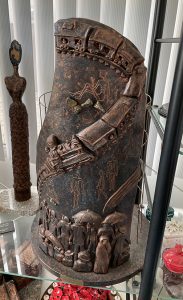
File photo
Her art depicts the history of that time, including the Night of the Broken Glass. It was in November 1938 when the Nazi regime coordinated a wave of antisemitic violence in Germany. They shattered glass from Jewish businesses that littered the streets. Books were burned, including anything the Nazis had determined was inappropriate – like anything authored by a Jewish writer.
“The books were thrown on the street and burned, and they started taking Jewish men to camps. This was the beginning of the holocaust … nine months before World War II started,” she said.
She shared photos of her art and more of her experience, explaining the history of WWII and what she saw.
“This is a message from Albert Einstein: ‘The world is a dangerous place, not because of those who do evil but of those who look on and do nothing.’ Don’t be a bystander. Speak up when you hear or see injustice,” she said. “I have a message from me to you, to all of you: It doesn’t matter what color eyes you have, what color hair you have [or] what color skin you have – we are all the same people. We don’t have to love everybody but we have to respect every person on this earth. We all have the right to be here.”

International Holocaust Remembrance Day at CVHS added by CV Weekly on
View all posts by CV Weekly →