





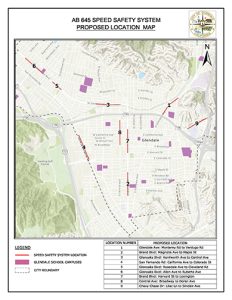
Image from www.glendalespeedsafety.com
By Mary O’KEEFE
There are some new laws for the road that went into effect this year for California drivers.
Speed laws for school zones have traditionally been 25 miles per hour (mph); however, through Jan. 1, 2031 local municipalities can lower the speed limit to 20 mph. After Jan. 1, 2031 all school zone speed limits will automatically be lowered from 25 to 20 mph when proper signage is posted.
Speed enforcement has also been given new laws; here are a few, according to California Highway Patrol:
Under AB 289, the state highway work zone speed safety program authorizes the Dept. of Transportation to establish a work zone speed safety system pilot program.
“The program will utilize a fixed or mobile radar or laser systems to detect speeding violations and capture a clear photograph of a vehicle’s license plate. Citations will be issued to the vehicle’s registered owner with specified requirements and procedures for program implementation, citation issuance, review and appeal,” according to CHP.
AB 390 expands the “slow down and move over” law to include any highway maintenance vehicle or stationary vehicle using flashing hazard lights or warnings such as cones and road flares. Drivers approaching a vehicle with these warnings must move into a lane that is not next to the stopped vehicle or slow down to a safe speed if changing lanes is not possible.
Speed limits can now be lowered by five miles per hour on highways if the need is determined by the Dept. of Transportation. Warning citations will be given during the initial 30 days after a speed limit is lowered; after that time, fee citations will be given.
There is also a new law concerning autonomous vehicles. This law now gives officers the authority to issue a “notice of autonomous vehicle (AV) non compliance.” The law also requires how “AVs that operate without a human operator in the vehicle interact with first responders, including a requirement for manufacturers to provide a two-way device in the vehicles to communicate with first responders.”
AB 645 deals with speed safety systems as pilot programs that will deal with speeding in communities utilizing automated speed cameras. Fines will start at $50 for those traveling 11 to 15 mph over the speed limit, $100 for those traveling 16 to 25 mph over the speed limit and for those traveling from 26 mph to 99 mph the fines are $200. Those driving at 100 mph and over will face a fine of $500.
Cities that are participating in the camera pilot program are Los Angeles, Glendale, Long Beach, San Francisco, San Jose and Oakland. According to the City of Glendale’s website, there will be about 16 locations that are being considered for the speed safety camera program. It appears the cameras will be activated mid-year. The proposed locations, according to the city’s website, are Glendale Avenue from Monterey Road to Verdugo Road, Brand Avenue from Magnolia Avenue to Maple Street, Glenoaks Boulevard from Kenilworth to Central avenues, San Fernando Road from California Avenue to Colorado Street, Glenoaks Boulevard from Rosedale Avenue to Cleveland Road, Glenoaks Boulevard from Allen Avenue to Ruberta Avenue, Brand Boulevard from Harvard Street to Lexington, Central Avenue from Broadway to Doran Avenue and Chevy Chase Drive from Lilac Lane to Sinclair Avenue.
For more information visit www.glendalespeedsafety.com.

Speed Law Changes in 2026 added by CV Weekly on
View all posts by CV Weekly →