





It’s a Small World After All
The gun captain gave the command, “Fire!” The cannon blast cut through the air. A band began to play as the crowd burst into applause. Moments later, some 20 miles away near Lockport, New York, a father and son embraced at the distant sound. Their job was complete and the blast marked the departure from Buffalo of the first boat to traverse the newly constructed Erie Canal.
It was Oct. 26, 1825 when the journey began. In this time before the telegraph, cannon blasts across the state notified its residents of momentous occasions. The canal stretched from the eastern shore of Lake Erie to the Hudson River, a length of over 360 miles. The federal government had declined to fund it so New York contracted with men across the state to build it.
The aforementioned father was Darius Comstock, born in 1768 and one of the fortunate men to land one of those lucrative contracts. He brought in his young son Addison to assist in the work. With the waterway complete, the two went in search of opportunities, their pockets now flush with Erie Canal cash.
Next we find our duo in Detroit where they’re informed of fine lands to the east. On Sept. 7, 1825 the two purchased acreage near the Raisin River in southeastern Michigan. Addison soon founded the town of Adrian on his 640 acres of prime land.
Fast forward nearly 100 years to June 1914 when we find a husband and wife involved in another construction project. It’s Darius Comstock and his wife Lydia May and they are hard at work building the first dry goods store in Tujunga. But wait – this cannot be the same Darius Comstock. No, it’s not – it’s his grandson, and namesake, Darius Comstock Dean born in Adrian in 1851. He traveled west to Tujunga when it was the Little Lands Colony.
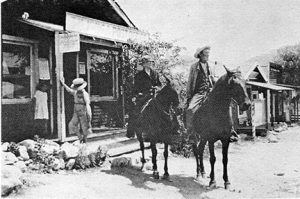
In 1913, Bolton Hall was built on the northeast corner of today’s Valmont Street and Commerce Avenue as a clubhouse for the Colony. In early 1914, the Little Landers cooperative store went up on the southwest corner. The Deans arrived and built their small dry goods store on the southwest corner just months later. Soon, the first Tujunga post office went up beside it.
Dean’s Store became one of the favorite gathering places for the Little Landers colonists. The store was quite small but its stock covered an entire range of merchandise. If customers couldn’t find what they were looking for Charles Dean, the son of Darius Comstock Dean, would travel to Los Angeles to acquire it for them.
The family was active in all community affairs, especially May (as she preferred to be called). From social doings to politics, she was always at hand for whatever the community needed. I found one reference to the fact that the first honest-to-goodness barber shop in the Sunland-Tujunga area was set up in the back of Dean’s Store.
It was reported that upon the sale of the store on Sept. 1, 1933, May hadn’t missed a day except twice at her place behind the counter: once when her husband Darius passed away just before Christmas in 1919, and again when her son Charles passed on Sept. 11, 1922 at the young age of 43.
At the time of retirement, she was 83 years old and had made the walk for nearly 20 years from her home on St. Estaban Street, rain or shine, day and night. When asked what she would do next, she replied, “I’m going to clean my house; it needs it!”
Lastly, I was born and raised in the small town of Adrian, Michigan – the same town founded by Darius Comstock and his son Addison. I then moved to the small town of Tujunga – the same town where Darius Comstock Dean established the first dry goods store.
It’s a small world after all.


VIEW OF THE VERDUGOS <<< CRAIG DURST added by CV Weekly on
View all posts by CV Weekly →