





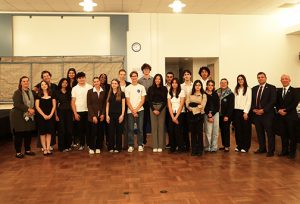
Photo by GUSD
By Eliza PARTIKA
Glendale Unified School District (GUSD) board of education held its first student voice panel of the year on Tuesday, Oct. 21 when students from Allan F. Daily High School, Herbert Hoover High School, Glendale High School, Verdugo Academy, Crescenta Valley High School and Clark Magnet High School raised concerns about safety, career and financial preparedness, and school culture and belonging.
Throughout the night students answered questions in three categories: college and career, student wellbeing and school experience, and safety and emergency preparedness.
Overall, the panelists from all high schools said they felt prepared for emergencies though students from multiple schools said there were not enough security guards to safely secure the entirety of their campuses and that there were not enough female guards to secure bathrooms. Students cited safety concerns in bathrooms, including vaping and bullying, as reasons for the need for more security.
Jennifer Nakano of Crescenta Valley High School said students also felt unsafe at sporting events where on multiple occasions she said parents have gotten into violent verbal altercations with students.
“There is not enough time to prepare us for all the emergencies that could happen,” Nakano shared.
Board member Shant Sahakian said he and other board members would look into the safety concerns at these events and in school bathrooms. Students and board members discussed several ideas they could implement, including apps and QR codes students could scan to report incidents anonymously or to seek help and resources for those in crisis.
Stella Khachatorian and Senna Hunter of Glendale High School suggested that schools could implement videos instead of in-person drills to help students understand why they need to know what to do in an emergency and how lacking that knowledge could impact them. Hoover High School sophomore Kayleen Shavian said having lessons on cybersecurity help students prepare for online emergencies outside of school.
“It readies us for any possible circumstance,” Shavian said.
Board president Ingrid Gunnell said the board would need to look into how feasible QR codes would be if the District’s new cellphone policy doesn’t allow students to carry cellphones during passing periods.
Students also stressed the lack of life skills and financial wellbeing classes available at their schools.
While the District has a subscription to EverFi, a financial literacy website for students, multiple panelists shared that their teachers treated the platform as “something to get through” before graded assignments, instead of implementing it into lesson plans. They requested the board create purposeful sessions that integrate finances into the classroom or create separate study sessions.
“There are no classes, no events to help prep students [on] how to take [achieve] wealth, how to do taxes and [that these] skills, regardless of what you do, [are going to be needed into adulthood]. So I think that if we were to implement certain classes that would teach that, or certain seminars, it would really help. There’s only 1% I’ve ever seen do this because [a] teacher decided to take time out of [his/her] own curriculum and move to help benefit students,” added Glendale High student Izabela Petrosyan.
As a follow up, student board member Vera Garabedian of Crescenta Valley High School asked how students were adjusting to their academic load and how teachers were managing the new six-period schedule. Nakano said many of the teachers at Glendale High are assigning more work instead of allowing students the time and space to complete assignments, adding to their workload.
Board member Kathleen Cross asked what strategies students use to manage their workload. Students responded that after-school study sessions and enrichment times built into their schedules work best because students are given extra time with their teachers and their peers to ask questions and get their work done.
Kathryn Buser of Verdugo Academy said students at Verdugo Academy and Clark Magnet would also benefit from gathering with classmates at their home schools to discuss curriculum, hold study sessions and learn about student loans, interest and other financial life skills.
According to Buser, what is being said about these things is only being said to senior students – and is typically indicated that the students who are working on college applications are going to have a harder course load.
“So it’s a lot to take in. I feel like we should start giving more knowledge about loans and scholarships and things like that [to younger students]. I also think access to scholarships should be more readily available because a lot of students, especially as [they get closer to college], don’t know how they’re going to be able to afford it or even if they’re going to be able to afford it,” Buser said.
When board members asked if students would attend weekend or weekday sessions on financial literacy and life skills or weekly peer study sessions, students showed their support by raising their hands.
Though students voiced concerns, they also commended teachers and staff at their schools for creating safe spaces for students to gather for studying and for their mental health, whether in a teacher’s classroom after school or the wellness centers implemented at each campus.
Discussions about school resources for mental health, academic stress and workload management focused on international student needs. International students Anait Tonoian of Daily High, and Arad Taherkhani and Allen Matevosyan of Clark Magnet suggested the schools implement buddy systems for international students and create more pathways for students to access clubs and resources they could use to help them navigate life in the United States.
Evangelina Romanova, an international student from Hoover High, said she started a club, the Open Arms Society, for international students so they can make friends and find answers for common questions, including residency questions on college applications and homework questions, and how to get involved in extracurricular activities. Glendale High student Izabela Petrosyan said international students said the best way to get in touch with parents and students is to reach out.
“If you call parents directly and give them all [of] the information about each resource and provide translations in each language then they will be aware of the programs that are available,” she said.
In her closing remarks, board member Neda Farid praised the students for how articulately they communicated their concerns to the board.
“It’s so wonderful to hear how you are troubleshooting important topics at hand,” said Farid.
Gunnell praised students for their commitment to bettering their education for themselves and the next generation of students.
“Your influence will go on in perpetuity. I heard a comment that there is not enough we can do to prepare for all emergencies – climate change, fires, active shooters. That is not a good legacy we are leaving you. Listening to students – it’s so lovely to hear your ideas. Your ideas give us hope when we have not given you a world of hope,” she said.
To close the meeting, Superintendent Dr. Darneika Watson thanked students for participating and confirmed the board’s commitment to addressing the safety and academic concerns that the students raised.

At GUSD Student Voice Panel, Safety and Life Prep are Main Concerns added by CV Weekly on
View all posts by CV Weekly →